6 min read
The employment landscape has quietly split into two competing philosophies. On one side sit the shortcuts: pre-recorded video courses that promise mastery in weeks, one-to-one “career gurus” who teach candidates how to reverse-engineer applicant tracking systems, and AI tools that can generate a polished portfolio and a plausible-sounding CV in a matter of days. On the other side sits something slower, harder, and far more durable — the actual acquisition of skill through real work. Nap OS was built firmly on the second philosophy, and understanding why that distinction matters is essential for anyone trying to build a genuine career or business rather than simply pass through a hiring filter.
The Problem With Shortcut Culture
Over the last several years, an entire cottage industry has grown up around helping people look employable rather than become employable. Career coaches now openly advertise services that teach candidates how to structure a CV specifically to defeat automated screening software, how to phrase bullet points using keywords scraped from job descriptions, and how to construct a portfolio of projects in a single week that gives the appearance of months of independent work. Some coaching programs even lean on generative AI to draft entire case studies, fabricate project narratives, and script interview answers designed to sound authentic under questioning.
None of this is illegal, and much of it is marketed as clever positioning rather than deception. But it creates a fundamental mismatch between what a CV or portfolio claims and what a person can actually do once they are sitting at a desk on day one of a new job. A resume can be optimized, a keyword density can be engineered, and an interview script can be rehearsed, but none of that changes the underlying reality of a candidate’s capability. When the shortcut works, the mismatch simply gets deferred to the first few weeks of employment, where it tends to surface quickly and painfully for everyone involved.
There is also a quieter cost that rarely gets discussed: the candidate’s own trajectory. Someone who has learned to pass filters rather than build competence is left in a strange position even after landing the job. They know the CV worked, but they may not fully trust their own ability to deliver on what it promised. That is a shaky foundation for a career, and an even shakier one for someone hoping to eventually run their own business or take on freelance clients who expect real, demonstrable results.
Asymmetrical Learning and Its Limits
A second widely used model is what might be called asymmetrical learning — the pre-recorded course, the certificate program, the self-paced video series watched alone on a laptop. These formats have real value for exposing people to concepts, vocabulary, and theory. What they cannot easily provide is the messy, iterative, feedback-driven process of doing actual work under real constraints, with real stakeholders, real deadlines, and real consequences for quality.
Watching someone else solve a problem on video is a fundamentally different experience from solving an unfamiliar problem yourself, getting it wrong, receiving feedback, and trying again. Certificates awarded at the end of these courses tend to certify attendance and completion rather than proven capability. Employers have grown increasingly aware of this gap, which is part of why certificates alone rarely move the needle in hiring decisions anymore. The learner has consumed information, but has not necessarily been tested against reality.
What Nap OS Does Differently
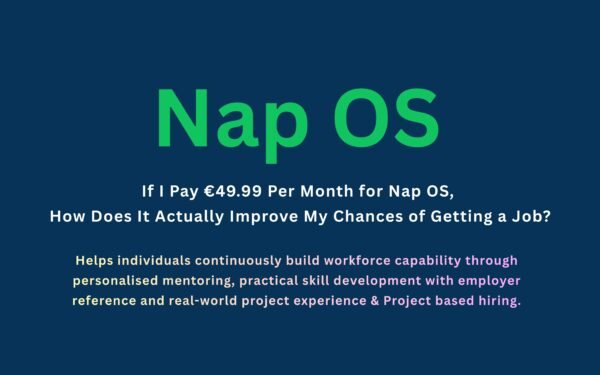
Nap OS starts from a different premise entirely: that the only reliable way to become genuinely employable, or genuinely capable of running a business, is to do real research and development work on real projects, with real feedback loops, and to walk away with a verifiable record of that work rather than a claim about it.
Instead of asymmetrical video content, Nap OS places users inside live R&D-style projects where the learning happens through direct contribution rather than passive observation. Users are not handed a script to follow; they are given problems to work through, often alongside others, with guidance available but not spoon-fed. This mirrors far more closely what actually happens inside a functioning company or a freelance engagement, where nobody hands you a syllabus and the value of your work is judged by outcomes rather than attendance.
Just as importantly, Nap OS treats employment referencing as a structural part of the experience rather than an afterthought. Rather than relying on a candidate’s own description of their work, or a hastily assembled portfolio, the platform is built so that the work itself generates a track record that others can verify. This referencing structure is designed to serve two different destinations at once: it supports people who want to be hired into existing organizations, and it equally supports people who want to go the self-employment or freelance route and need potential clients to trust that the work described actually happened and actually met a standard.
This dual pathway matters because the choice between traditional employment and independent work is no longer a one-time fork in the road for most people. Many now move between the two, taking on a mix of contract work, freelance clients, and salaried roles over the course of a career, sometimes launching their own companies once they have accumulated enough real project experience and enough trusted references to make that leap credible. Nap OS is structured around that reality rather than around the older assumption that a person picks one lane and stays in it.
Freedom From Traditional Gatekeeping
One of the more significant claims behind the Nap OS approach is its openness to people regardless of age, location, or prior educational background. Traditional routes into skilled work have long been gatekept by formal qualifications, geography, and the assumption that a person’s twenties are the appropriate window for skill acquisition. Real project-based learning, by contrast, does not particularly care how old a contributor is or which university, if any, they attended. What it cares about is whether the work gets done and whether it holds up to scrutiny.
This matters enormously for people who were failed by earlier stages of formal education, for people returning to work after a gap, for people in locations without easy access to traditional training infrastructure, and for people simply starting later than convention expects. A project-based, reference-backed model allows all of these people to build a genuine track record from wherever they are standing, rather than being filtered out before they even get the chance to demonstrate what they can do.
The timeframe attached to this approach — building toward real employment, freelance income, or even a company of one’s own within a year or two — is deliberately ambitious but not detached from reality, because the time is spent producing real, referenceable work rather than accumulating certificates or rehearsing interview answers. A year of genuine project contribution, verified by others and backed by real outcomes, tends to be worth considerably more than a year of passive coursework, no matter how many certificates come out the other end of it.
Why the Legitimate Path Wins Over Time
It is worth being honest about the appeal of the shortcut route. Hacking a CV past an ATS, building a portfolio in a week with AI assistance, and rehearsing interview answers can genuinely produce a job offer faster than the slower work of building real capability. For someone facing financial pressure or a long stretch of unemployment, that speed is tempting and understandable.
But speed to an offer is not the same as speed to a sustainable career, and it is certainly not the same as the ability to later go freelance or start a company on the strength of a real track record. Employers and clients are, on the whole, becoming more sophisticated at detecting the difference between engineered signals and demonstrated competence, and that trend is likely to continue as AI-generated portfolios become more common and therefore more suspect by default. The candidates and freelancers who will be trusted with real responsibility, real client budgets, and real leadership over time are the ones who can point to work that genuinely happened and people who will genuinely vouch for it.
Nap OS is a bet on that longer view: that real project experience, honest referencing, and a structure open to anyone regardless of age, location, or credential will consistently outperform manipulated CVs and manufactured portfolios, not just in landing the first opportunity, but in everything that has to be built on top of it afterward.