5 min read
Every year, millions of graduates step into the job market holding a credential but not a track record. They have grades, a certificate, and a CV built from a template, yet almost nothing that proves they can actually do the job they are applying for. Employers, meanwhile, are drowning in applications that look identical on paper and reveal almost nothing about real capability. This mismatch between what education certifies and what work actually requires is not a minor inefficiency in an otherwise healthy system. It is the central failure point of the modern career pipeline, and it is precisely the problem Nap OS was built to solve through what it defines as personalised work experience.
The Gap Between Learning and Doing
The transition from education to employment to entrepreneurship has always been treated as three separate systems rather than one continuous journey. Universities teach theory but rarely map it to job readiness. Recruiters filter candidates using CVs and keyword matching, a method that rewards good formatting over real skill. Early-career talent, by definition, has no experience to point to, so it is locked out of the very opportunities that would let it build experience. Entrepreneurship, when it is supported at all, tends to be delivered through short, unstructured programmes rather than a sustained pathway. The result is a talent economy that wastes enormous human potential simply because there is no infrastructure connecting the dots between learning, doing, and building.
What “Personalised” Actually Means Here
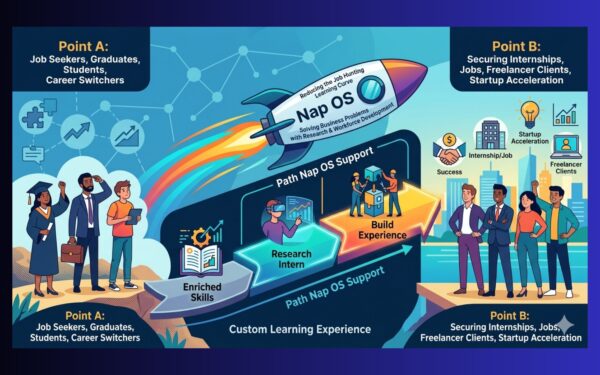
Most platforms that use the word personalised really mean recommendation. They suggest a course, a job listing, or a mentor based on shallow profile data. Nap OS treats personalisation as something structural rather than cosmetic. Inside the Workforce pillar, an individual is first profiled using an AI career engine that identifies real skills, gaps, and potential directions rather than relying on self-reported interests. From there, the system builds a learning path unique to that person, generates simulated work experience relevant to their target role, and helps them assemble a portfolio that demonstrates capability instead of simply listing qualifications. Interview simulation and continuous feedback loops refine this profile over time, so the system does not just personalise a single recommendation, it personalises an entire developmental journey. This is the difference between being pointed toward generic content and being guided through a career built specifically around one person’s evidence, gaps, and goals.
Three Systems, One Loop: Workforce, Recruit, Incubate
What makes this personalisation durable rather than a one-off exercise is the architecture behind it. Nap OS is structured as three interlocking systems rather than a single app. Workforce develops job-ready individuals by turning raw potential into a verified, structured digital identity. Recruit gives employers a way to hire based on that verified capability instead of CV filtering, using skills-based search and candidate verification rather than guesswork. Incubate takes the same underlying profile and, where appropriate, channels it toward venture creation, offering idea validation, business model support, and mentor matching for those who want to build rather than be employed. Crucially, these are not three separate products bolted together. They form a closed loop: a person develops capability through Workforce, gets deployed through Recruit or channelled into venture building through Incubate, and the outcomes of that experience feed back into their profile, refining the system’s understanding of them and re-entering them into the ecosystem at a higher level. Few platforms even attempt to connect these three stages, let alone let the data from one continuously improve the other two.
Why Point Solutions Cannot Replicate This
It is worth being specific about why existing platforms cannot simply add a feature and catch up. LinkedIn owns professional identity but has no mechanism for generating verified work experience or structured skill development. Indeed and similar job boards are matching engines built on top of CVs, not capability data, so they inherit the same signal problems they are meant to solve. Coursera and other learning platforms produce certificates, but a certificate is still a proxy for skill, not evidence of it. Recruitment technology vendors optimise the hiring funnel for employers but have no visibility into how a candidate developed their abilities in the first place. Each of these companies is optimised for one node in the pipeline and structurally incapable of connecting to the others, because doing so would require rebuilding their entire product around a different unit of value: verified capability rather than content consumption, applications, or job postings. Nap OS was designed from the outset around that unit of value, which is why the personalisation problem, in practice, only becomes solvable when Workforce, Recruit, and Incubate exist inside the same infrastructure and share the same underlying profile of a person.
The Multi-Sided Advantage
Personalisation at this depth also depends on having enough different kinds of data flowing through a single system, and that is where the multi-sided nature of Nap OS matters most. Individuals contribute skills and progression data. Employers contribute hiring outcomes and real performance signals. Universities contribute context about graduate cohorts and employability gaps. Governments and ecosystem partners contribute programme-level outcomes across entire regions or sectors. A platform serving only individuals, or only employers, can personalise based on one slice of that picture. A platform that sits across all five stakeholder groups at once can continuously refine what personalisation even means, because it can see whether a recommended skill path actually led to a job, whether a hired candidate actually performed well, and whether a funded venture actually survived. This is the structural reason the claim in the product’s own positioning, that no other platform currently offers a unified AI-native employability infrastructure layer, is more than marketing language. It reflects a genuine architectural gap in the market rather than a temporary feature lead.
Early Signals and What Comes Next
Nap OS is still early. A small base of paying Workforce subscribers and initial interest from technology companies exploring career tools and talent infrastructure are the first proof points rather than the finished story. The near-term roadmap is deliberately sequential: grow and refine the Workforce product and its AI career engine, convert early business interest into structured pilots, then layer in the Recruit module so employers can draw directly from the same verified talent pool, before expanding Incubate and pursuing university and government partnerships at scale. This sequencing matters because each stage strengthens the data available to the next one, which is exactly the compounding effect that makes the whole system harder to copy the longer it runs.
Conclusion
The case for why only Nap OS can deliver personalised work experience effectively does not rest on having a cleverer algorithm than any single competitor. It rests on architecture. Personalisation of this depth requires continuous data from education, employment, and entrepreneurship flowing through one connected system rather than three disconnected markets. Nap OS is one of the few products built, from its foundations, around that connected loop rather than around a single transaction in the hiring or learning process. As the gap between credentials and capability continues to widen, that structural advantage is likely to matter more, not less.