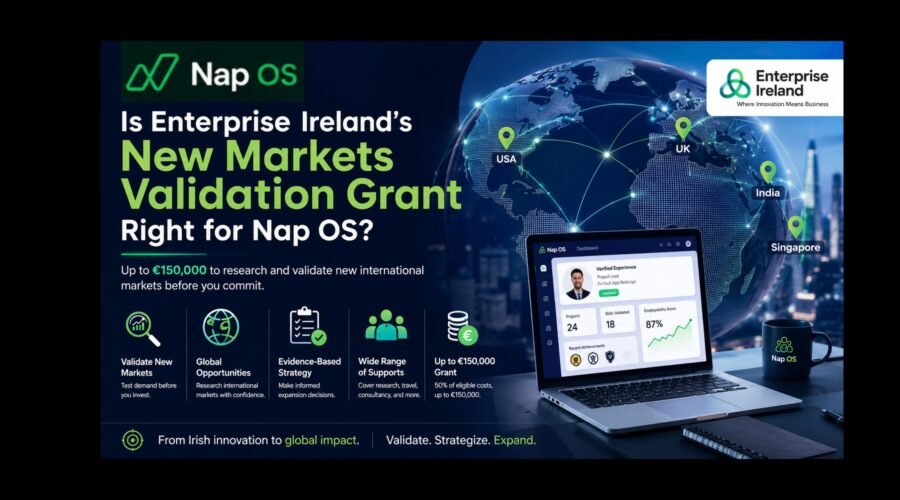
9 min read
A strategic assessment of the €150,000 Enterprise Ireland support for international market validation
For an Irish startup, international expansion can look deceptively simple.
Build the product. Put it online. Run some marketing. Find customers overseas.
In reality, entering a new market is much more complicated.
A product that works in Ireland may require a different pricing model in the UK or US. The buyer may be different. The procurement process may be longer. Regulations may change. Competitors may be positioned differently. Universities, employers, students and workforce organisations may have completely different expectations.
This is particularly relevant for Nap OS, an Irish HRTech and workforce technology company developing a platform around verified, project-based work experience and employability.
Enterprise Ireland’s New Markets Validation Grant is therefore an interesting support to examine—not simply because it can provide up to €150,000, but because of what the grant is designed to fund: evidence before international commitment.
For Nap OS, that distinction could be important.
What is the New Markets Validation Grant?
Enterprise Ireland describes the New Markets Validation Grant as a support for companies that want to undertake rigorous validation of a selected market before committing resources to a launch.
The core objective is not simply international marketing.
It is market validation.
The current Enterprise Ireland guidance provides support of 50% of eligible expenditure, up to a maximum grant of €150,000. Eligible projects can investigate a new geographic market for an existing product or service, or an existing geographic market for a new product or service.
The support can cover a relatively broad range of research-related expenditure, including:
- Salaries and overheads
- Overseas travel and subsistence
- Consultancy
- Business accelerators
- Trade fairs
- Market reports
- Office space used for research
However, there is an important boundary:
Sales and marketing activities are not eligible.
That makes the positioning of an application extremely important.
A company should not approach this as:
“We want funding to sell our product in America.”
The stronger proposition is:
“We have identified America as a strategically important market and need to rigorously validate the customer, commercial, competitive, regulatory and market-entry assumptions before committing significant resources.”
That is a very different funding proposition.
Why this matters for Nap OS
Nap OS is not simply trying to build another job board.
The underlying proposition is centred on verified work experience, project-based learning, employability and workforce readiness.
That creates a potentially international problem.
The graduate employability challenge exists across multiple countries, but the way the problem manifests itself differs by market.
For example:
- Who pays for employability infrastructure?
- Is the primary customer the student, university, employer or workforce organisation?
- What constitutes “verified experience”?
- How do employers evaluate project-based evidence?
- What university systems need to integrate with the platform?
- What pricing model is acceptable?
- What data-protection requirements apply?
- What procurement barriers exist?
- What competitors already serve the market?
- How does Nap OS differentiate itself?
- Can the Irish operating model be replicated internationally?
These are not questions that can be answered simply by looking at website traffic.
They require structured market research.
And that is where the New Markets Validation Grant potentially becomes relevant.
Nap OS already has something many early-stage companies don’t
One of the strongest aspects of the Nap OS story is that international validation would not necessarily begin from a blank sheet of paper.
Nap OS has already been developing and testing its proposition through real users, projects, internships, university relationships and employment outcomes.
The company has also attracted users organically from markets including Ireland, the United States, Singapore and India.
That creates an interesting situation.
Nap OS does not need to ask:
“Does anyone anywhere have this problem?”
There is already evidence that the employability and work-experience problem exists.
The more sophisticated question is:
Where is the strongest commercial market for solving this problem, who is the economic buyer, and what market-entry model should Nap OS use?
That is a much more appropriate internationalisation question.
The difference between traction and market validation
This distinction is particularly important.
Having users in another country does not automatically mean that the company has validated that market commercially.
Organic users can demonstrate interest.
They do not necessarily demonstrate:
- willingness to pay;
- repeat purchasing;
- institutional demand;
- sustainable customer acquisition;
- appropriate pricing;
- procurement readiness;
- competitive advantage;
- regulatory readiness; or
- a scalable route to market.
Nap OS therefore needs to distinguish between international usage and international commercial validation.
The New Markets Validation Grant could potentially sit between those two stages.
The objective would be to take existing evidence and turn it into a rigorous international market-entry strategy.
What could a Nap OS market-validation project look like?
A strong project would need to be much more specific than “research the US market.”
For example, Nap OS could select a particular geographic market and investigate several defined hypotheses.
1. Customer validation
Identify the primary economic buyer.
Is it:
- universities;
- colleges;
- employers;
- recruitment organisations;
- graduate programmes;
- government workforce programmes;
- students; or
- another workforce intermediary?
The project could test which segment has the strongest commercial need.
2. Competitive analysis
Nap OS would need to understand the competitive landscape.
This includes traditional career platforms, university career-management systems, internship platforms, talent marketplaces, learning platforms and emerging AI-enabled employability products.
The objective would not simply be to produce a list of competitors.
It would be to determine:
What job is Nap OS uniquely positioned to perform?
3. Pricing validation
The Irish pricing model should not automatically be exported to another country.
A market-validation project could test:
- student pricing;
- university licensing;
- employer subscriptions;
- workforce subscriptions;
- enterprise pricing;
- project-based pricing; and
- institutional partnerships.
The question is not:
“What price do we want?”
It is:
“What value does the market recognise, and who is willing to pay for it?”
4. Regulatory and procurement analysis
This could be particularly important for a workforce technology platform.
If Nap OS sells to universities or large employers, the sales process may involve procurement, data protection, information security and institutional approvals.
Those barriers can dramatically affect the speed of market entry.
Understanding them before committing significant resources could save substantial time and capital.
5. Market-entry strategy
The final output should ideally answer:
If Nap OS enters this market, how exactly should it enter?
For example:
Irish headquarters → university partnerships → employer network → verified projects → graduate talent pipeline.
Or perhaps the research demonstrates that a direct-to-consumer approach is stronger.
The point is that the strategy should emerge from evidence.
Why the €150,000 headline should not be the starting point
It is tempting to focus on the €150,000 maximum.
That would be the wrong way to approach this support.
Enterprise Ireland provides up to 50% of eligible expenditure, meaning the maximum grant implies a substantial eligible project cost.
The real question for Nap OS should therefore be:
What international-market uncertainty is important enough to justify a structured research project?
If the answer is unclear, Nap OS probably isn’t ready to construct a large application.
If the company can identify a series of critical assumptions—customer, pricing, competition, regulation, distribution and market-entry model—the grant becomes much more strategically interesting.
The biggest suitability question for Nap OS
There is, however, an important issue that should not be ignored.
The Enterprise Ireland terms of reference available for the grant state that the support is available to Enterprise Ireland client companies with a minimum of five employees in Ireland.
That matters for Nap OS.
Having interns, volunteers, users, contractors or community members is not necessarily equivalent to having five employees for grant eligibility purposes.
Therefore, although the strategic fit of the grant may be strong, eligibility should not be assumed.
Nap OS would need to establish its Enterprise Ireland client status and employee position directly with its Client Adviser before building an application around this support.
This is a good example of why grant suitability has two dimensions:
Strategic suitability ≠ confirmed eligibility.
A grant can be perfectly aligned with a company’s growth strategy while the company still needs to satisfy specific programme conditions.
How this could fit into the wider Nap OS funding roadmap
This grant also becomes more interesting when viewed as part of a broader development sequence.
Nap OS is currently exploring several different types of support, including feasibility, innovation and Enterprise Ireland startup funding.
Those supports should not all be treated as interchangeable.
A sensible progression could look something like:
Research the underlying innovation → validate the technology/business model → validate commercial demand → validate international market → scale.
The New Markets Validation Grant potentially belongs much further along that pathway than an early feasibility grant.
That is important because Nap OS already has an MVP and early market evidence.
The international question is becoming increasingly relevant:
Can what has been developed and tested in Ireland become a repeatable international business?
That is fundamentally a market-entry question.
What would make a strong Nap OS application?
If Nap OS eventually pursued this support, I would structure the proposition around uncertainty reduction, not expenditure.
For example:
Current evidence
Nap OS has developed an operating platform and accumulated evidence from users, projects, universities and employment outcomes.
International opportunity
The graduate employability and workforce-readiness problem exists beyond Ireland, with potential opportunities in selected international markets.
Knowledge gap
Nap OS does not yet have sufficient evidence to determine which international market, customer segment, pricing model and market-entry strategy will produce the strongest commercial opportunity.
Proposed validation
Conduct structured research into a selected target market covering:
Customer → Problem → Competition → Pricing → Regulation → Procurement → Distribution → Partnerships → Market Entry.
Commercial outcome
Produce an evidence-based international market-entry strategy and determine whether Nap OS should:
enter, delay, modify the proposition, or reject the market.
That final point is important.
A good validation project should be capable of producing a “no-go” decision.
If research demonstrates that a market is unattractive, that is still valuable.
It prevents the company from spending significantly more money entering the wrong market.
My assessment of suitability for Nap OS
Based on Enterprise Ireland’s published description, I would rate the strategic fit as:
Strong strategic fit — but eligibility needs to be confirmed.
The strongest alignment comes from five areas:
1. Nap OS has an existing product/service.
The grant specifically supports validation involving an existing product/service entering a new geographic market.
2. Nap OS has early international evidence.
Existing users and activity outside Ireland can provide a starting point for identifying markets worth investigating, although this is not the same as commercial validation.
3. The problem is inherently international.
Graduate employability, work experience and workforce readiness are not exclusively Irish problems.
4. Nap OS needs market-specific evidence.
The customer, pricing, competition and institutional buying process may vary significantly between countries.
5. The grant is designed around validation before commitment.
That is potentially the most important alignment.
Nap OS should not use the support simply to accelerate international sales. It could use the underlying research process to determine where international expansion makes commercial sense and how it should be executed.
The strategic question for Nap OS now
The interesting question is no longer simply:
“Can Nap OS work outside Ireland?”
There are already indications that the problem and proposition resonate internationally.
The more important question is:
“Which international market should Nap OS enter first, which customer should it sell to, what commercial model should it use, and what evidence is required before making that investment?”
That is a much more investable question.
And it is exactly why market validation matters.
Enterprise Ireland’s New Markets Validation Grant provides up to €150,000 at a 50% eligible-cost rate and is explicitly designed to help companies research and validate new markets before committing resources to market entry.
For Nap OS, the opportunity is therefore not simply “fund international expansion.”
It is:
Use structured research to turn early international traction into an evidence-based market-entry decision.
That could become an important bridge between building an Irish HRTech product and building an internationally scalable workforce technology company.
One caution: the current Enterprise Ireland programme materials indicate specific eligibility requirements, including the five-employee condition in the published terms of reference. Nap OS should confirm its eligibility with Enterprise Ireland before treating the grant as part of its funding plan.
Enterprise Ireland – New Markets Validation Grant
Nap OS: From Irish validation to international validation
The next stage of the journey may not be about building more features.
It may be about answering a harder question:
Where does Nap OS have the strongest right to win?
And that requires evidence