8 min read
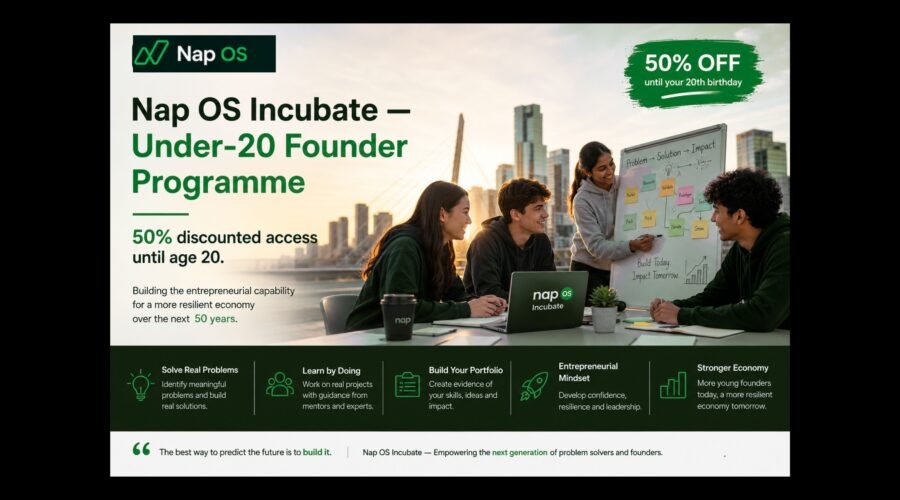
Building the entrepreneurial capability for a more resilient economy over the next 50 years
Every generation enters adulthood facing a different economic environment.
Some experience rapid growth. Others enter the workforce during recessions, inflation, technological disruption, housing pressures, geopolitical uncertainty or major changes in the labour market. The next generation will also face challenges that are difficult to predict today.
The question is not whether future economic disruptions will happen.
The question is whether the next generation will be prepared to respond to them.
Nap OS Incubate — Under-20 Founder Programme is built around that principle.
Nap OS is introducing a 50% discounted access programme for aspiring founders until their 20th birthday, designed to make structured entrepreneurial development more accessible at an early stage of life.
The objective is not simply to encourage young people to “start a company.”
The objective is to help young people learn how to identify problems, understand markets, develop solutions, work with others, create evidence, communicate ideas, build portfolios and progressively understand how businesses and innovation actually work.
That capability can become an important component of a country’s long-term economic resilience.
Why start before 20?
Entrepreneurship is often presented as something people begin after university, after gaining years of employment experience or after identifying an investment opportunity.
But entrepreneurial capability does not need to begin there.
Young people can begin learning how to recognise problems, investigate markets, communicate with potential users, develop solutions and work on real projects long before they establish a company.
The earlier these capabilities are developed, the more time individuals have to experiment, fail safely, learn and improve.
A 17-year-old does not need to become a CEO.
A 19-year-old does not need to raise venture capital.
They need an environment where they can learn how to think, build and solve problems.
That is what Nap OS Incubate is designed to provide.
From education to economic capability
Traditional education is essential, but education alone does not always provide the complete environment required to understand how real-world problems are solved.
Students may learn theories, complete assignments and pass examinations.
Entrepreneurship requires another layer.
It requires asking:
- What problem are we actually solving?
- Who experiences this problem?
- How significant is it?
- What evidence exists?
- What alternatives already exist?
- What would make someone use the solution?
- How could the solution become sustainable?
- How do we communicate the idea?
- How do we work with employers, researchers, customers and other stakeholders?
- What evidence demonstrates that the solution works?
Nap OS Incubate is designed around this progression.
The ambition is to create a structured environment where aspiring young founders can accumulate real evidence of learning and problem-solving, rather than simply collecting certificates.
The 50% Under-20 principle
The cost of accessing entrepreneurial support can become a barrier.
Young people often have limited income, limited professional networks and limited access to experienced mentors.
That creates an important paradox.
The people who could potentially benefit most from early experimentation may have the fewest resources to access it.
The Under-20 Founder Programme addresses one part of that problem through 50% discounted access until age 20.
The principle is simple:
If you are young enough to be learning, you should not be priced out of the opportunity to experiment.
This is not intended to guarantee entrepreneurial success.
It is intended to lower the initial barrier to participation.
What does an Under-20 Founder actually develop?
Nap OS Incubate is designed to help participants progressively develop several forms of capability.
1. Problem identification
Participants learn to move beyond the question:
“What business should I start?”
and instead ask:
“What problem is worth solving?”
That distinction matters.
Strong ventures generally begin with meaningful problems rather than simply with ideas.
2. Market awareness
Young founders can learn to investigate the environment around a problem.
Who experiences it?
What solutions already exist?
What are employers, customers, institutions or communities currently doing?
What is changing?
This develops commercial awareness before major financial commitments are made.
3. Practical problem-solving
Instead of relying exclusively on theoretical learning, participants can work through structured problems and projects.
The goal is to create an environment where learning happens through doing, testing and receiving feedback.
4. Communication
A founder must communicate with many different groups.
Customers.
Employers.
Researchers.
Investors.
Universities.
Government organisations.
Potential employees.
Learning to communicate a problem clearly and explain evidence is therefore an entrepreneurial capability in itself.
5. Portfolio development
Over time, participants can accumulate evidence of what they have actually done.
Projects.
Research.
Problem statements.
Experiments.
Presentations.
Market analysis.
Prototypes.
Feedback.
Outcomes.
This creates a portfolio that can potentially support future applications for employment, university programmes, competitions, incubation and funding opportunities.
Why this matters during a financial crisis
During an economic crisis, employment opportunities can contract.
Businesses may reduce hiring.
Investment may slow.
Startups may struggle to raise capital.
Graduates may find it harder to obtain their first opportunity.
The people who have developed only one pathway into the economy can become particularly vulnerable when that pathway weakens.
Economic resilience therefore requires more than simply creating jobs during good economic periods.
It also requires developing a population capable of adapting when conditions change.
Entrepreneurial capability can contribute to that adaptability.
A person who knows how to identify problems, communicate with stakeholders, build solutions, understand customers and create economic value has capabilities that can potentially be applied across different economic environments.
They may become an employee.
They may become a founder.
They may join an early-stage company.
They may develop an innovation inside an established organisation.
They may become a researcher.
They may eventually create employment for others.
The objective is not to make everyone an entrepreneur.
The objective is to ensure that more people understand how economic value is created.
A 50-year perspective
It is impossible to predict the economic conditions of 2076.
However, we can invest in capabilities that remain useful despite changing conditions.
Technology will change.
Industries will change.
Jobs will change.
Business models will change.
Economic cycles will change.
But the ability to:
identify problems → learn → experiment → collaborate → build → communicate → adapt
is likely to remain valuable.
This is why the Under-20 Founder Programme should be viewed as more than a discount initiative.
It is an investment in human capability.
Imagine a generation where thousands of young people have already experienced building projects before reaching their twenties.
They have learned how to investigate problems.
They have worked with people outside their immediate education environment.
They have received feedback.
They have created portfolios.
They have experienced failure without the consequences of committing significant capital.
Some will become founders.
Some will become employees.
Some will become researchers.
Some will become investors.
Some will become policymakers.
Some will build companies inside existing organisations.
The economic benefit does not come from every participant becoming a startup founder.
It comes from creating a larger population with entrepreneurial and problem-solving capability.
From individual resilience to national resilience
Economic resilience begins at the individual level but can scale to the national level.
A person with adaptable skills is more capable of responding to labour-market change.
A workforce with adaptable skills gives companies more capacity to innovate.
Innovative companies can create new products, services and employment.
New companies can expand the tax base and generate economic activity.
Universities and research institutions can contribute knowledge and technology.
Government can create an environment where these capabilities interact.
The result is an ecosystem rather than a single programme.
Nap OS does not claim that one platform can make an economy recession-proof.
No responsible organisation can make that promise.
Instead, the ambition is to contribute to a more recession-resilient workforce and entrepreneurial ecosystem by helping people develop capabilities before they urgently need them.
Building before the crisis
One of the biggest mistakes societies can make is waiting for a crisis before developing resilience.
When unemployment rises, people suddenly need experience.
When investment falls, founders suddenly need stronger business models.
When industries disappear, workers suddenly need new skills.
When companies stop hiring, graduates suddenly need evidence of capability.
Preparation is cheaper and more effective when it begins before the crisis.
That is the philosophy behind Nap OS Incubate.
Build capability before it becomes an emergency.
A different definition of entrepreneurial success
Success should not only be measured by the number of companies created.
If one participant builds a company, that is valuable.
But if another participant discovers that entrepreneurship is not for them and becomes an exceptional employee, researcher or innovator, that is also valuable.
The programme should therefore measure broader outcomes:
- Problems investigated
- Projects completed
- Skills developed
- Evidence created
- Employer interactions
- Research engagement
- Prototypes developed
- Teams formed
- Ventures explored
- Funding applications supported
- Employment outcomes
- Further education outcomes
- Companies created
- Jobs eventually created
This creates a more realistic definition of economic impact.
Why Nap OS?
Nap OS is being developed around the idea that the journey from education to employment and entrepreneurship should be better connected.
Its broader ecosystem brings together Workforce, Recruit and Incubate.
Workforce focuses on opportunities, projects and career development.
Recruit focuses on helping employers evaluate people through evidence and project-based experience rather than relying exclusively on CVs.
Incubate focuses on aspiring entrepreneurs and structured problem-solving.
The Under-20 Founder Programme sits within that broader ecosystem.
A young person can therefore begin by learning how to solve problems, develop evidence and build a portfolio.
Over time, that portfolio can become part of their professional and entrepreneurial identity.
The long-term vision
The ambition is not to predict the next recession.
It is to prepare people for an economy that we cannot yet predict.
If today’s teenagers become tomorrow’s founders, researchers, engineers, marketers, employers, investors and policymakers, then the capabilities they develop today can influence the economic environment of the next several decades.
The 50% discount is therefore a simple mechanism supporting a much bigger idea:
Give young people access to structured opportunities to learn how to solve real problems before the economy forces them to learn the hard way.
Nap OS Incubate cannot guarantee that someone will become a successful entrepreneur.
It cannot guarantee employment.
It cannot guarantee that the next financial crisis will be avoided.
But it can work toward something more realistic and potentially more valuable:
a generation that is better prepared to adapt, create, collaborate and rebuild when economic conditions change.
That is the long-term economic resilience opportunity.
From crisis response to crisis readiness.
From job seeking to capability building.
From ideas to evidence.
From education to real-world problem solving.
From today’s young people to tomorrow’s economic builders.
Nap OS Incubate — Under-20 Founder Programme.
50% discounted access until age 20.
Build before you need to.