7 min read
In the day-300 piece I wrote that we intend to build toward a thousand freelance Project Managers. I also wrote something I have not stopped thinking about since.
When we advertised for interns, the value to the applicant was obvious. They needed real experience and a route to a job, and we had exactly that. The self-interest did the persuading for us. A reviewer with five years behind them does not need us in the same way. The honest question — what is in this for me? — has a much thinner answer.
A thin answer deserves a precise one. So here is how the money actually works: what starts the clock, what does not, how the hours are logged, when they are paid, and the one number I am not printing yet and why.
Two clocks, not one
Most platforms that pay reviewers pay per review. A flat fee per submission, which sounds clean until you meet the submission that needed two hours and got paid the same as the one that needed ten minutes. Flat fees per unit of work quietly punish the people who do the work properly, and the only asset this company owns is work done properly.
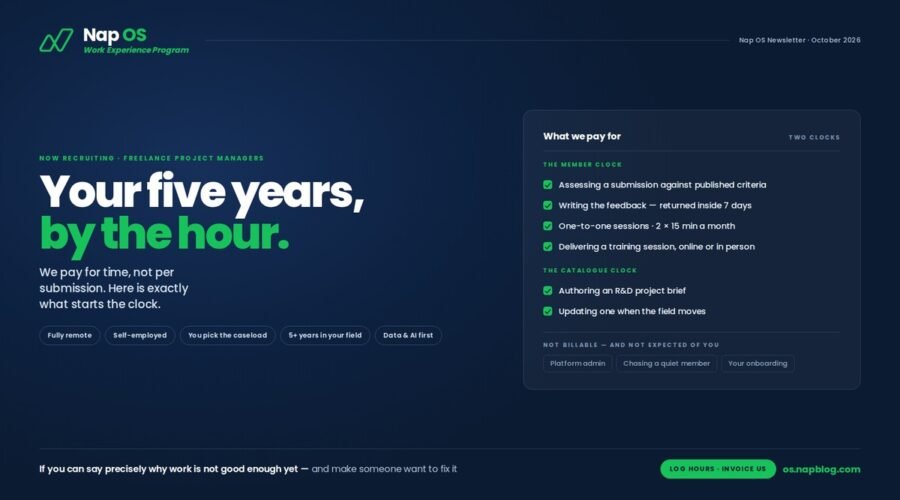
So we pay for time. And we run two separate clocks, because Nap OS asks Project Managers to do two genuinely different jobs.
The member clock covers everything you do with and for a named member: assessing what they submit, writing the feedback, and the one-to-one sessions.
The catalogue clock covers authoring and maintaining the R&D project briefs themselves — work that has nothing to do with any individual member and everything to do with whether the product exists at all.
They are logged separately, invoiced separately, and reported separately. A Project Manager can do one, the other, or both.
What starts the member clock
Three things, and nothing else.
Assessing a submission against the published criteria. A Nap OS brief runs ten tasks over a fortnight, and every task carries its deliverable and the criteria it will be judged against, published before the member begins. Your job is to read what they produced, hold it against those criteria, and write the feedback that goes back inside seven days. That reading and that writing is the hour. It is also the most valuable hour in the business, because the written feedback is what a member keeps.
The one-to-one sessions. Two fifteen-minute sessions per member per month. Thirty minutes of scheduled call time, and the clock covers the call itself.
Delivering training. We have run more than twenty in-person work experience sessions, and more online. Where a Project Manager delivers one, the delivery time is billable in the same way a review is — a session is not goodwill, it is work.
And here is what does not start the clock, stated plainly so nobody discovers it later: platform admin, chasing a member who has gone quiet, your own onboarding, the conversation in which we agree your caseload, and anything we ask you to do that we have not agreed is billable in advance. If it is not one of the three above, ask before you do it.
The catalogue clock, and why the R&D briefs are paid work
This is the part most people miss about Nap OS, so it is worth being exact.
The briefs are not exercises. They are R&D project briefs — scoped pieces of research and development work in one of five domains: Startup and Entrepreneurship, Strategy and Operations, Marketing and Sales, Product and Research, and Data and AI. Members have generated six hundred of them. A good one takes a real, open problem in a field, breaks it into ten tasks a competent beginner can actually start, defines the deliverable at each step, and states in advance what separates adequate from good.
Writing that is not content production. It is domain work. The only people who can do it are people who have done the job — which is to say, Project Managers.
So authoring a brief is billable by the hour, on its own clock. So is substantively updating one when a field moves, which in Data and AI means fairly often. The hours are logged against the brief rather than a member, and the brief stays in the catalogue afterwards, carrying the name of the person who wrote it.
For some reviewers this turns out to be the more interesting line of the two. Reviewing is reactive and fits in the gaps. Authoring is a defined piece of work with your name on it, and a senior person can do it at eleven at night in a way they cannot take a call.
How the hours are logged, and when the money moves
The mechanics are deliberately boring.
You log hours in the app, against the member and brief they belong to, or against the brief you authored. Logging happens as you work, not reconstructed at month end, because a timesheet written from memory a fortnight later is a guess and we would rather not pay for guesses or ask you to make them.
Hours are reviewed and approved on a monthly cycle. You invoice us as a self-employed contractor — this is contract work, not employment, and you are responsible for your own tax and your own insurance. We pay against the invoice.
Caseloads are offered, not assigned. You see what the caseload is, in which domain, and roughly what it will cost you in hours a month, and you say yes or no. Declining does not affect what you are offered next. A caseload you took because you felt obliged is a caseload you will do badly, and a review done badly is worse for us than a review not done.
The number I am not printing today
You will have noticed there is no rate in this article.
That is a decision, not an oversight, and here is the reasoning in full.
A member pays €49.99 a month. That buys them submission review, two fifteen-minute sessions, written feedback inside seven days, and a verified record of what they completed. Everything the member consumes comes out of that €49.99, and the hourly rate we can sustain is a direct function of how many hours a member actually consumes — a figure we are still measuring honestly rather than estimating optimistically.
I could print an attractive number today and quietly cut it in March. A lot of platforms do exactly that, and everyone who joined at the first rate learns about the second one by email. I would rather agree the rate per caseload with the first Project Managers, in writing, with the hours we are actually seeing in front of both of us — and publish a standard rate when it is a real number I can stand over for a year.
If that costs us some reviewers who want a figure before a conversation, that is a fair price. The ones who join on an honest conversation are the ones I want anyway.
The arithmetic I keep running, and you should see it too
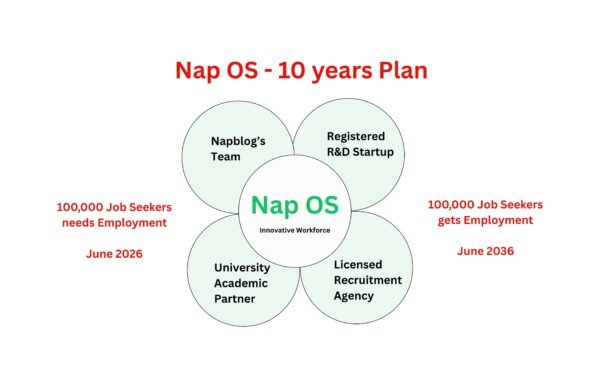
A thousand reviewers and a hundred thousand members would be a hundred members each. Two fifteen-minute sessions a month, per member, is fifty hours of calls alone — before anyone reads a single submission. That is not freelance work. That is a job and a half.
So the ratio only holds because a minority of members are on the paid tier. The plan is quietly sized for conversion staying low. If we get better at the thing we are explicitly trying to get better at, the reviewer bench is the first component that fails.
I do not have a clean answer to that yet. What I have is the knowledge that it is coming, and a preference for telling you now rather than letting you find out from a caseload that doubled without warning.
What we cannot promise
We cannot guarantee you volume. We will tell you how big the pipeline is, not how big we hope it will be.
And the boundaries of the work are fixed by law, not preference. Napblog Limited trades as Nap OS and holds Licensed Employment Agency licence EA 5651. We sell project briefs, review and career support. We do not sell recruitment or job placement, and we do not guarantee anyone employment. The reference a Project Manager provides is a factual confirmation of work completed and reviewed against stated criteria — not a character reference, not a personal endorsement, and not a job offer. Earlier this month an employer we had never met contacted us to verify one of those records. It held up because it was narrow. Keep it narrow.
Who this is for
At least five years of professional experience in a specific field. Data and AI first, because that is what the careers fairs told us; then marketing, product, finance, operations and engineering. Fully remote. Self-employed. Caseloads offered rather than assigned.
If you can tell someone precisely why their work is not good enough yet, in a way that makes them want to go and fix it, the clock is worth your time and I would like to talk to you about what the rate should be.
Start here: os.napblog.com
Pugazheanthi Palani is Founder and CEO of Napblog Limited, trading as Nap OS, a licensed employment agency (EA 5651) at 77 Camden Street Lower, Dublin 2. Fees cover project briefs, Project Manager review and career support — not recruitment or job placement, and employment is not guaranteed. Project Manager engagements are contracts for services, not contracts of employment.