6 min read
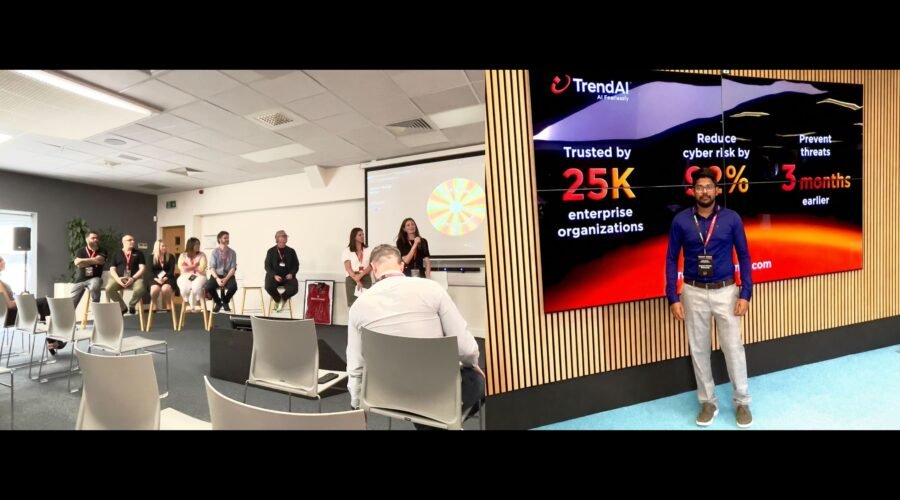
The event was hosted at the TrendAI office in the Cork Business & Technology Park on Model Farm Road, bringing together security practitioners, product teams, and industry voices for an afternoon focused on how artificial intelligence is reshaping both the threats organisations face and the tools available to defend against them.
For Nap OS, attending was a deliberate step in an ongoing effort to sharpen our own security strategy by learning directly from the wider security community, rather than working in isolation. Security has never been a solved problem, and the rapid pace of AI adoption across every industry means the risk landscape is shifting faster than most internal teams can track alone. Sessions like this one give us a chance to compare notes, challenge our assumptions, and bring fresh thinking back into our own product and infrastructure decisions.
The venue itself proved an easy and well-connected location, whether arriving by bus from the city centre, by train into Kent Station, or by taxi. That logistical ease meant the team could focus entirely on the content of the day rather than the practicalities of getting there, and it set a relaxed tone that carried through into the welcome lunch and the networking that followed.
Why Collaboration Sits at the Centre of Security
One of the clearest messages to come out of the afternoon was that security is fundamentally a team sport, and increasingly a cross-industry one. No single engineering team, however skilled, can independently track every emerging AI-driven threat, every regulatory shift, or every new attack technique. The organisations doing security well are the ones actively comparing notes with peers, vendors, insurers, and policymakers rather than trying to solve every problem behind closed doors.
That was very much the spirit of the Cork briefing: practitioners from different companies sitting in the same room, asking hard questions, and being honest about what is working and what still keeps them up at night. For Nap OS, this reinforced something we already believed but are now more deliberately building into our roadmap, that our security strategy should be shaped as much by external dialogue as by internal review.
This also came through in the format of the event itself. Starting with a welcome lunch and networking before the formal talks began meant that much of the day’s real value happened in informal conversations, comparing how different organisations structure their security teams, where they invest their budget, and which vendors they trust. That kind of unscripted exchange is difficult to replicate through webinars or written reports, and it is one of the main reasons in-person events remain worth the travel time, even for a team as geographically spread as ours.
A Programme Built Around Shared Learning
The afternoon programme covered a wide range of ground, moving from global threat intelligence trends through to the practicalities of cyber insurance, the evolving landscape of AI governance, and Ireland’s National Cyber Security Bill. Each topic was handled by practitioners speaking from direct experience rather than abstract theory, which made the discussion feel grounded and immediately useful. Threat intelligence sessions highlighted how attackers are experimenting with AI just as quickly as defenders are, while governance-focused talks explored the practical steps organisations are taking to keep AI systems accountable and auditable as regulation catches up with technology.
The session on Ireland’s National Cyber Security Bill was particularly timely given how quickly the regulatory environment is moving. Speakers walked through what the legislation is likely to mean in practice for organisations operating critical infrastructure and digital services, including new reporting obligations and expectations around risk management. Even for teams like ours that sit outside the strictest scope of the bill, the direction of travel was clear: regulators across Europe are converging on the idea that security accountability needs to be demonstrable, not just assumed, and that organisations should expect to document their reasoning as much as their outcomes.
Perhaps the most candid part of the day was the discussion of real-world incident response. Rather than a polished case study, the session leaned into the messy reality of responding to a live security event: the decisions made under pressure, the communication challenges internally and with customers, and the lessons only learned after the fact. For a team like ours that is still maturing its own incident response processes, hearing this kind of unfiltered account was arguably more valuable than any single statistic about the threat landscape. It served as a reminder that resilience is built as much through preparation and honest post-incident review as through any single tool or control.
Exploring Product Security Through AI-Powered Search
A recurring thread throughout the day was how AI is changing not just the threats organisations face, but also the way security teams evaluate and select the products they rely on. Traditionally, vetting a security product meant manually working through vendor documentation, compliance certifications, and scattered reviews, a process that is slow and easy to get wrong when time is tight. AI-powered search and discovery tools are starting to change that equation, allowing teams to query across vendor documentation, vulnerability databases, and threat intelligence feeds in a fraction of the time, surfacing relevant gaps or red flags that might otherwise be missed.
It is worth being clear-eyed about the limits of this approach as well. AI search tools are only as good as the data they are trained on and the sources they are pointed at, and vendor marketing material is not always a reliable substitute for independent testing. Several attendees shared stories of AI-generated summaries confidently citing outdated compliance information or missing recently disclosed vulnerabilities altogether. The consensus in the room was that AI-assisted search works best as a first pass, a way to quickly narrow a long list of candidate products down to a shortlist worth deeper investigation, rather than as the final word on whether a given tool is safe to deploy.
For Nap OS, this is a particularly relevant shift. As we evaluate security tooling for our own platform, we are increasingly interested in how AI-assisted search can help us move faster without cutting corners on due diligence. Rather than treating AI as a replacement for careful human judgement, we see it as a way to widen the net of what our security team can realistically review in a given sprint, freeing up time for the deeper architectural and threat-modelling conversations that still require experienced people in the room.
It also means our security reviews can be more consistent across products, since AI-assisted search can apply the same set of due-diligence questions uniformly, rather than depending entirely on the individual reviewer’s memory of what to check each time. The Cork briefing gave us useful examples of how other organisations are striking that balance, and where they have drawn the line between automation and human oversight.
Where This Leaves Nap OS
Coming away from Cork, the Nap OS team has a clearer sense of where our own security strategy needs to evolve. We are taking forward a stronger commitment to external collaboration, treating events and relationships like this one as a standing part of how we stay current rather than an occasional extra. We are also looking more seriously at how AI-assisted discovery tools can support faster, more thorough product security reviews, alongside the human expertise that remains essential to sound decision-making.
The offer to continue the conversation over drinks at a nearby hotel afterwards was a nice touch too, reinforcing that relationship-building was as much a part of the day’s purpose as the formal agenda itself. Above all, the day was a useful reminder that AI security is not a destination but an ongoing conversation, one that Nap OS intends to stay actively part of. We would like to thank the TrendAI team in Cork for hosting such an open and practical afternoon, and we look forward to continuing the conversation in the months ahead.