6 min read
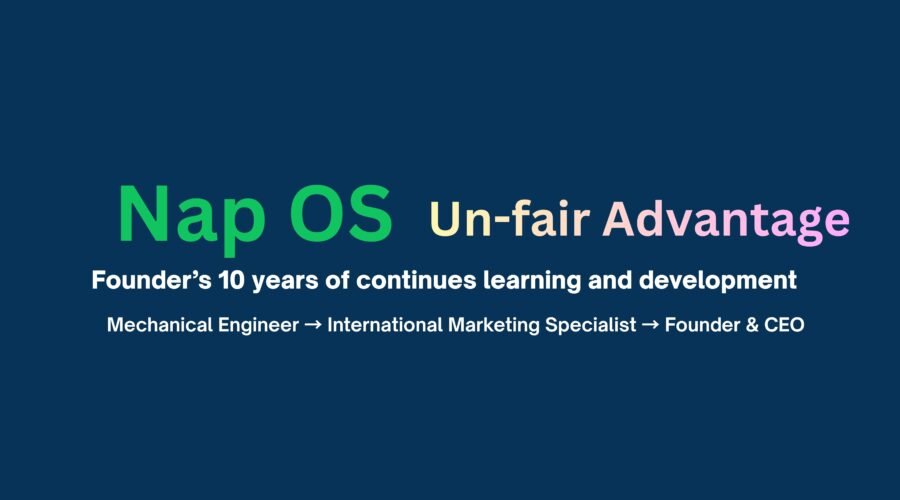
Most startups have a story. Very few have a decade. Nap OS, the Career & Venture Operating System built by Napblog Limited, is unusual in that its founder, Pugazheanthi Palani, spent ten years researching the exact problem the product now solves before writing a single line of the platform’s architecture. That sequencing — research first, product second — is the source of what venture builders call an unfair advantage: a structural edge that competitors cannot simply copy because it was not built overnight and cannot be rebuilt overnight either.
A decade of independent research, not a pitch-deck idea
Nap OS did not begin as a business plan. It began in 2016 as an independent research effort into why capable, motivated people were struggling to convert their education into meaningful careers, and why the systems meant to help them, universities, recruitment agencies, and government training schemes, kept producing the same gap between credentials and capability. Over the following years that research widened to cover labour market dynamics, project-based learning, entrepreneurship, artificial intelligence, and digital transformation, tested continuously against real students, graduates, employers, and founders rather than left as theory.
This is the part of the founder’s story that is easy to skip past and impossible to shortcut. A competitor can copy a landing page, a pricing table, or a feature list within weeks. What cannot be copied on the same timeline is ten years of iterative contact with the actual mechanics of hiring, immigration, education, and venture creation across multiple countries and sectors. By the time Nap OS reached its current form, its founder had already tested and discarded dozens of framings for the same underlying problem, which means the product encodes a decade of eliminated dead ends as much as it encodes what finally worked.
From research findings to a working operating system
The clearest evidence that this R&D was genuinely engineered into the product, rather than retrofitted as a marketing narrative, is the architecture of Nap OS itself. The platform is organised into three systems that map directly onto the three-stage pathway the research kept surfacing again and again: education into employment into entrepreneurship.
Workforce is the supply-side system, built to develop job-ready individuals through AI-personalised skill paths, structured work experience, and a verified digital identity that replaces a static CV. Recruit is the demand-side system, giving employers and universities a way to hire on demonstrated capability instead of filtering resumes by keyword. Incubate is the creation-side system, giving students and early-career professionals a structured, mentor-supported route from an idea to a fundable venture, so that entrepreneurship is not gated behind having already found a job first.
Each of these three systems could exist as a standalone company, and in fact each competes in a market already crowded with single-purpose tools: learning platforms, applicant tracking systems, and startup accelerators all attack one slice of the same problem. What the decade of founder-led research produced was the insight that these three slices are not separate markets at all, but three stages of one continuous loop.
An individual builds skills inside Workforce, gets hired or gains verified experience through Recruit, and either re-enters the loop at a higher level or moves into Incubate to build a venture of their own. Every completed cycle generates more verified outcomes and more signal for the next person entering the system, which is exactly the kind of compounding structure a feature-copying competitor cannot replicate without also rebuilding the full loop, not just one piece of it.
The engineering underneath the strategy
The founder-led R&D shows up just as clearly inside the product surface as it does in the overall strategy. Nap OS is delivered as a browser-based, desktop-style workspace, a dock of modular apps covering a personal portfolio, work experience tracking, project management, gap analysis, employment outcomes, and certificates, alongside an internal analytics engine that manages outcomes, recognitions, emails, time, and revenue across every user on the platform.
Benchmark Mode places a person’s profile against peer medians and top-decile thresholds. Trajectory Forecast projects 30, 60, and 90-day profile-strength growth. Insight Cards surface activity trends and streaks automatically. None of this is decorative; it is the direct product of a founder who spent years asking what evidence actually convinces an employer, a university, or an immigration officer, and then built the measurement layer to generate that evidence continuously rather than once.
Early traction that tests the thesis in the real world
An unfair advantage is only worth something if the market responds to it, and Nap OS already has early signals worth pointing to rather than assuming. The Workforce plan, priced at 49.99 euro per month, has paying subscribers today, and two technology companies are in active B2B conversations about the platform’s talent infrastructure.
On the distribution side, a daily newsletter has reached 182 editions and roughly 2,400 subscribers, and now ranks as the platform’s second-largest traffic source behind organic search, ahead of Bing and even early referral traffic from AI assistants. Usage data shows active users concentrated in Dublin as the home market, alongside meaningful clusters in the United States, Singapore, and India, suggesting the underlying problem Nap OS addresses is not specific to one country’s education system or one region’s hiring culture.
That international pattern matters because it connects directly back to the founder’s original research question. Ireland’s Critical Skills Employment Permit and France’s Talent – Salarie Qualifie route both reward documented, role-matched evidence over generic claims of competence, and both frequently reject applications for exactly the reason Nap OS was built to solve: a lack of substantive, verifiable proof behind a qualification or job title.
A founder who had only built a generic upskilling app would have no reason to notice this connection. A founder who spent a decade researching how education, employment, and migration systems actually evaluate people was positioned to see it immediately, and to design a product that produces the specific kind of evidence these systems are already looking for.
Why the advantage compounds instead of fading
The most common failure mode for an unfair advantage is that it erodes the moment a well-funded competitor decides to copy it. Nap OS is structured to resist that erosion in three ways. First, the research foundation itself keeps compounding: every cohort that moves through Workforce, Recruit, and Incubate generates new outcome data that sharpens the next version of the platform’s matching and profiling layer, so the system gets harder to catch the longer it runs, not easier.
Second, the three-sided architecture means a competitor has to match all three systems at once to offer an equivalent loop, rather than picking off Nap OS’s easiest-to-copy feature. Third, the founder’s direct, hands-on research relationship with the problem, reflected in a content engine built on daily publishing rather than paid acquisition, gives Nap OS a distribution channel that is difficult to buy and slow to replicate, because it depends on a decade of accumulated, specific knowledge rather than a marketing budget.
Ten years of founder-led R&D is not a slogan for Nap OS; it is the mechanism by which a fragmented set of employability and entrepreneurship problems became one coherent, closed-loop operating system. Competitors can copy a pricing page or a feature in a sprint. What they cannot copy on the same timeline is the decade of direct research that decided which features mattered in the first place, and the compounding loop of verified outcomes that keeps widening the gap every day the system runs.