Last updated: May 29, 2026
5 min read
The education system has spent decades optimising for access, scale, and standardisation. It has successfully produced degrees, certifications, and knowledge frameworks. Yet, one fundamental question remains unresolved:
Why do students still struggle to convert learning into real-world outcomes?
At Napblog Limited, we believe the problem is not education itself. It is the absence of infrastructure that connects learning to execution. This is where Nap OS—positioned as the world’s first executable skill operating system—introduces a new paradigm.
We call it Execution Infrastructure as a Service (EIaaS).
And within it, we are defining a new layer for education: Execution-Led Learning as a Service (ELaaS).
Together, these frameworks aim to transform how individuals learn, prove capability, and contribute to the economy.
The Missing Layer in Education
Traditional education systems operate across three layers:
- Content delivery (lectures, courses, materials)
- Assessment (exams, assignments, grading)
- Certification (degrees, diplomas, credentials)
What is missing is the fourth and most critical layer:
Execution.
Students learn concepts but rarely execute them in structured, repeatable, and verifiable ways that align with real-world expectations.
This creates a disconnect:
- Students believe they are prepared
- Employers struggle to verify capability
- Institutions cannot measure true outcomes
EIaaS is designed to solve this gap.
What is Execution Infrastructure as a Service (EIaaS)?
Execution Infrastructure as a Service (EIaaS) is a system-level framework that provides individuals with the tools, workflows, and environments required to convert skills into measurable, verifiable outputs.
Instead of asking:
“What do you know?”
EIaaS asks:
“What have you executed?”
Nap OS operationalises EIaaS by offering:
- Structured execution environments
- Skill-to-tool mapping
- Real-world task simulations
- Output documentation systems
- Portfolio generation frameworks
This transforms learning into a continuous cycle of execution and validation.
From Knowledge Economy to Execution Economy
We are transitioning from a knowledge economy to an execution economy.
In the past:
- Information was scarce
- Knowledge had high value
Today:
- Information is abundant
- Knowledge is accessible
The differentiator is no longer what you know.
It is what you can execute consistently.
EIaaS aligns with this shift by prioritising:
- Action over theory
- Output over input
- Consistency over intensity
Nap OS becomes the infrastructure that enables this transition.
Introducing ELaaS: Execution-Led Learning as a Service
While EIaaS provides the infrastructure, ELaaS defines how learning happens within that infrastructure.
Execution-Led Learning as a Service (ELaaS) is a model where:
- Learning is driven by real-world execution
- Progress is measured through outputs
- Skills are validated through evidence
- Feedback loops are continuous
In ELaaS:
Students do not learn first and apply later.
They learn by executing.
This creates:
- Faster skill acquisition
- Deeper understanding
- Higher retention
- Immediate relevance
ELaaS is not an alternative to education.
It is an evolution of it.
How Nap OS Enables EIaaS and ELaaS
Nap OS acts as the operating system that integrates EIaaS and ELaaS into a functional, scalable product.
It provides:
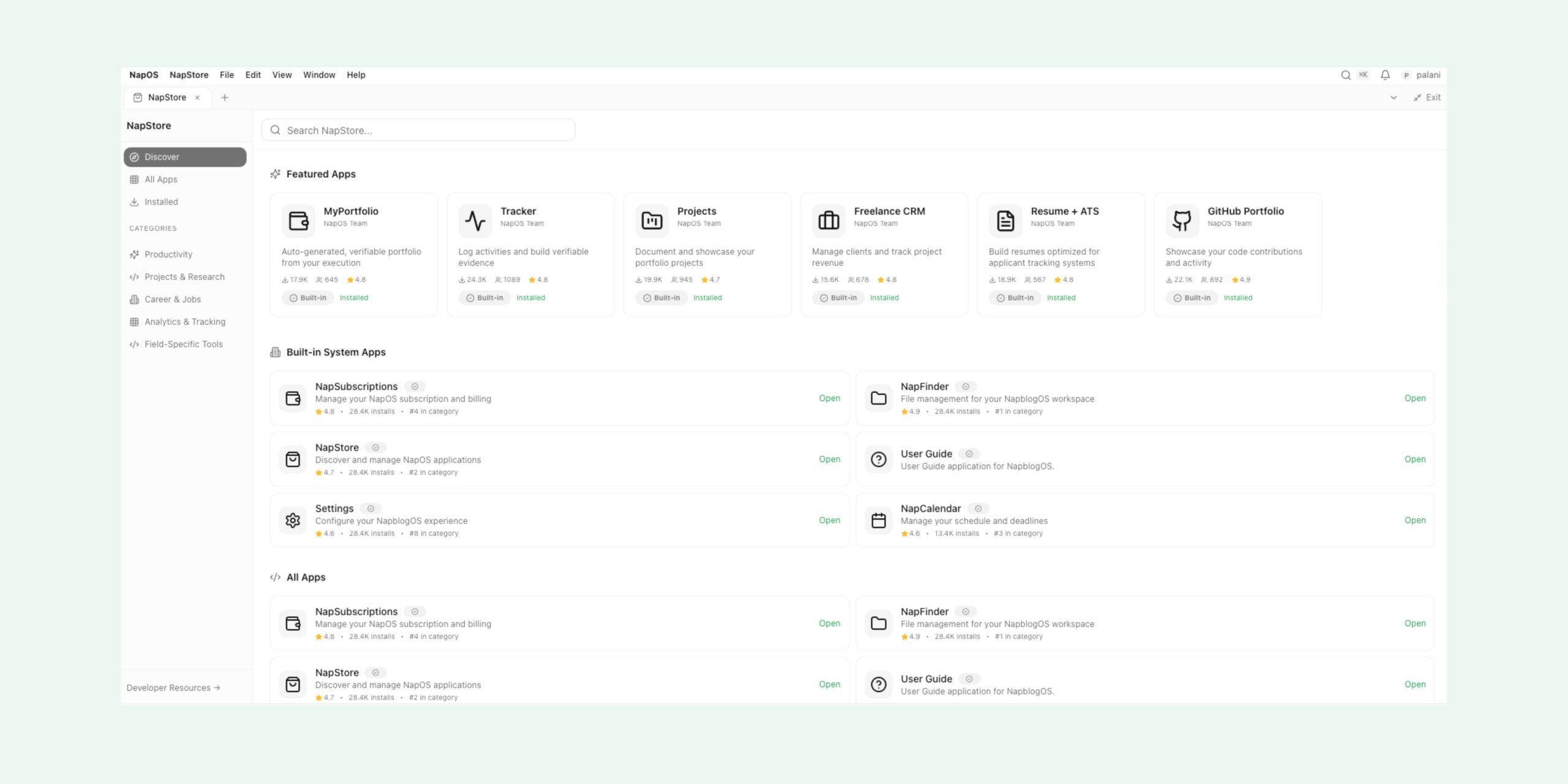
1. NapStore: Skill-Based Execution Modules
Students install “apps” that represent skills.
Each app includes:
- Tools
- Workflows
- Tasks
- Outputs
This creates a structured pathway from learning to execution.
2. Execution Tracking System
Every activity is:
- Logged
- Measured
- Time-stamped
- Documented
This ensures transparency and accountability.
3. Evidence Generation Engine
Outputs are captured as:
- Reports
- Files
- Screenshots
- Links
- Analytics
This builds a verifiable portfolio.
4. Portfolio Layer (Live CV)
All outputs are aggregated into a live portfolio that:
- Updates in real time
- Reflects actual work
- Can be verified by employers
5. Recruitment Integration
Nap OS connects execution to opportunity by:
- Tracking job applications
- Aligning portfolios with roles
- Enabling recruiter verification
This completes the cycle from learning to employment.
Why EIaaS Matters for the Education Industry
The education industry faces increasing pressure to:
- Improve employability outcomes
- Align with industry needs
- Demonstrate value
EIaaS provides a solution by:
- Embedding execution into learning
- Making outcomes measurable
- Reducing the gap between education and employment
Institutions can:
- Integrate EIaaS into curricula
- Track student execution
- Provide real-world experience at scale
This enhances both credibility and impact.
The Positive Impact on Students
For students, EIaaS and ELaaS create a new experience:
From Passive to Active
Students move from consuming content to executing tasks.
From Uncertainty to Clarity
They understand what skills they need and how to apply them.
From Waiting to Building
They do not wait for opportunities—they create them.
From Claims to Proof
They replace statements with evidence.
This fundamentally changes how students approach their careers.
The Positive Impact on Employers
Employers benefit from:
- Reduced hiring risk
- Faster candidate evaluation
- Access to verified talent
- Better alignment with job requirements
EIaaS enables employers to:
- See real work
- Assess practical skills
- Make data-driven hiring decisions
This improves efficiency and outcomes.
The Positive Impact on Society
At a macro level, EIaaS contributes to:
- Reduced youth unemployment
- Better skill distribution
- Increased productivity
- Stronger economic participation
It creates a system where:
- Talent is visible
- Opportunity is accessible
- Effort is rewarded
This is critical in a rapidly evolving global economy.
Breaking the Limitations of Traditional Systems
Traditional systems struggle with:
- Static assessments
- Delayed feedback
- Limited scalability of internships
- Lack of real-world exposure
EIaaS addresses these by:
- Providing continuous evaluation
- Enabling real-time feedback
- Scaling execution opportunities globally
- Integrating tools and workflows
This makes learning dynamic and relevant.
The Role of Technology
EIaaS is made possible by modern technology, including:
- Cloud-based platforms
- AI-driven insights
- Automation tools
- Data analytics
Nap OS leverages these technologies to:
- Personalise learning paths
- Track execution patterns
- Recommend improvements
- Optimise outcomes
Technology becomes an enabler, not a replacement for human effort.
Challenges and Considerations
While EIaaS and ELaaS offer significant benefits, they also require:
- Cultural change in education
- Adoption by institutions
- Commitment from students
- Alignment with industry standards
Not everyone will adapt immediately.
But the direction is clear.
Execution is becoming the new standard.
The Future of Education
The future will not be defined by:
- Degrees alone
- Certificates alone
- Traditional metrics alone
It will be defined by:
- Execution capability
- Verified outputs
- Continuous learning
EIaaS and ELaaS are steps toward this future.
Napblog Limited’s Vision
Napblog Limited positions itself as more than a product company.
It is a research-driven organisation building:
- Systems
- Frameworks
- Infrastructure
Nap OS is the first implementation of this vision.
EIaaS is the industry layer.
ELaaS is the learning model.
Together, they form a new foundation for education and careers.
Conclusion
Execution Infrastructure as a Service (EIaaS) and Execution-Led Learning as a Service (ELaaS) represent a shift in how we think about education, skills, and employability.
They move the focus from:
- Learning to doing
- Knowing to executing
- Claiming to proving
Nap OS brings these concepts to life by providing a system where:
- Skills are practised
- Work is documented
- Outputs are verified
- Opportunities are accessible
This is not just an innovation.
It is a necessary evolution.
Because in a world where information is abundant, execution is the true differentiator.
And the future belongs to those who can prove what they can do.