6 min read
I [Pugazh, Founder Nap OS] were in same shoes 6 years ago and applying for jobs…
Graduate.
Update your CV.
Apply for jobs.
Wait.
Receive an automated rejection—or worse, no response at all.
Apply again.
Repeat.
For many people, this cycle continues for months. Some eventually secure interviews, while others begin to lose confidence, motivation, and valuable time. During this waiting period, their skills often remain invisible to employers, despite their willingness and ability to contribute.
The challenge isn’t simply unemployment. It’s that the traditional hiring process is built around static snapshots of a candidate rather than continuous evidence of their capabilities.
At Nap OS, we believe there is a better approach.
Instead of asking people to spend months waiting for opportunities, we believe they should be continuously building evidence that makes opportunities more likely.
The Traditional Hiring Model
Today’s hiring process has remained largely unchanged for decades.
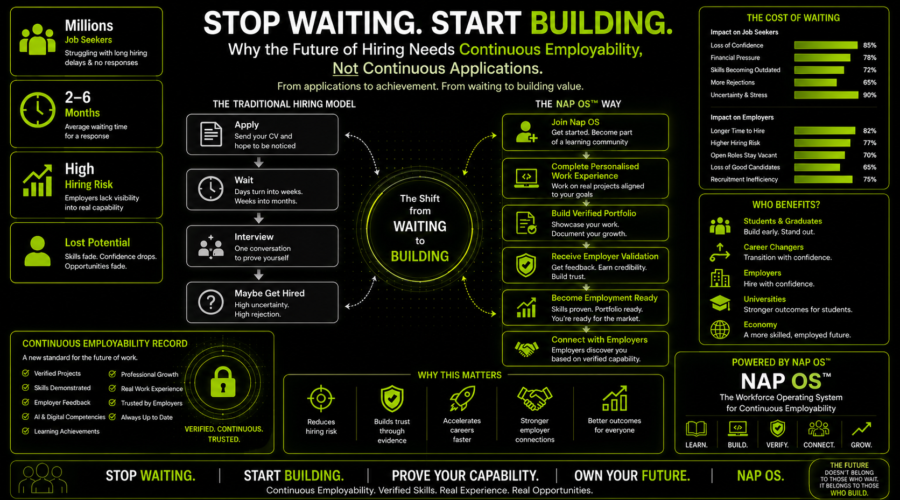
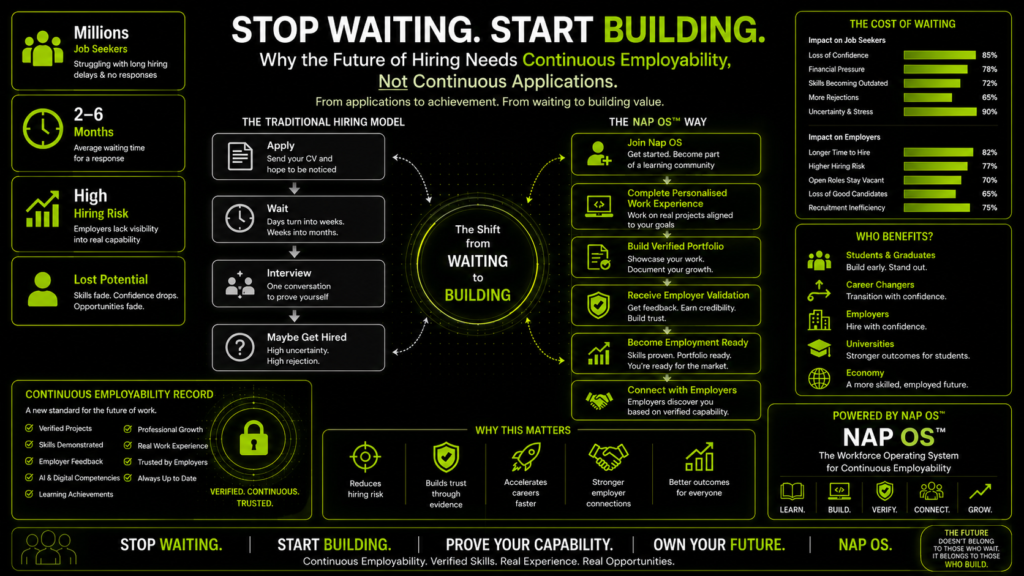
The typical journey looks like this:
Apply
↓
Wait
↓
Interview
↓
Maybe Get Hired
This process places nearly all of the control in the hands of employers.
Candidates spend significant time:
- Tailoring CVs.
- Writing cover letters.
- Completing application forms.
- Waiting for responses.
- Repeating the process across multiple employers.
From an employer’s perspective, this approach also creates challenges.
Recruiters often have to evaluate hundreds or thousands of applications using limited information, typically relying on:
- CVs
- Academic qualifications
- References
- Interviews
While these remain important, they often provide only a partial picture of an individual’s capability.
A degree demonstrates academic achievement.
A CV summarises previous experience.
An interview measures communication and interpersonal skills.
None of these consistently show how someone performs when solving real problems over time.
The Hidden Cost of Waiting
Waiting is one of the least discussed costs within recruitment.
A graduate waiting six months for employment isn’t simply unemployed.
During that period they may also experience:
- Declining confidence.
- Limited professional development.
- Reduced industry exposure.
- Skills becoming outdated.
- Financial pressure.
- Growing uncertainty about career direction.
For employers, waiting has costs too.
Vacancies remain open.
Recruitment cycles become longer.
Hiring decisions become riskier.
Talent that could have been developed is often overlooked.
The recruitment process becomes reactive rather than developmental.
Employment Should Not Begin on Day One
One of the biggest assumptions in traditional recruitment is that meaningful professional development begins after someone receives an employment contract.
In reality, employability should begin long before the first day of work.
Imagine two graduates.
Graduate A spends six months applying for jobs.
Graduate B spends six months completing industry projects, building a verified portfolio, learning new technologies, receiving structured feedback, collaborating with employers, and continuously improving.
Both graduates apply for the same position.
Who presents lower hiring risk?
The answer is obvious.
A Different Model
Nap OS proposes a different way of thinking.
Rather than viewing employability as something that begins after hiring, it becomes a continuous process.
Instead of this:
Apply
↓
Wait
↓
Interview
↓
Maybe Get Hired
Nap OS encourages:
Join
↓
Complete Personalised Work Experience
↓
Build a Verified Portfolio
↓
Receive Employer Validation
↓
Become Employment Ready
↓
Connect with Employers
The difference is significant.
Instead of measuring potential through documents alone, employers begin seeing continuous evidence of capability.
From Credentials to Capability
Modern hiring still places substantial emphasis on credentials.
Qualifications remain valuable.
However, employers increasingly ask additional questions:
Can this person solve problems?
Can they collaborate?
Can they communicate?
Can they deliver work?
Can they learn quickly?
Can they adapt?
These questions cannot always be answered by a CV.
They require evidence.
A portfolio of real work.
Employer feedback.
Completed projects.
Verified achievements.
Documented progress.
This is where continuous employability becomes valuable.
Continuous Employability Records
One of the most interesting opportunities for workforce innovation is the concept of a Continuous Employability Record.
Today, people maintain records such as:
- Academic transcripts.
- Professional certifications.
- Employment history.
- References.
What if employability itself became continuously documented?
Instead of recording only where someone worked, a modern employability record could include:
- Industry projects completed.
- Skills demonstrated.
- AI competencies developed.
- Employer feedback.
- Team collaboration.
- Portfolio evolution.
- Continuous learning achievements.
- Practical experience across multiple disciplines.
This creates a richer picture of capability than a static CV alone.
Reducing Hiring Risk
Recruitment fundamentally involves managing uncertainty.
Employers ask themselves:
Will this person perform?
Will they fit our team?
Can they learn quickly?
Will they deliver results?
Traditional hiring attempts to answer these questions using interviews and references.
Continuous employability provides additional evidence.
The more verified work someone completes before employment, the less uncertainty exists.
Instead of making hiring decisions based primarily on prediction, employers can evaluate demonstrated capability.
Benefits for Students
Students gain significantly from this approach.
Rather than graduating with only academic achievements, they can also graduate with:
- Industry experience.
- Verified projects.
- Employer feedback.
- Professional portfolios.
- Practical AI skills.
- Stronger professional networks.
Their employability becomes cumulative.
Each project strengthens the next opportunity.
Benefits for Universities
Universities increasingly focus on graduate outcomes.
Continuous employability aligns naturally with this objective.
Instead of education ending at graduation, universities can help students continuously build career capital throughout their studies.
This strengthens:
- Graduate employability.
- Industry engagement.
- Employer partnerships.
- Student satisfaction.
- Institutional reputation.
Benefits for Employers
Employers benefit through improved hiring confidence.
Instead of evaluating anonymous applications, they can review candidates with verified evidence of capability.
Recruitment becomes:
- More informed.
- More predictable.
- Lower risk.
- Better aligned with business needs.
This has the potential to reduce hiring mistakes while improving candidate quality.
Benefits for Career Changers
Continuous employability is equally valuable for professionals changing careers.
Someone transitioning from marketing into data analytics, for example, can gradually build:
- New projects.
- Practical experience.
- Verified skills.
- Employer references.
- AI competencies.
Instead of beginning from zero, they create a visible pathway demonstrating their transition.
An Infrastructure Opportunity
Importantly, this is not about changing employment law.
Nor is it about replacing universities.
It is not intended to replace recruiters.
Instead, it represents an infrastructure opportunity.
Just as LinkedIn became professional networking infrastructure, and GitHub became software development infrastructure, there is an opportunity to build infrastructure for continuous employability.
The missing layer is not another job board.
The missing layer is verified, ongoing evidence of capability.
Looking Ahead
Artificial intelligence is changing how people learn, work, and collaborate.
At the same time, employers continue searching for better ways to identify capable individuals.
The future of hiring will likely involve more than CVs and interviews.
It will increasingly incorporate:
- Verified work.
- Skills validation.
- AI-assisted learning.
- Employer collaboration.
- Portfolio-based assessment.
- Continuous employability records.
Rather than replacing existing hiring practices, these approaches can complement them.
Conclusion
The future of employment should not be defined by long periods of waiting.
It should be defined by continuous progress.
Every project completed.
Every skill learned.
Every employer interaction.
Every verified achievement.
Each becomes another piece of evidence demonstrating capability.
That shift changes the conversation from:
“I’m waiting to be hired.”
to
“I’m continuously becoming more employable.”
At Nap OS, we believe employment readiness should not begin with a job offer. It should begin the moment someone chooses to invest in building real capability.
The future of workforce development is not simply finding talent.
It is continuously developing, verifying, and connecting talent.
That is the opportunity we believe Nap OS is building toward: a workforce operating system where employability is not a one-time event, but a continuously evolving record of learning, experience, and demonstrated capability.
Mail your story and CV to palani@napblog – We’ll start working to gather…