6 min read
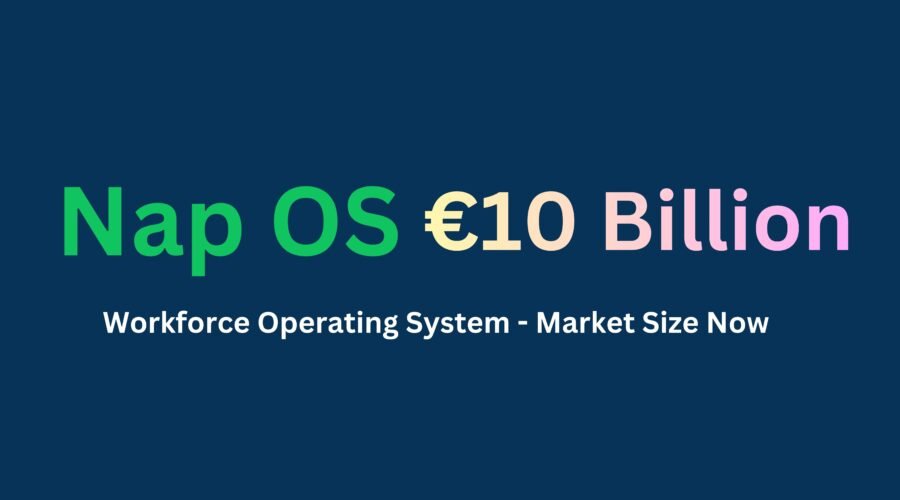
Nap OS sits at the intersection of two large and converging categories: Workforce Management (WFM) Software and HR Technology more broadly. The global WFM software market, which includes emerging Workforce Operating Systems such as Nap OS, is currently valued between $9.76 billion and $13.09 billion. This range reflects differences in how analysts define the category’s boundaries, but even at the conservative end, it represents a substantial and mature total addressable market (TAM). More importantly for a founder-led early-stage company, this market is not static.
Analysts project it will scale to between $15.67 billion and $34.46 billion by 2034, growing at a compound annual growth rate of 7.6% to 12.8%. Even using the lower bound of these projections, the market is expected to grow by roughly 60% over the next decade, while the upper bound implies the category could nearly triple in size. For a new entrant like Nap OS, this growth trajectory matters more than the current absolute figure, because it signals that the category is expanding fast enough to create room for new platform models rather than simply reallocating spend among incumbents.
This TAM should also be understood alongside the broader HR technology market, which independently exceeds $40 billion globally. Nap OS operates in the overlap between workforce management, digital credentialing, and recruitment technology, meaning its addressable opportunity is not confined to a single reporting category. Millions of graduates and career changers enter labour markets every year, each representing a potential Workforce Member, while every employer engaged in hiring represents a potential Employer Membership customer. This dual-sided structure is what gives Nap OS access to a market far larger than its current niche of international students and recent graduates in Ireland.
From Total Market to Serviceable Market
A $9-34 billion global figure is a useful anchor, but feasibility depends on how much of that market Nap OS can realistically serve, and in what timeframe. The serviceable addressable market (SAM) for Nap OS should be defined more narrowly: the segment of the WFM and HR technology market concerned specifically with workforce identity verification, employer-validated experience, and continuous employability infrastructure. This is a fast-growing sub-segment within the larger category, driven by three converging pressures.
Employers increasingly need faster, lower-risk ways to assess whether a candidate is genuinely work-ready, especially in tight or specialised labour markets. Governments and immigration systems, including Ireland’s Critical Skills Employment Permit framework and comparable pathways such as France’s Talent-Salarié Qualifié route, are creating structural demand for verifiable local work experience. Universities and career services are under growing pressure to demonstrate graduate employability outcomes, creating an institutional incentive to partner with platforms that can produce evidence of real workplace performance.
Within Ireland alone, the population of international students, Stamp 1G graduates, and early-career jobseekers represents a defined and currently underserved beachhead. Layered on top of this is the employer side of the market: any Irish employer hiring graduate or entry-level talent, particularly those navigating employment permit sponsorship, is a plausible Employer Membership customer.
Universities and workforce development organisations represent a third channel, functioning less as direct payers in the near term and more as validation and distribution partners, as demonstrated by Nap OS’s existing relationship with UCD and engagement with institutions in France and Hungary. Taken together, this SAM is realistically in the tens of millions of euro annually within Ireland alone, before any international expansion, and grows substantially once Nap OS extends into other markets with similar visa-linked employability gaps, beginning with the US as outlined in the founder’s export plans.
Serviceable Obtainable Market and Near-Term Realism
The serviceable obtainable market (SOM) is where Nap OS’s actual traction becomes the most credible evidence of feasibility, because it grounds the market sizing exercise in demonstrated willingness to pay rather than projection alone. Nap OS has already converted an organically built audience of 2,371 newsletter subscribers into 10 paying Workforce Members, generating €x,xxx in monthly recurring revenue and €xx,xxx in annualised recurring revenue.
While these figures are early-stage, they are meaningful because they were achieved without paid acquisition spend, relying instead on founder-led content that generated over 71,000 article views and nearly 98,000 impressions. This indicates that customer acquisition costs, at least in the current channel, are low relative to typical HR technology benchmarks, which improves the unit economics case for scaling the SOM.
The near-term milestone of growing paying Workforce Members from xx to xxx within the first two months of the programme, anchored around a validated acquisition channel at the Edu Fair with xx,xxx attendees, gives a concrete and testable basis for projecting SOM growth over the next 12 to 24 months.
If even a small single-digit percentage of Edufair-type event attendees convert into paying members over time, alongside continued organic subscriber growth, the obtainable market within the Irish graduate segment alone could scale into the hundreds of thousands of euro in annual recurring revenue within a few years, before layering in Employer Membership revenue.
On the employer side, Employer Letter of Intent worth €xx,xxx per month, combined with active discussions with two technology companies exploring workforce infrastructure partnerships, suggests employer demand exists beyond the founder’s own network, though it remains at an early and unproven stage of commercial maturity.
Feasibility Assessment
Feasibility for Nap OS should be assessed across four dimensions: market timing, product-market signal, business model durability, and execution capability. On market timing, the convergence of a growing WFM/HR technology market with structural immigration and employability pressures in Ireland creates a genuine window of opportunity rather than a manufactured one; the Catch-22 facing international graduates who need local experience to get local jobs, but need local jobs to get local experience, is a well-documented and persistent friction point rather than a speculative pain point. This lends credibility to the customer problem underpinning the market sizing above.
On product-market signal, the evidence is promising but still early. Ten paying Workforce Members and one Employer Letter of Intent are meaningful proof points, particularly given they were achieved without paid marketing, but they are not yet sufficient to describe product-market fit as established. This aligns directly with the feedback previously received from the Fund evaluation panel, which specifically flagged the need to further validate product-market fit and better articulate the value proposition.
The Funding programme is well matched to closing this exact gap, since its structure is designed to support exactly this kind of validation work through mentorship and customer engagement rather than pure product-building.
On business model durability, the shift to a simplified, dual-sided subscription model centred on Workforce and Employer Memberships strengthens feasibility considerably compared to a more diffuse, feature-heavy platform. Recurring subscription revenue is inherently more scalable and easier to forecast than transactional or project-based models, and the removal of non-core activities suggests a founder response to real commercial feedback rather than a cosmetic change.
The network effects described, where every verified project, employer reference, and institutional evaluation strengthens the value of the platform to future employers, is a genuine structural advantage if it can be sustained, since it creates increasing switching costs and data advantages over time that are difficult for competitors such as LinkedIn, Handshake, or Workday to replicate quickly, given their broader and less specialised focus.
On execution capability, the founder’s track record of coordinating more than 100 distributed contributors, building institutional relationships with X Uni and international university partners, and generating documented employment outcomes for more than 50 former interns and contributors, provides tangible evidence of delivery capability beyond the product itself. This operational history reduces execution risk relative to a purely idea-stage founder.
Conclusion
Taken together, the market sizing analysis supports a credible, though not yet fully proven, growth pathway for Nap OS. The global TAM of $9.76 billion to $34.46 billion by 2034 provides a large enough backdrop to justify ambition, the Irish graduate-and-employer SAM provides a concrete and reachable near-term opportunity, and the current SOM, while modest in absolute terms, demonstrates real paying demand achieved organically.
Feasibility is best described as moderate-to-strong rather than fully de-risked: the customer problem is real and structurally reinforced by immigration policy, the business model has been sensibly simplified toward recurring revenue, and the founder has demonstrated delivery capability, but employer-side commercial traction remains the weakest and most important link to strengthen before a stronger Pre-Seed Start Fund reapplication can be made.