8 min read
The hiring process is becoming increasingly dependent on data.
CVs are parsed by software.
Candidates are ranked by algorithms.
Skills are extracted automatically.
AI can summarise applications, generate candidate profiles and increasingly support recruitment decisions.
But there is a fundamental question that technology alone cannot answer:
Who should ultimately decide whether a person is capable of doing the work?
At Nap OS, we believe the answer should remain human.
Technology should improve the quality, availability and organisation of evidence around a candidate. It should not quietly replace human judgement with an opaque score.
That principle is one of the reasons Nap OS is building towards a Workforce Operating System based on dynamic data modelling and human-decision-led, project-based hiring.
The objective is not to create a system that claims to be “fool-proof” because no technology can eliminate human error, bias or uncertainty completely.
The objective is to create a system that is more evidence-based, transparent, reviewable and difficult to misuse.
The Problem With Static Hiring Data
Traditional recruitment is heavily dependent on static information.
A CV might contain:
- Education
- Job titles
- Company names
- Years of experience
- Skills
- Certifications
- Achievements
- Contact details
This information is useful.
But it represents a person’s professional identity at a particular point in time.
A CV might say:
“Project Management”
But it does not necessarily tell an employer:
- What project?
- What was the problem?
- What did the person actually do?
- What decisions did they make?
- Who worked with them?
- What did they produce?
- What happened as a result?
- Who reviewed their contribution?
- What did they learn?
- Can they demonstrate the work?
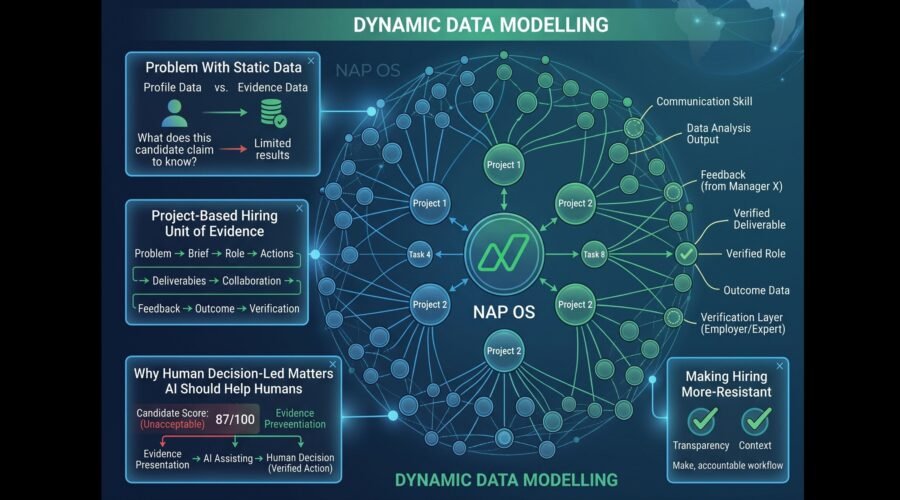
This is the difference between profile data and evidence data.
Nap OS is interested in the second.
Project-Based Hiring Changes the Unit of Evidence
Project-based hiring begins with a different question.
Instead of asking only:
“What does this candidate claim to know?”
the employer can ask:
“What has this person actually done?”
A project creates a natural evidence structure.
For example:
Problem → Brief → Role → Actions → Deliverables → Collaboration → Feedback → Outcome → Verification
That structure can contain much richer information than a conventional CV.
A candidate might not have five years of employment experience.
But they may have completed five meaningful projects.
Those projects can reveal how they communicate, analyse problems, work with others, manage deadlines, use technology and respond to feedback.
This is particularly important for students, graduates, career changers and international professionals who may have capability but limited conventional employment history.
Why “Human Decision-Led” Matters
Artificial intelligence can process enormous amounts of information.
That does not mean AI should make the final hiring decision.
Hiring is not simply a data classification problem.
A hiring decision can affect someone’s career, income, confidence and future.
There can also be information that an automated system cannot properly understand.
For example:
- A candidate may have changed career.
- A project may have been completed under difficult circumstances.
- A candidate may have taken responsibility beyond their formal title.
- A portfolio may contain work produced collaboratively.
- A candidate may have learned significantly from an unsuccessful project.
- A non-traditional career path may actually contain highly relevant experience.
A purely automated ranking system can struggle with context.
A human can ask:
“What is actually happening here?”
That is why Nap OS sees AI as an evidence-enabling technology, rather than an unquestionable hiring authority.
AI Should Help Humans Make Better Decisions — Not Make Invisible Decisions
This distinction is central to the Nap OS architecture.
AI can help:
- Organise project evidence
- Identify relevant skills
- Summarise project contributions
- Match project experience to role requirements
- Highlight missing evidence
- Generate questions for an interviewer
- Identify areas that require human review
- Help candidates understand what evidence they should build
But the system should not simply produce:
Candidate Score: 87/100 — Hire
and expect an employer to accept that output without understanding how it was generated.
A more responsible model is:
Here is the evidence.
Here is what the system identified.
Here is what has been verified.
Here are the uncertainties.
Now the human makes the decision.
That is what we mean by human-decision-led hiring.
From Static Records to Dynamic Data
This leads to another important concept behind Nap OS:
Dynamic data modelling.
A person’s professional capability is not static.
It changes continuously.
A student completes a project.
Then they receive feedback.
Then they improve.
Then they complete another project.
Then they work with a different team.
Then they acquire a new skill.
Then an employer reviews their work.
Then they enter employment.
Then they acquire professional experience.
Their workforce profile should therefore evolve.
A static CV cannot easily represent this progression.
A dynamic workforce data model can.
What Does Dynamic Data Mean for Nap OS?
Imagine a Nap OS profile not as a digital CV, but as a continuously developing professional evidence graph.
At the centre is the individual.
Connected to that individual are:
Projects
↓
Tasks
↓
Skills
↓
Outputs
↓
Feedback
↓
Reviewers
↓
Verification
↓
Outcomes
↓
Roles
↓
Employment
Each new experience can add another layer.
The profile therefore becomes more valuable over time.
A project completed at university can remain relevant after graduation.
An internship can add new evidence.
An employer project can add another verified experience.
A professional role can extend the same record.
The system becomes dynamic because the person’s workforce identity is continuously updated by new evidence.
The Workforce Operating System Concept
This is why Nap OS describes itself as a Workforce Operating System.
An operating system coordinates multiple components so that applications and users can interact with the underlying system.
Nap OS applies a similar idea to workforce development.
The individual is not simply a CV.
The employer is not simply a job poster.
The project is not simply an assignment.
The skill is not simply a keyword.
The verification is not simply a badge.
All of these components need to interact.
The Nap OS vision is therefore to create infrastructure connecting:
People + Projects + Skills + Evidence + Verification + Employers + Opportunities
Dynamic data modelling provides the foundation for those relationships.
Why Projects Are Powerful Data Sources
Projects are particularly useful because they generate contextual data.
Consider the difference between:
“Marketing — Intermediate”
and:
“Developed a digital campaign for a defined audience, produced five content assets, analysed engagement data, presented recommendations and incorporated reviewer feedback.”
The second contains significantly more context.
It provides evidence of:
- Communication
- Research
- Marketing
- Data analysis
- Presentation
- Collaboration
- Execution
- Iteration
Instead of treating skills as isolated labels, Nap OS can connect them to the projects where those skills were actually demonstrated.
That creates a richer workforce profile.
Verification Creates a Trust Layer
Dynamic data alone is not enough.
Data needs provenance.
Where did it come from?
Who created it?
Who reviewed it?
Was it self-reported?
Was it generated from a project?
Was it confirmed by an employer?
Was it assessed by an expert?
These distinctions matter.
Nap OS therefore places importance on a verification layer.
A candidate saying:
“I completed this project”
is different from:
“Here is the project, here is my contribution, and here is a reviewer who verified that contribution.”
The objective is not to eliminate trust.
It is to give humans better reasons to trust.
Making Hiring More “Fool-Resistant”
The phrase “fool-proof” needs to be treated carefully.
No hiring system can guarantee perfect decisions.
Humans can make mistakes.
Data can be incomplete.
Projects can be misunderstood.
Verification can be weak.
Algorithms can contain bias.
Employers can still make subjective decisions.
Therefore, Nap OS should not promise perfect hiring.
A better objective is fool-resistant system design.
That means designing the workflow so that important decisions are supported by:
Evidence
What actually happened?
Context
What was the candidate’s role?
Verification
Who can confirm the contribution?
Transparency
Why is this evidence relevant?
Human review
Who ultimately decides?
Feedback
Can the decision or evidence be challenged or improved?
This creates a more accountable system.
The Human Remains in the Loop
The Nap OS model can therefore be represented as:
AI discovers → Data structures → Evidence is presented → Human reviews → Human decides → System learns from outcomes
This is very different from:
AI scores → AI ranks → Human accepts
The first model uses technology to strengthen human judgement.
The second risks turning human judgement into a rubber stamp.
Nap OS is building around the first philosophy.
Dynamic Data Can Also Help Candidates
This architecture is not only useful for employers.
It can help candidates understand themselves.
A student might discover that their projects repeatedly demonstrate:
- Research
- Communication
- Data analysis
- Leadership
But perhaps they have little evidence of:
- Stakeholder management
- Commercial decision-making
- Customer discovery
The system can therefore help answer:
“What should I build next?”
This turns the workforce profile from a passive record into an active development system.
The candidate does not simply ask:
“What jobs can I apply for?”
They can ask:
“What evidence do I need to become ready for the roles I want?”
That is a much more powerful career-development question.
From CV-Based Hiring to Evidence-Based Hiring
Nap OS does not believe the CV will disappear.
The CV will remain useful.
But it should become the summary layer, rather than the entire evidence layer.
The future could look like:
CV → Projects → Evidence → Verification → Human Review
A recruiter can quickly understand the candidate.
An employer can investigate the evidence.
A hiring manager can make the final decision.
The candidate gets an opportunity to demonstrate capability.
That creates a more complete hiring conversation.
Why This Matters for the Future of Work
The workforce is becoming increasingly dynamic.
People change careers.
Students enter new industries.
Professionals learn new technologies.
AI changes job requirements.
Project-based work is becoming more important.
Traditional job titles may not fully describe what someone can actually do.
This makes dynamic workforce data increasingly valuable.
The professional identity of the future may therefore be less like a document and more like a living evidence system.
That is the direction Nap OS is exploring.
The Nap OS Principle
At the heart of the product is a simple principle:
Do not ask technology to decide who a person is. Give humans better evidence to understand what a person can do.
This is why Nap OS combines:
Project-Based Experience
with
Dynamic Data Modelling
with
Verification
with
Human Decision-Making
with
AI Assistance
The objective is not to automate humanity out of hiring.
It is to remove unnecessary information gaps so that humans can make better-informed decisions.
The Future: A Workforce Operating System Built Around Evidence
Imagine a student entering university.
Instead of creating a CV in their final year, they begin building a workforce profile from their first project.
They complete projects.
Their work is reviewed.
Their skills develop.
Their evidence grows.
Their profile changes.
Employers discover relevant project experience.
Human hiring managers review the evidence.
The candidate progresses into employment.
Then the system continues.
Their professional experience becomes new evidence.
Their capabilities evolve.
Their workforce profile becomes richer.
That is the long-term vision behind Nap OS.
Not a CV database.
Not an AI hiring score.
Not an automated replacement for human judgement.
A dynamic Workforce Operating System built around real work, evidence and human decisions.
The core philosophy is simple:
AI can help organise the evidence.
Data can connect the evidence.
Verification can strengthen the evidence.
But humans should make the decision.
And that is why Nap OS is building toward human-decision-led, project-based hiring powered by dynamic workforce data.