6 min read
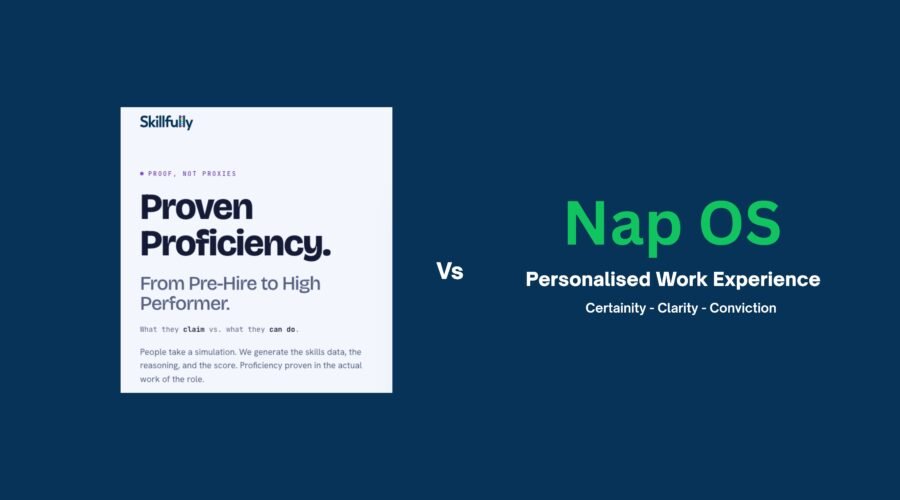
A degree says a candidate studied something. A resume says they claim to have done something. Neither answers the one question every hiring manager actually cares about: can this person do the job? Two platforms — Nap OS and Skillfully — have emerged to solve pieces of that puzzle, but they approach it from almost opposite directions. Understanding those differences isn’t just an academic exercise. It reveals two genuinely valuable products serving two genuinely different audiences, each with a compelling and distinct value proposition.
Skillfully: Proof Through Simulation
Skillfully’s pitch to the market is refreshingly direct: stop trusting resumes, and start trusting evidence. Instead of asking a candidate to describe their skills in a cover letter or perform well in a traditional interview, Skillfully puts them inside an AI-scored simulation of real work tasks. The candidate performs, the system scores, and the employer receives a clean, comparable output — something like a 4.5 out of 5 with a “strongly recommended” label attached.
This is an elegant solution to a very real enterprise problem. Large employers, especially those hiring at scale for graduate programs or high-volume roles, need a fast, standardized way to filter thousands of applicants down to a manageable shortlist. Traditional aptitude tests and structured interviews are expensive, slow, and often inconsistent between interviewers. Skillfully compresses that process into a scalable, data-driven assessment layer. Its primary buyer is the enterprise itself — HR and learning-and-development teams who need confidence before they invest further time in a candidate. Its core value is measurement: it takes existing skill, however that skill was built, and makes it visible and comparable.
For an employer evaluating hundreds of applicants for a single graduate scheme, that is an enormously attractive proposition. It doesn’t matter how the candidate got good at the task — what matters is that Skillfully can prove, quickly and at scale, that they are good at it.
Nap OS: Proof Through Experience
Nap OS starts from a different premise entirely. Rather than measuring skills a candidate already has, it focuses on the much harder problem many young people face before they even get the chance to be measured: they don’t yet have real experience to point to. A graduate with a strong degree but no internship, no portfolio, and no professional reference is often invisible to employers, regardless of how capable they might actually be.
Nap OS’s answer is to build that experience directly. Through real internships, live projects, structured project management, and genuine career acceleration support, candidates leave with something concrete: a verified internship, a shipped product, a GitHub repository, a portfolio, a reference from an actual project manager, and work history they can put on LinkedIn with total confidence, because it actually happened. The primary buyer today is the individual — the candidate themselves — with universities and employers as a natural next stage of growth. The outcome isn’t a score. It’s a body of work.
This is a fundamentally generative approach rather than an evaluative one. Where Skillfully asks “what can you already prove?”, Nap OS asks “what can we help you build?” That distinction matters enormously for the audience Nap OS actually serves: early-career candidates, career changers, and anyone who has the ability but lacks the track record to demonstrate it. For that person, a simulation score is of limited use if they’ve never had the chance to develop the underlying skill in a real-world setting to begin with. Nap OS meets them earlier in the journey, at the point where experience itself is the missing ingredient.
Why Both Are Right for Their Audience
It would be easy to frame this as a competitive matchup, but the more accurate — and more interesting — framing is that these are two products built for two different moments in a person’s career, serving two different buyers with two different budgets and motivations.
Picture a new graduate with no professional experience. If they encounter Skillfully, the story goes like this: the employer asks them to complete a simulation, and if they perform well, they walk away with a strong, quantified signal of aptitude. That is genuinely useful, particularly for roles where a structured task can approximate real job performance, and particularly for employers who need to process large applicant volumes fairly and efficiently.
If that same graduate encounters Nap OS instead, the story is different. They don’t yet have anything to simulate their way into proving, so instead they spend months building it: a real internship, a completed project, a manager who can vouch for their work, a portfolio that shows rather than tells. By the end, they’re not walking away with a score — they’re walking away with a career.
Both outcomes are valuable. Both solve real pain points. And crucially, they solve them for different people at different moments, which is precisely why treating this as a head-to-head rivalry misses the point.
The One Point of Overlap
There is a narrow area where the two products do converge, and it’s worth naming honestly rather than glossing over. Both are ultimately trying to answer the same underlying employer question: how do we know this candidate can actually perform in the role? Skillfully answers that question with a simulation. Nap OS answers it with completed, verifiable work. Reasonable people can disagree about which form of evidence is stronger, and the honest answer is probably “it depends on the role.” For jobs where a bounded, well-defined task closely mirrors day-to-day work, a simulation can be a fast and fair proxy. For roles where judgment, collaboration, and sustained execution matter more, actual completed work and a real reference likely carry more weight. Neither approach makes the other redundant — they simply carry different strengths depending on context.
A Complementary Future
What makes this comparison genuinely exciting, rather than simply a market-mapping exercise, is the possibility that these two approaches could eventually reinforce one another. Consider a candidate who arrives at an employer not with a bare resume and degree, but with eight verified projects, three months of completed internship work, direct feedback from a project manager, a live portfolio, and on top of all that, a Skillfully proficiency score layered in as an additional data point.
That combination would be difficult for any employer to ignore. The experience-creation layer and the skills-verification layer aren’t fighting for the same territory; they’re addressing adjacent stages of the same talent lifecycle. One builds the substance, the other helps validate it at scale. Together, they could offer something neither delivers alone: a candidate profile that is both rich in real, lived proof and efficiently quantifiable for high-volume hiring decisions.
The Core Difference, in a Sentence
If there’s one distinction worth remembering above all others, it’s this: Skillfully measures, Nap OS creates. Skillfully’s message to a candidate is essentially “show us what you can do,” which is a fair and useful test for someone who already has something to show. Nap OS’s message is “we’ll help you become someone who can do it,” which speaks directly to the far larger population of people who haven’t yet had the chance to build that evidence in the first place.
Conclusion
Neither platform needs to diminish the other to succeed. Skillfully has built a genuinely strong offering for enterprises that need fast, standardized, scalable evidence of skill among large applicant pools — a real and valuable service, particularly for high-volume hiring. Nap OS has built an equally strong offering for individuals who need something more foundational: real experience, real references, and a real track record, especially early in their careers when that foundation simply doesn’t exist yet. Rather than being locked in direct competition, they occupy adjacent layers of the same hiring ecosystem, and the strongest future for candidates and employers alike may well involve both working in tandem rather than in opposition.