6 min read
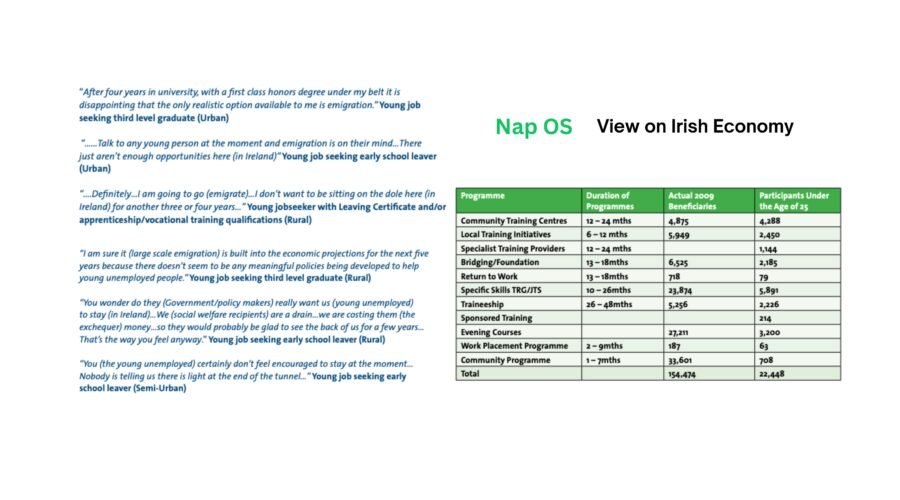
Ireland has confronted mass youth unemployment before, and the record of that confrontation offers a useful measuring stick for anyone building a solution today. In March 2011, the National Youth Council of Ireland (NYCI) published a position paper titled “Creating a Future for Young Jobseekers,” written by Marie-Claire McAleer and James Doorley. It remains one of the most detailed diagnostic accounts of how Ireland’s education, training and welfare systems failed young jobseekers during the post-2008 recession, a period when youth unemployment roughly tripled and Ireland recorded the second-highest youth unemployment rate in Western Europe. Reading that paper today alongside a newer Irish venture, Nap OS from Napblog Limited, is a striking exercise: the structural gaps NYCI catalogued more than a decade ago map closely onto the problems Nap OS says it exists to solve.
The 2011 Diagnosis: Five Gaps in the System
NYCI structured its paper as a direct comparison of what the system was actually delivering against what young jobseekers needed, under the heading “Improving the System by Removing the Gaps.” Five weaknesses stood out.
In education and training, course capacity had doubled on paper between 2008 and 2010, but mostly through shorter courses rather than genuine expansion, while apprenticeships collapsed and new charges appeared on Post Leaving Certificate courses. Training was disconnected from real labour market demand and from the individual circumstances of the learner.
In employment services, jobseekers described an inconsistent system with no single point of contact, unclear entitlements, and no real one-stop shop linking welfare, guidance and training referrals. Caseloads per employment officer were roughly double the international norm.
In internships and entrepreneurship, Ireland had comparatively few structured placements, no charter protecting an intern’s welfare entitlements, and enterprise supports that were built for scaled businesses rather than young, first-time founders.
In emigration support, the only formal guidance service, EURES, covered EU destinations but not the non-EU countries, such as Australia, Canada and the United States, that most jobseekers actually intended to move to.
And at the policy level, government’s response was reactive rather than strategic: benefit cuts for under-25s, discontinued schemes, and no dedicated cross-departmental youth employment strategy or accountable body to own the problem.
Why the Diagnosis Still Resonates
Ireland’s headline employment numbers have moved a great deal since 2011, and any claim about today’s exact unemployment rate deserves its own up-to-date data rather than assumptions carried over from a 2011 report. What has proven more durable, however, is the underlying architecture NYCI criticised: hiring built around credentials and CVs rather than demonstrated capability, career guidance that is generic rather than personalised, and a gap between what education certifies and what employers actually need to see before they will hire someone with no work history.
Those structural issues, rather than any single headline statistic, are the terrain a new generation of employability platforms has chosen to build on, and Nap OS is a useful case study of what that looks like in practice.
Nap OS: An Operating System for Employability and Entrepreneurship
Nap OS, built by Napblog Limited, describes itself not as a single tool but as a multi-sided operating system for developing, verifying and deploying human capability. Its own framing of the problem echoes NYCI’s almost point for point: education does not map to job readiness, hiring runs on CVs rather than capability, real work experience is inaccessible to early-stage talent, and entrepreneurship support remains unstructured. Where NYCI catalogued these as policy failures in the Irish welfare and training system, Nap OS treats them as a product opportunity.
The platform is built around three connected systems. Workforce is the supply side, using AI-driven career profiling, skills-gap analysis, personalised learning paths and simulated work experience to turn a learner or jobseeker into what the platform calls a verified capability profile, rather than just a CV. Recruit is the demand side, giving employers a way to search and hire on the basis of demonstrated skills and verified portfolios instead of filtering CVs by keyword. Incubate is the creation side, offering AI-assisted startup coaching, idea validation, business model building and mentor matching to move people from employment into founding their own ventures.
The logic is explicitly circular: individuals build skills through Workforce, get hired or start ventures through Recruit and Incubate, and re-enter the ecosystem with more experience and data than before. Inside the live product, users see this translated into a dashboard of practical tools: a portfolio builder, a work-experience tracker, certificates, and a built-in Gap Analysis module that scores a user’s career readiness, competency dimensions such as technical skill, industry exposure and consistency, and surfaces specific missing skills to close.
A Multi-Sided Platform
Nap OS positions itself across five stakeholder groups rather than one. Individuals get career development, employment access and entrepreneurship support. Employers get talent acquisition, skills intelligence and reduced hiring friction. Universities get graduate employability data, employer engagement and outcome tracking. Governments get workforce development infrastructure, youth employment programming and a mechanism for executing skills policy. Ecosystem partners, such as accelerators, training providers and recruitment firms, get a shared layer to plug into rather than building their own. This breadth matters because NYCI’s own recommendations were never aimed at jobseekers alone; they called for coordinated action across training providers, employers, guidance services and government departments at once.
Mapping Nap OS Against the NYCI Gaps
Set side by side, the correspondence between the two documents is close enough to be treated as a genuine gap-closing exercise rather than a coincidence. Where NYCI found training disconnected from labour market demand, Nap OS’s Workforce module ties personalised learning paths to a live skills-gap analysis rather than a fixed curriculum. Where NYCI found no coherent, person-centred employment service, Nap OS substitutes an always-on AI coach and an individual competency profile that follows the user rather than resetting with every new caseworker.
Where NYCI found internship provision thin and unprotected, Nap OS’s AI-generated work experience and portfolio verification aim to manufacture the equivalent of workplace exposure for people who cannot otherwise access it. Where NYCI found entrepreneurship support inaccessible to small, early-stage founders, Incubate is built specifically for first-time founders rather than scaled businesses, with tools such as an MVP roadmap generator and a funding-readiness system pitched at that stage. NYCI’s emigration and top-level government policy gaps sit outside what a single company can fix on its own, but Nap OS’s positioning toward universities and governments as customers, offering outcome tracking and skills-policy execution, at least speaks to the coordination failure NYCI identified in that fifth domain.
Early Signals
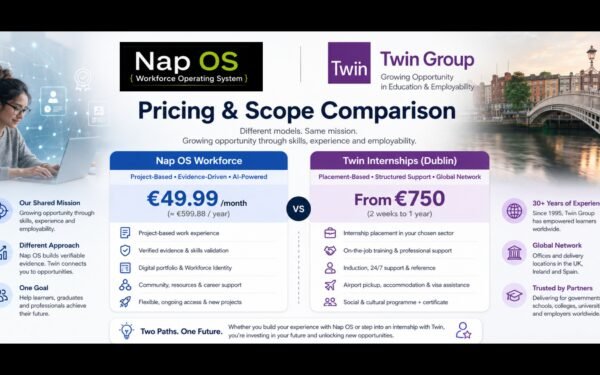
According to Nap OS’s own investor materials, the product has early but real traction: four paying Workforce subscribers at 49.99 euro a month, two technology companies in active B2B discussions, and a daily newsletter that had reached 182 editions and roughly 2,400 subscribers as of mid-2026, driven substantially by organic search interest in Irish education and QQI-related topics. These are early-stage numbers, and should be read as such, but they indicate a company still in validation rather than one that has already solved the problem at scale.
Conclusion
The value of setting Nap OS against the NYCI paper is not that one document proves the other right. It is that the 2011 diagnosis gives a concrete, evidence-based checklist against which any new intervention, including an AI-driven one, can be honestly measured. Ireland’s youth unemployment crisis was never just a shortage of jobs; NYCI’s own research pointed to fragmented training, under-resourced guidance services, thin internship and enterprise support, gaps in emigration advice, and the absence of a single accountable strategy.
Nap OS is, in effect, a private-sector attempt to rebuild several of those missing pieces, from education-to-employment mapping to verified experience to entrepreneurship pathways, around AI rather than around a government department. Whether it closes the gap at the scale NYCI called for in 2011 is a question only continued traction, and independent evaluation, can answer.
Sources
Marie-Claire McAleer and James Doorley, Creating a Future for Young Jobseekers: NYCI Position Paper on Youth Unemployment, National Youth Council of Ireland, March 2011.