7 min read
Ireland’s recruitment challenge is not simply about finding more applicants. It is about understanding what people can actually do—and giving them opportunities to develop the capabilities employers need.
Research reported in November 2024 brought that challenge into focus. A Robert Walters poll of 1,500 Irish professionals and employers found that 71% of employers admitted hiring underqualified employees because of budget limitations. The research defined “underqualified” as lacking the full set of qualifications, skills, or experience required for a role. Only 34% of employers hiring these employees were reportedly willing to invest in the training needed to close the gap.
Those findings describe a troubling mismatch between recruitment decisions and workforce development. However, they are a snapshot from 2024—not evidence, by themselves, of a measured “2024–2025 spike” or today’s hiring rate.
For Nap OS, the underlying problem remains a clear product challenge: how can candidates build relevant experience, and how can employers assess it more confidently?
The answer begins with proof.
Understanding the Problem Behind the 71%
“Underqualified” can describe several different situations.
A candidate might lack a formal credential but possess strong practical ability. Another might hold the expected degree yet have limited experience applying that knowledge. Someone else may have transferable skills that a conventional recruitment process fails to recognise.
These differences matter. Hiring someone who does not meet every advertised requirement is not automatically a poor decision. It can create an opportunity for a capable person to grow.
The difficulty arises when the employer does not understand the gap—or expects the employee to overcome it without adequate support.
The same Robert Walters research found that 46% of employers identified budget constraints as their primary challenge in hiring the right person. This places the findings in a resource-constrained context, rather than establishing that candidates alone are responsible for the mismatch.
Nap OS’s opportunity is to make those gaps more visible before employment begins.
The Cost Does Not End at Recruitment
A lower recruitment budget can look like an immediate saving. But the relevant question is what happens after the new employee starts.
In the reported poll, 80% of employers said they had noticed increased employee stress associated with the additional workload created by hiring underqualified candidates. That is a reported perception, not a controlled measurement of causation, but it highlights an important operational concern.
Imagine a hypothetical analyst hired without enough practical spreadsheet experience. A colleague may need to correct formulas, explain reporting conventions, and review each output.
That support can be valuable when planned. It becomes a problem when it is invisible, unbudgeted, and added to an already full workload.
The objective should not be to eliminate learning from employment. It should be to distinguish between readiness, development needs, and the support a team can realistically provide.
Where Nap OS Fits
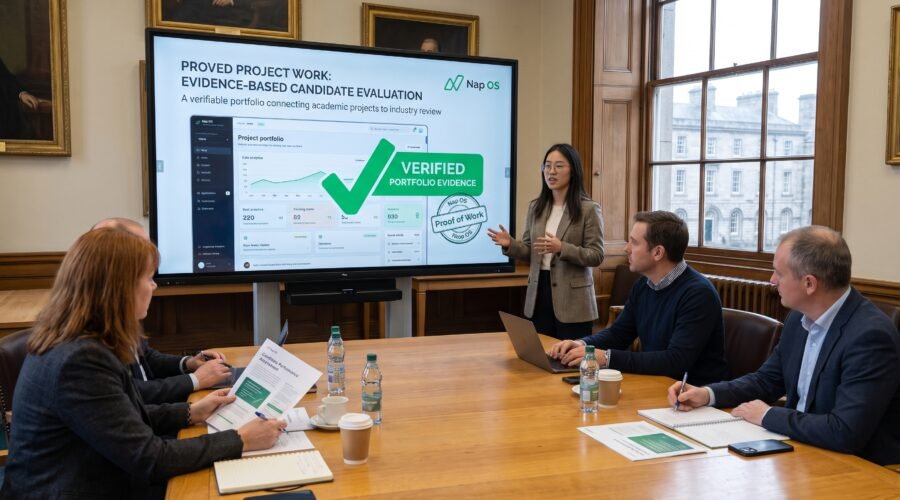
Nap OS describes its product as a platform for building verifiable experience through structured projects, documented contributions, and professional portfolios. Its published materials position project evidence as an alternative to relying primarily on CV claims.
That approach addresses two connected problems.
First, candidates need opportunities to practise relevant work before they can confidently claim competence.
Second, employers need useful evidence for assessing those claims.
Nap OS brings these needs into the same product direction: complete a defined task, produce an output, receive assessment or feedback, and preserve a record that explains the contribution.
This is not a complete solution to Ireland’s skills shortages, recruitment budgets, or training constraints. It is a way to improve the information and experience available at a critical point between education and employment.
From “I Have This Skill” to “Here Is What I Did”
A CV often compresses ability into a few words: analytical thinking, communication, project management, or digital marketing.
Those phrases provide a starting point, but they leave important questions unanswered.
What problem did the person tackle? What decisions did they make? What did they produce? How much support did they need?
Nap OS’s published workflow model connects tasks with business objectives, progress status, and linked deliverables. Its documentation also describes structured evidence records containing responsibilities, outputs, demonstrated skills, feedback, and verification.
The product value lies in those connections.
A research report becomes more informative when the reader can see the brief, the participant’s responsibilities, and the reasoning behind the recommendations.
A presentation becomes more useful when it is accompanied by an explanation of the audience, the objective, and the changes made after review.
How a Project-Based Journey Can Work
Nap OS’s methodology describes career-matched project briefs, assessed deliverables, portfolio preparation, and completion records with verification identifiers.
A practical journey can therefore be understood through five stages:
- Identify a target role or capability.
- Complete a relevant, clearly scoped project.
- Produce an assessable deliverable.
- Respond to feedback and explain decisions.
- Present the work with its context and review record.
Consider a hypothetical graduate targeting a junior marketing role. Rather than listing “market research” on a CV, the graduate could complete a competitor analysis, explain the selection criteria, identify limitations, and present recommendations.
An employer would then have something specific to discuss.
The project would not prove readiness for every marketing responsibility. It would provide a more grounded starting point for evaluating selected capabilities.
Confidence Built Through Practice
For students, graduates, international applicants, and career changers, the difficulty is often not simply a lack of ambition. It is uncertainty about how to demonstrate readiness.
A candidate may understand a subject academically but struggle to describe how that knowledge translates into a workplace contribution.
Nap OS’s project-and-portfolio model is designed to help users make that translation through documented activity and evidence of what they delivered.
The intended confidence comes from being able to explain:
- What the task required.
- How the work was approached.
- Which decisions were difficult.
- What feedback changed.
- What could be improved next time.
Confidence should not mean pretending to know everything. A credible candidate can describe both their strengths and their limits.
That is a stronger foundation than memorising interview language unsupported by experience.
Better Evidence Can Support Better Hiring Questions
An employer reviewing a portfolio should not simply ask whether it looks impressive.
The more useful questions concern relevance and authorship.
Can the candidate explain the work? Which parts were completed independently? What tools were used? What help was received? Does the task resemble the requirements of the vacancy?
Nap OS’s portfolio materials describe support for project files, repository links, media, and contextual descriptions. These formats can give employers material to examine beyond a short CV summary.
However, a verification label needs a clear scope. Confirming project completion is different from assessing technical accuracy or independently testing competence.
For Nap OS to be useful, its records should make those distinctions understandable. The employer still needs to evaluate role fit, references where appropriate, and any formal requirements attached to the position.
Supporting Training, Not Replacing It
The 34% training figure is central to this discussion. The reported research suggests a gap between employers’ willingness to hire people missing requirements and their willingness to fund the development those people need.
Nap OS should not become an argument for shifting every training responsibility onto job seekers.
Project experience before hiring cannot teach an employee every internal system, customer expectation, security procedure, or team practice.
Instead, evidence from completed work could help an employer plan more specific development.
A candidate might demonstrate strong research ability while needing support with stakeholder presentations. Another might produce accurate analysis but require guidance on communicating uncertainty.
The constructive response is targeted onboarding.
The aim is not “no training required.” It is a clearer understanding of what someone can already do and what they need to learn next.
Evidence Must Be Honest About the Work
Nap OS’s public materials describe both simulated project experiences and work connected with live business tasks. Those categories should remain clearly distinguished in any portfolio record.
A simulation can demonstrate useful ability. It should not be presented as employment or client delivery if that did not happen.
Likewise, a team project should identify the individual’s contribution rather than implying sole ownership of the entire outcome.
A trustworthy record should explain the setting, scope, assistance received, assessment criteria, and reviewer’s role.
That clarity protects everyone involved. Candidates receive credit for their actual work. Employers understand what they are evaluating. Reviewers avoid making broader assurances than the evidence supports.
The value of proof-of-work infrastructure depends on the quality of these distinctions.
Measuring Whether the Product Helps
Nap OS’s product proposition is compelling, but its impact should be assessed rather than assumed.
There is a difference between publishing portfolios and improving hiring alignment.
Useful evaluation questions include:
- Do participants complete relevant projects?
- Can they explain their contributions more clearly afterwards?
- Do employers find the records understandable and useful?
- Can reviewers apply assessment criteria consistently?
- Are development needs identified earlier?
- Do users experience better recruitment outcomes?
Where employment or onboarding results are measured, they need context. A successful hire may reflect several factors, not the platform alone.
The 2024 employer survey establishes a reason to investigate better approaches. It does not establish that Nap OS has already reduced hiring mismatch or employee stress.
Demonstrating that contribution is the next standard the product should pursue.
Building a More Informed Route into Work
Ireland’s hiring challenge requires employers, educators, candidates, and product builders to share responsibility.
Employers need realistic role requirements and development plans. Candidates need accessible ways to practise and demonstrate capability. Education providers need credible connections between learning and application.
Nap OS is built to contribute at that intersection: structured projects, assessable outputs, and records that make work easier to examine.
The ambition is not to label more people “underqualified.” It is to replace vague assumptions with a clearer picture of readiness.
When candidates can show their contribution and employers can understand its limits, the conversation changes—from whether someone appears qualified to what they have demonstrated, what the role requires, and how the remaining gap can be closed.