8 min read
There is a conversation that happens hundreds of times a year in Dublin, and it always goes the same way.
A graduate applies for a role. The role wants experience. The graduate has a degree, often a good one, sometimes two, and no Irish work history. The application goes into a portal and nothing comes back. They apply again. And again. Somewhere around the fiftieth application a specific kind of doubt sets in: not “am I good enough” but “will anyone ever actually look”.
Over August and September I had one-to-one conversations with 119 graduates and job seekers about exactly this. I expected to hear that people felt unqualified. That is not what they said. Over and over, in different words, they said they never get to show what they can do.
“Many graduates have the skills and qualifications but don’t get enough chances to prove themselves.”
“You are ghosted, no updates on your application, and a rejection email without any proper reasoning.”
The most-raised theme was sharper still, and it was not about employers at all. It was about institutions: people felt the university they had paid and trusted had stopped short of employment. One person put it this way: “I feel this should be more of the University’s responsibility — we all trusted the University even before coming to Dublin.”
Nap OS exists because of that gap. And from today, the fastest way to reach it is WhatsApp.
Why WhatsApp
Because that is where people already are.
A careers fair gives you ninety seconds. A website gives you a form. Email gives you a reply in three days, if it does not land in promotions. WhatsApp gives you a conversation that can pause on Tuesday and resume on Thursday without either side losing the thread — on the app already open on the phone in your hand.
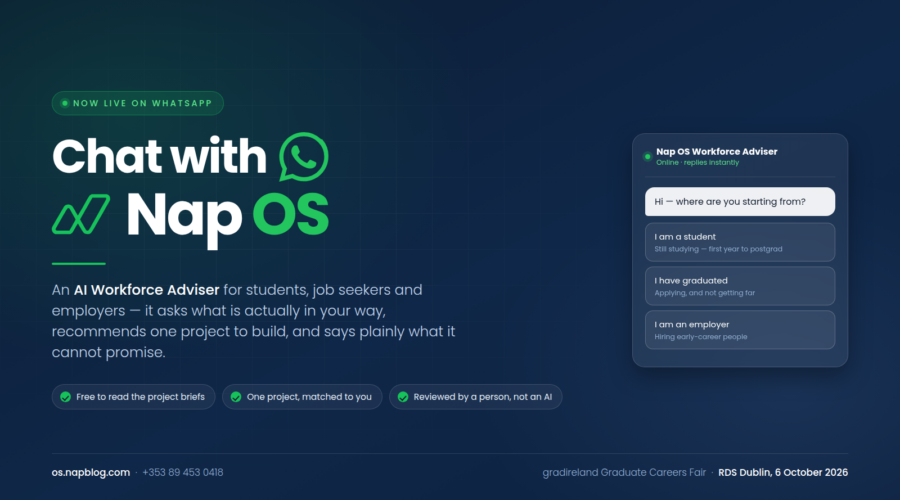
Scan the QR code on our stand, or tap the button on napblog.com, and you are talking to the Nap OS AI Workforce Adviser. No account, no download, no form. It answers immediately, at eleven at night if that is when you are job-hunting, which for a lot of people it is.
What actually happens when you message it
It takes four things, one question at a time, and it tells you why it is asking each one: your full name, your email, your college or employer, and your course or field. That takes about a minute and it means a real person — me — can follow up properly rather than losing you in a chat thread.
Then it does the useful part. It asks what is actually in the way.
That is a genuine question, not a funnel. The answers fall into recognisable shapes: I apply and hear nothing back. Every role wants experience I have not been given. I do not know what to build. My experience is from another country and nobody reads it. I am changing field. I have done real work but I cannot show it credibly. Which one you are in changes the advice completely, and most careers content never bothers to ask.
Then it recommends one project brief. Not a catalogue — one, matched to the blocker you described and the area you want to work in. It tells you what the project is, roughly how long it takes, which skills it demonstrates, what you hand over, and how the work gets verified.
That is the whole first conversation. Four questions, one honest diagnosis, one concrete thing to build.
What a project brief actually is — and the part most people get wrong
Here is the thing I want to be completely direct about, because it is the question that comes up most and it deserves a straight answer rather than marketing.
The project briefs are simulated. They are practice exercises, like a university case study.
They are not a client’s job handed to an unpaid person. No business gets free labour out of a Nap OS project. Nap OS does not sell, licence or otherwise monetise anything a member produces, and no third party receives your output as a deliverable.
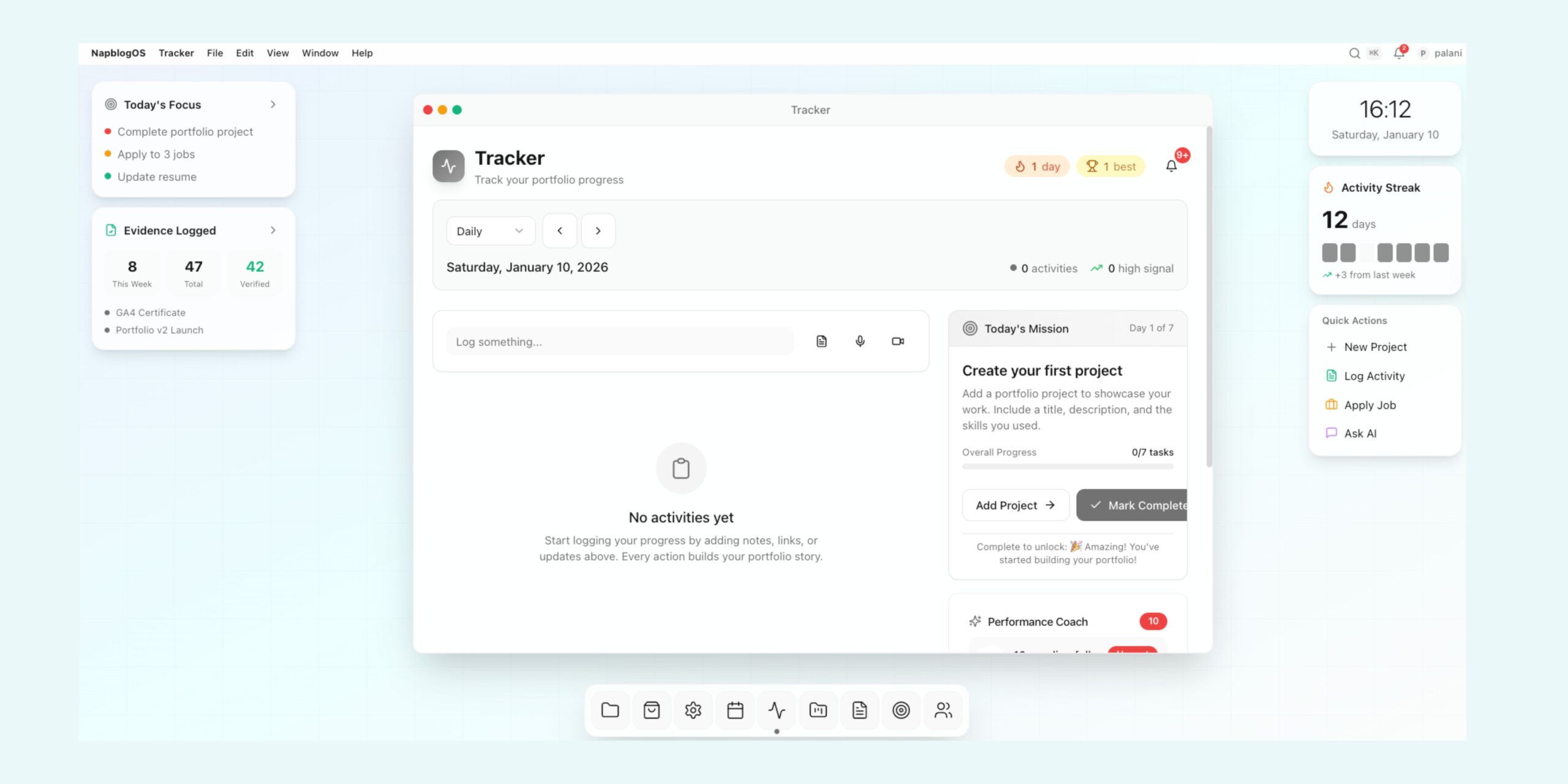
So what is the work for? It becomes yours. The finished project is your portfolio piece, and the structured record of it — what you did, the hours, the skills demonstrated, the reviewer’s assessment against published criteria — becomes evidence attached to your Nap OS profile. That evidence is what employers search in Nap OS Recruit when they are hiring.
That is why “unpaid” is the wrong frame. Nobody is paid for a case study at university either. The difference is that this one is structured, reviewed by a person, and kept in a form somebody else can check.
It also means the entry on your LinkedIn has to be accurate, and we are strict about that. A Nap OS entry reads as a self-directed project programme, with two sentences that are never dropped: “I choose the projects and the hours I work”, and “It is a learning programme rather than a job.” Members sometimes ask whether they can write “Intern at Napblog” instead, because it looks stronger. The answer is no, and the reason is self-interested as much as ethical: any employer who checks will be told by us that it was a learning programme, and an entry that contradicts its own verification does you more harm than no entry at all.
What it costs
Both halves plainly, because a person told something is free who then meets a payment page has been misled.
Creating a Nap OS account is free. You can explore the platform and read the project briefs without paying anything. Nobody is asked to pay to look.
Nap OS Workforce is €49.99 a month. It buys two things the free account does not include: a project manager working with you one to one, and work experience certification — the verified record an employer can check. It is a rolling subscription you can cancel, and because it is an online purchase, Irish and EU consumer law gives you a 14-day right to cancel.
That subscription is how Nap OS earns its revenue. There is nothing embarrassing about a company charging for its work, and I would rather say so than be coy about it.
For employers
The pitch to employers is simpler: we give you evidence instead of claims.
A CV is a claim. A finished, reviewed project is evidence. If you hire early-career people, the hardest part is not finding applicants — it is working out which of two hundred similar-looking graduates can actually do the thing. Nap OS Recruit lets you search on demonstrated work: the brief completed, the skills it required, the reviewer’s assessment, the hours.
We will also tell you the truth about what you are looking at. Ask whether a member was employed by Napblog and we will say no — it was a self-directed learning programme with one-to-one review. Every member project record is verifiable with us directly, by phone or email.
If you have a live vacancy or project, that is a conversation with me rather than with the adviser, and the agent will hand you straight over.
What the adviser will not do
This is the section I am proudest of, and it is unusual enough to publish openly. The adviser is under standing instruction to refuse several things, even when refusing is less helpful in the moment:
- It will not promise you a job. It will not say or imply that completing a project leads to, guarantees or improves your odds of a job, an interview or a shortlisting. Ask it directly and it will tell you it cannot tell you that — and that you should not trust any service that does.
- It will not answer visa or immigration questions. Not general information, not even if you volunteer your own status. It will point you to Immigration Service Delivery or a solicitor. Getting that wrong could cost someone their status, and an AI adviser has no business near it.
- It will never claim an AI decides anything about you. No Nap OS AI screens, scores or ranks a person. A human decides, always.
- It will not name other members. Ask for proof and it will name the companies people have gone to, and offer to put you in touch — but it will not hand a stranger another member’s name in a chat.
- It will not invent a project, a statistic or a partner. If something is not in its documents, it says it does not know and passes you to a person.
An adviser that will not say no is not an adviser. It is a brochure with a text box.
What we can honestly say about outcomes
Nap OS keeps a roster of every person who has come through, with their role, how long they were with us, and where they are now. These are our own records, not an audited study, and I would rather give you the real, smaller numbers than round ones I cannot stand behind.
Forty-nine people have come through Nap OS to date. Twenty-three are now employed by an outside employer, across twenty-one companies — including Amazon, JPMorgan Chase, ServiceNow, ESB Networks, Bosch Rexroth, Accenture and CPM Ireland. Five are self-employed or have founded something. Seventeen did or are doing an internship, ten of them still students. Seven work at Napblog itself, and we do not count our own payroll as a placement. Forty of the forty-nine are in Ireland.
You will notice there is no percentage there, and that is deliberate. We do not publish a success rate, because the roster counts people who came through, not people who signed up, and those are very different numbers. Anyone quoting you a job success rate — us included — is telling you something they cannot prove.
Two things a project does not fix, and it would be dishonest to suggest otherwise: a thin job market, and being ghosted by employers. What it changes is the third thing — having something concrete to be assessed on, and something to say about impact rather than duties.
Start a conversation
Message the adviser on WhatsApp at +353 89 453 0418, or scan the code on the Nap OS stand at the gradireland Graduate Careers Fair, RDS Dublin, on Tuesday 6 October. Free entry, and you can ask for me by name.
Create a free account at os.napblog.com and read the briefs before you decide anything.
Universities teach. Nap OS proves. Employers hire.
Pugazheanthi Palani is Founder and CEO of Napblog Limited, Dublin. Reach him at palani@napblog.com or +353 89 453 0418.