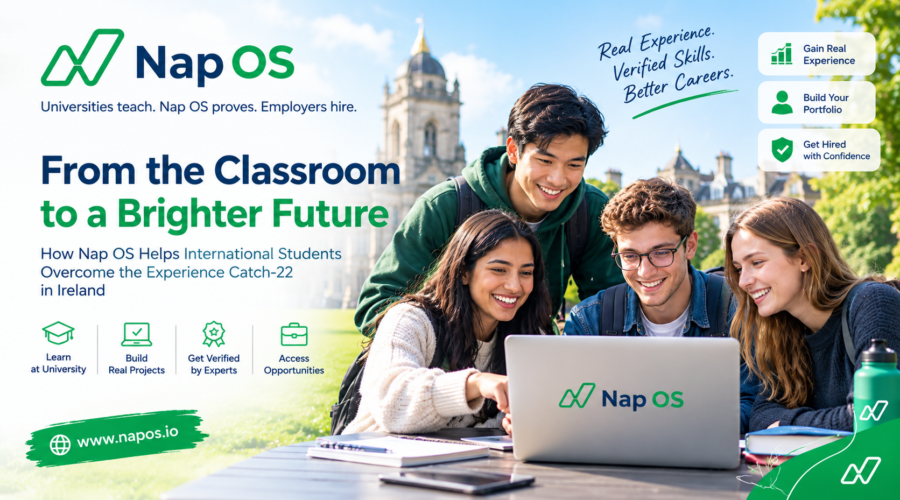
8 min read
Nap OS Product Perspective
For many international students, studying in Ireland is only the first step.
The bigger challenge begins when education has to become employment.
A student can arrive with a strong academic background, relevant qualifications and years of experience from another country, yet still face a difficult question from an employer:
“Do you have experience working in Ireland?”
That question can create a frustrating cycle.
You need experience to become competitive.
You need an opportunity to gain experience.
But employers may prefer candidates who already understand the local workplace.
This is the experience Catch-22.
For Nap OS, this is not simply a recruitment problem. It is a workforce-readiness and evidence problem.
The question we are trying to solve is:
How can an international student build credible, demonstrable professional experience before they need to compete for a full-time job?
The International Student Experience Gap
International students in Ireland can face several barriers when transitioning from university into employment.
The first is local experience.
A student may have completed projects, internships or employment in another country, but an Irish employer may still want evidence that the candidate can operate within the Irish professional environment.
The second is work eligibility and availability.
Students on immigration permissions such as Stamp 2 are subject to restrictions on employment hours during certain periods. This can make traditional employment more difficult to access, particularly when employers are looking for candidates with greater availability.
The third is CV and communication expectations.
A technically strong candidate can still struggle if their CV is not appropriately structured, their achievements are not clearly demonstrated, or they lack familiarity with the way Irish employers recruit and communicate.
And finally, there is competition.
International students are competing alongside Irish and EU candidates for internships, graduate positions and entry-level roles.
None of these barriers necessarily means the student lacks capability.
The problem is that capability is often difficult for an employer to see.
That distinction is central to Nap OS.
The Problem Is Not Always “No Skills”
Imagine two graduates applying for the same role.
Graduate A writes:
“Strong communication skills, teamwork and leadership experience.”
Graduate B says:
“I worked with a four-person team on a live communications project, coordinated weekly tasks, produced the final content and received feedback from an external reviewer.”
The second candidate has not necessarily got better skills.
But the second candidate has provided evidence.
That is the difference between claiming capability and demonstrating it.
This is where Nap OS sees an opportunity.
Instead of waiting for a student to obtain a traditional job before they can demonstrate workplace capability, Nap OS enables them to participate in structured practical projects and turn that experience into an evidence-based professional portfolio.
The journey becomes:
Learn → Build → Work → Receive Feedback → Verify → Showcase → Connect → Employment
1. Start Building Experience Before Graduation
One of the biggest mistakes students can make is waiting until their final semester to start thinking about experience.
By then, recruitment cycles may already be underway.
Instead, international students can begin building evidence during their university journey.
That could include:
- Practical projects
- University-industry projects
- Internships
- Volunteering
- Society leadership
- Hackathons
- Research projects
- Entrepreneurship projects
- Freelance work
- Community initiatives
- Portfolio development
The important point is that experience does not have to begin with a permanent job.
A student can start by solving a real problem.
They can contribute to a team.
They can produce an output.
They can receive feedback.
They can improve.
They can document what happened.
That is already the beginning of professional experience.
2. Turn Projects Into Evidence
A major weakness of traditional education-to-employment pathways is what happens to practical work after the project finishes.
A student submits an assignment.
The lecturer grades it.
The semester ends.
The work disappears.
Nap OS sees an opportunity to change that lifecycle.
A meaningful project can become a structured professional record.
Instead of simply saying:
“Completed a university marketing project.”
a student could demonstrate:
Problem → Role → Actions → Deliverables → Feedback → Outcome → Skills Demonstrated
This gives employers considerably more context.
For example, a student studying communications could show:
- The original project brief
- Their individual responsibilities
- Content they produced
- Campaign decisions they made
- Team collaboration
- Feedback received
- Final outcome
- Reflection on what they learned
The result is not simply another CV bullet point.
It is career evidence.
3. Add Verification to the Experience
Nap OS goes one step further.
Experience becomes more valuable when another person can verify it.
This could involve an employer, mentor, project supervisor, university representative or other appropriate reviewer confirming the work and contribution.
That creates three layers:
Claim
“I have project-management skills.”
Evidence
“Here is the project I managed.”
Verification
“Here is an independent person who reviewed and confirmed my contribution.”
This is the foundation of the Nap OS product philosophy.
The goal is not to replace the CV.
The goal is to build the evidence underneath it.
4. Build Local Experience Without Breaking the Rules
For international students, the solution cannot simply be “get any full-time job.”
Immigration conditions matter.
Students must understand and comply with the employment conditions attached to their immigration permission, and they should use official Irish immigration guidance for current rules.
But professional development does not have to depend entirely on conventional employment.
Students can build capability through appropriate projects, university activities, volunteering and other permitted forms of practical experience.
This creates an important distinction:
Employment is one form of experience.
It is not the only form of experience.
Nap OS is interested in the wider experience layer.
If a student contributes meaningfully to a project, that contribution can potentially become part of their professional portfolio.
If they receive feedback, that feedback can become evidence.
If they solve a problem, the problem-solving process can be documented.
If their work is independently reviewed, that can increase credibility.
5. Use University as the Starting Point
Nap OS does not believe the university should be separated from employment preparation.
Quite the opposite.
University is one of the best places to start.
Students already have access to:
- Lecturers
- Researchers
- Careers teams
- Student societies
- Classmates
- Alumni
- Industry events
- University projects
- Academic expertise
The opportunity is to connect academic learning with practical application.
This leads to a simple model:
Universities teach.
Students acquire knowledge, theory and academic capability.
Nap OS proves.
Students apply knowledge through practical projects and build structured evidence.
Employers hire.
Employers can assess candidates with more information about what they have actually done.
This is the meaning behind the Nap OS positioning:
Universities teach. Nap OS proves. Employers hire.
6. Prepare for the Transition to Stamp 1G and Beyond
For eligible international graduates, the Third Level Graduate Programme can provide an important post-study transition period under Stamp 1G.
But obtaining additional time to work does not automatically solve the experience problem.
The student still needs to compete.
The stronger strategy is therefore to use university time to prepare for the employment period before graduation arrives.
That means developing:
A professional identity.
A portfolio.
References.
Evidence of practical work.
Industry relationships.
Interview stories.
Knowledge of the Irish employment market.
A clear understanding of their target roles.
Then, when the student reaches the post-study employment stage, they are not beginning from zero.
They are beginning with evidence accumulated throughout their education.
Nap OS as the Missing Layer Between Education and Employment
This is the product opportunity Nap OS is pursuing.
Today, the journey often looks like:
Education → Graduation → CV → Applications → Interviews → Employment
We believe there should be another layer in the middle:
Education → Practical Experience → Evidence → Verification → Portfolio → Employer Discovery → Employment
That middle layer is where Nap OS operates.
The platform is designed around the idea that individuals should be able to continuously build and demonstrate workforce capability rather than relying entirely on qualifications and self-reported CV claims.
For international students, this can be particularly valuable.
They may have the qualification.
They may have the motivation.
They may have the technical skills.
What they may lack is locally understandable evidence.
Nap OS is designed to help close that gap.
The Catch-22 Can Become a Catch-Up Opportunity
The traditional Catch-22 says:
“You need experience to get a job, but you need a job to get experience.”
Nap OS challenges the second half of that assumption.
You do not necessarily have to wait for your first full-time job to start building meaningful evidence of capability.
You can start with a project.
Then another.
Then another.
You can receive feedback.
You can improve.
You can build a portfolio.
You can develop references.
You can demonstrate what you actually contributed.
Over time, the experience gap becomes smaller.
The student’s professional story becomes stronger.
And the employer has more information with which to make a decision.
From International Student to Verified Professional
The long-term opportunity is bigger than helping students create better CVs.
It is about creating a new way for emerging professionals to build trusted workforce identity.
Imagine an international student arriving in Ireland with academic potential but limited local professional experience.
Their journey through Nap OS could become:
Arrive → Learn → Join a Project → Build → Receive Feedback → Get Verified → Build Portfolio → Meet Employers → Secure Employment
That is a fundamentally different career journey from waiting until graduation and hoping a CV is enough.
It also creates value for the wider ecosystem.
Universities can see students applying their knowledge.
Students can accumulate evidence.
Employers can discover demonstrated capability.
Mentors can contribute feedback.
And individuals can build a professional record that grows with them.
Ireland Does Not Need Students to Become “More Employable” by Simply Adding More Qualifications
The deeper question is:
How do we help people convert qualifications into demonstrable workforce capability?
That is the problem Nap OS is focused on.
International students already make a significant contribution to Ireland’s education ecosystem.
Many arrive with previous professional, academic and cultural experience.
The challenge is converting that potential into something the local employment market can easily understand, evaluate and trust.
Nap OS believes the answer is not another CV-writing tool.
It is not simply another job board.
And it is not simply another recruitment platform.
It is an evidence layer between education and employment.
Don’t Wait for the Job to Start Building Your Career
For an international student in Ireland, the most powerful career strategy may be to start building evidence before the job application arrives.
Don’t wait until graduation to ask:
“What experience do I have?”
Ask much earlier:
“What can I build?”
“What can I contribute to?”
“Who can review my work?”
“What can I prove?”
Because the future of graduate recruitment should not depend entirely on who has already been given an opportunity.
It should increasingly depend on what a person can demonstrate.
That is the opportunity Nap OS is building toward.