6 min read
Every job seeker eventually runs into the same wall. Employers want experience before they will hire, yet no one will give a young person experience until someone else hires them first. This is the catch-22 of the modern labour market, and it has quietly become one of the most persistent inefficiencies in how talent moves from education into work. Universities were supposed to solve this problem. For over a century, a degree was meant to function as a trusted signal that a graduate was ready to contribute to a workplace. Increasingly, that signal has weakened, and a new kind of platform, Nap OS, is stepping in to close the gap in a way that traditional higher education structurally cannot.
The Problem Universities Were Never Built to Fix
The catch-22 exists because the systems that produce graduates and the systems that hire them were built independently, at different times, for different purposes. Universities were designed to transmit knowledge and confer credentials. Hiring systems evolved separately, built around CVs, applicant tracking software, and interviews that filter candidates long before anyone actually observes their work. The result is a mismatch: education optimises for passing exams and accumulating credit hours, while employment optimises for demonstrated capability. A university degree tells an employer that a candidate sat through a curriculum and met a minimum bar of assessment. It does not tell an employer whether that person can manage a real project, communicate with a real client, or produce work that survives contact with a real business.
This is not a new observation, but it has become more acute. Graduate outcomes are under growing pressure, employer integration with universities remains weak, and career guidance inside most institutions is generic rather than personalised. At the same time, employers face their own version of the same inefficiency. Recruitment is expensive, the signal-to-noise ratio in a stack of CVs is low, and screening candidates who all hold similar degrees but have no comparable proof of skill wastes enormous amounts of time. Governments sit on top of this, watching youth unemployment and skills mismatches persist even as billions are spent on workforce programs that are difficult to execute and slow to show results. Every stakeholder in the system, the individual, the employer, the university, and the government, is absorbing the cost of the same structural gap.
What Nap OS Does Differently
Nap OS was built around a simple but consequential insight: the fix for the experience paradox is not more education, it is a different kind of infrastructure entirely. Rather than adding another credential or another course, Nap OS operates as what its creators describe as an operating system for employability and entrepreneurship, a unified layer that gives individuals continuous, personalised access to skill development, real work experience, employment pathways, and entrepreneurial support, all in one place.
The distinction matters. A university delivers a single, static product at a single point in time: a degree, awarded after a fixed number of years, based on assessments that are simulated rather than real. Nap OS instead treats career development as a continuous, AI-personalised process, where the fundamental unit of progress is not a grade but a verified, experience-based profile. Instead of asking a student to prove they memorised material, it asks them to prove they can do the work, and it builds a structured, evolving record of that proof over time.
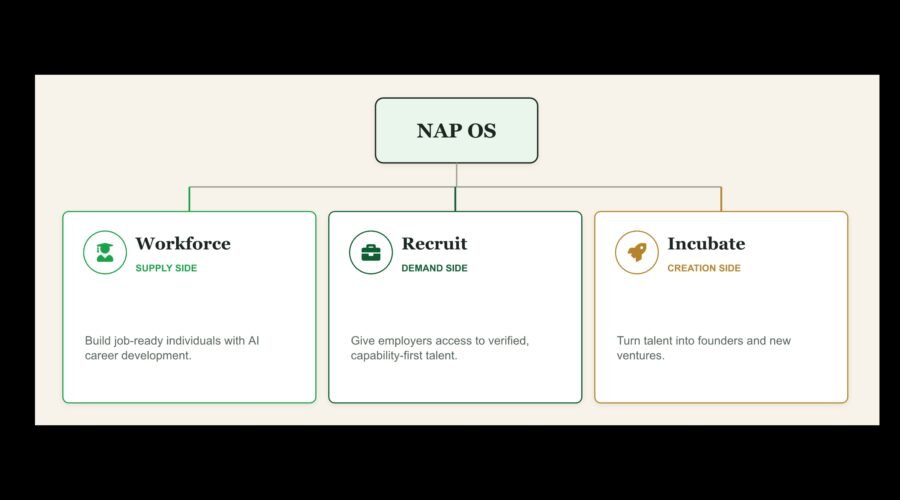
This shift, from static credentialing to continuous capability, is what allows Nap OS to move faster than any university’s employability pipeline. A university’s feedback loop between curriculum design and labour market need is famously slow. Course content can take years to update, and even employer partnerships tend to be limited, occasional guest lectures, sporadic internship pipelines, or career fairs, rather than being built into the core of the educational experience. Nap OS closes that loop by design, structuring its entire product around three integrated systems: one that develops job-ready individuals through AI-guided skill building, one that connects that verified talent directly to employers, and one that channels ambitious individuals into founding their own ventures rather than simply seeking employment elsewhere.
Turning Degree Holders Into Verified Capability Profiles
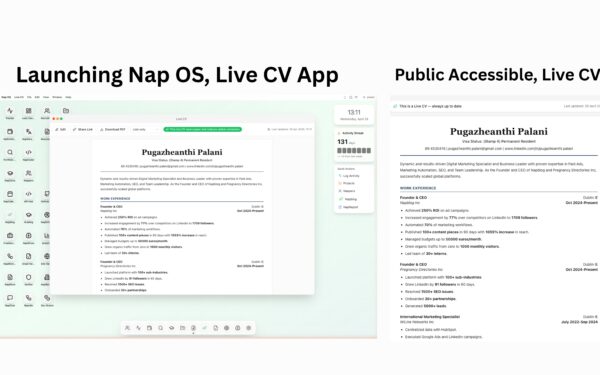
The most direct answer Nap OS offers to the catch-22 is its approach to work experience itself. Instead of requiring a person to already have a job before they can gain experience, the platform generates structured, AI-supported project work that produces a real, evaluable output, a portfolio, rather than a certificate. Features like AI career profiling, skills gap analysis, personalised learning paths, and an interview simulation engine exist specifically to compress the distance between “has no experience” and “can demonstrate real capability,” without requiring an employer to take a chance first. The explicit goal, in the platform’s own framing, is to transform “degree holders” into “verified capability profiles.”
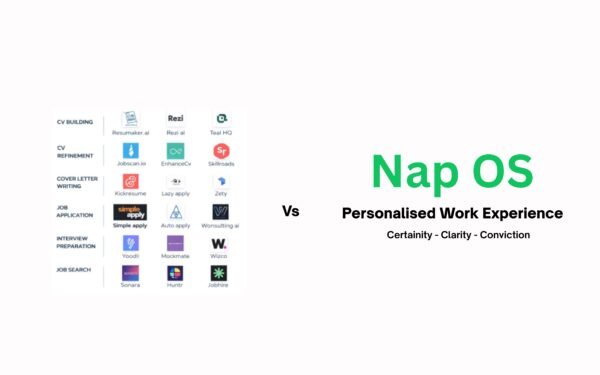
This is a meaningfully different value proposition than a university can offer, because a university’s incentive structure is built around enrolment and graduation, not around continuously proving employability. Nap OS’s incentive structure, by contrast, is built around outcomes: getting a person hired, or helping them build something of their own. On the employer side, this shows up as a shift from CV filtering toward capability-based hiring, using AI talent matching, skills-based search, and a candidate verification layer so that a company can evaluate what someone has actually built rather than guessing based on a transcript. For employers drowning in low-signal applications, this is not a minor convenience; it is a direct fix to the exact inefficiency that CV-based hiring created in the first place.
Entrepreneurship as the Third Path
Where Nap OS goes further than any university career office is in its third pillar: incubation. Rather than treating entrepreneurship as a separate, elective track reserved for a small number of ambitious students, Nap OS builds venture creation into the same system as employability development. Its incubation tools, an AI startup coach, an idea validation engine, a business model builder, an MVP roadmap generator, and a funding readiness system, exist so that the same person who is building a verified skills profile can just as easily pivot into founding a company as into taking a job. Universities tend to treat entrepreneurship support as unstructured and inconsistent, often bolted onto a business school rather than integrated into the core student experience. Nap OS treats it as a first-class outcome, on equal footing with employment.
This creates what the platform describes as a closed-loop ecosystem: individuals develop skills, they get hired or they build a venture, and either path feeds back into the system at a higher level, generating more skills, more outcomes, and more data that improves the next round for someone else. It is a compounding structure, and compounding structures are precisely what static, once-and-done university degrees are not built to produce.
Why Speed and Personalisation Are the Real Differentiators
None of this suggests that university education has no value. Universities remain important for research, for broad-based knowledge, and for aspects of intellectual formation that go beyond immediate job readiness. But when the specific problem is the experience paradox, the mismatch between what employers require and what unemployed or newly graduated individuals can prove, Nap OS is simply built for a different job than a university is. It focuses entirely on personalisation at the individual level, continuous rather than periodic assessment, and direct integration with employer demand, rather than treating employability as a side effect of a broader academic mission.
The evidence of demand is still early but real. The platform has already attracted paying users on its Workforce product, is in active discussions with technology companies interested in talent infrastructure, and has been building an audience through consistent content publishing focused on themes like verifiable work experience versus CV-padding and ATS gaming, and the shift from education to employment to entrepreneurship as a single continuous journey rather than three disconnected stages.
The catch-22 that has frustrated job seekers for generations was never really a talent problem. It was an infrastructure problem, a mismatch between how proof of capability is generated and how it is evaluated. Universities, built for a different era and a different mission, are not positioned to solve that mismatch quickly. A purpose-built operating system for employability and entrepreneurship, one that treats verified work, not credentials, as the core currency, is a structurally faster and more direct way to close the gap.
Mail to: palani@napblog.com to get started with building personalised work experience.