8 min read
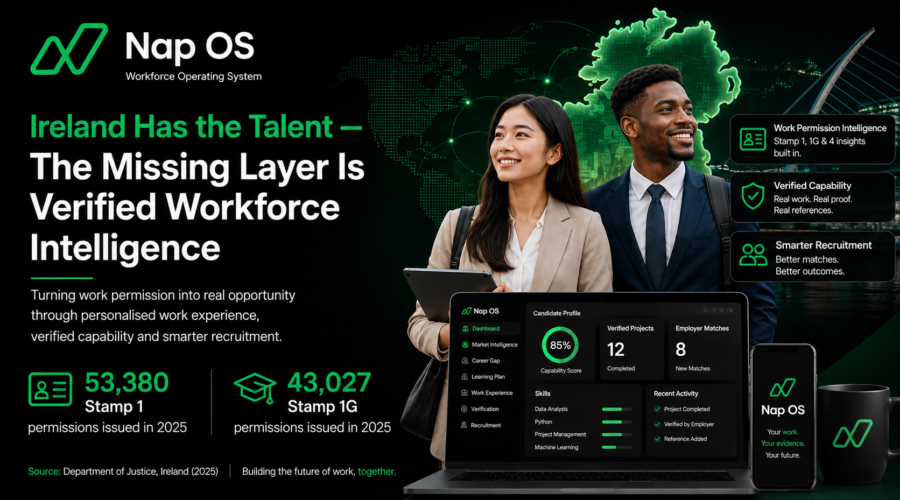
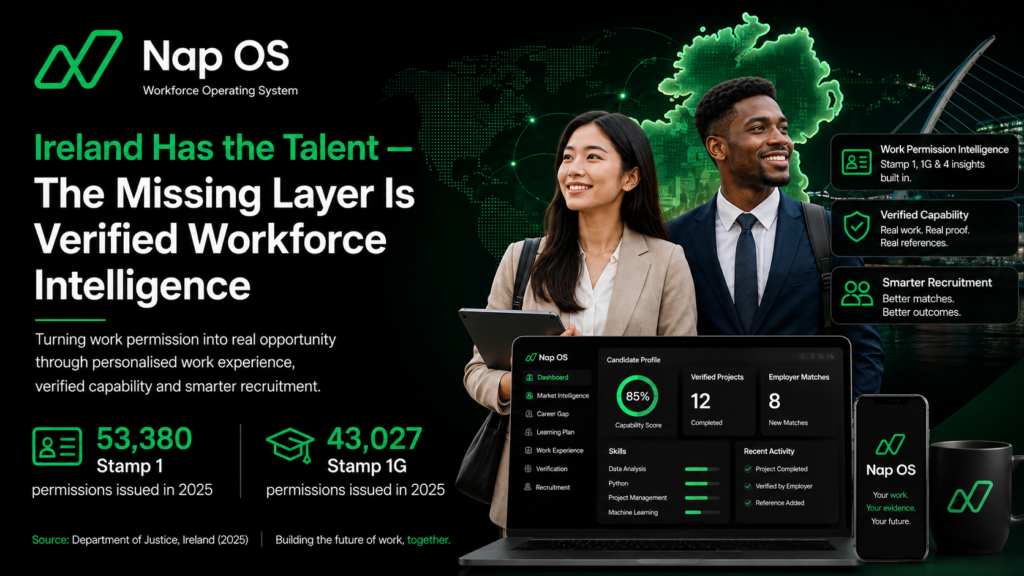
In 2025, Ireland issued 53,380 Stamp 1 permissions and 43,027 Stamp 1G permissions, according to official data provided by the Department of Justice in response to a parliamentary question. Together, that represents 96,407 permissions across two important immigration categories connected to work, employment and the transition into the Irish labour market.
These figures matter for more than immigration statistics.
They point towards a much bigger workforce question:
How does Ireland help people who are legally able to participate in the labour market become visible, relevant and trusted to employers?
For international students, graduates, skilled professionals and other non-EEA workers, having legal permission to work is only one part of the journey.
The next challenge is getting an employer to understand their capabilities, experience, availability and fit for a particular role.
That is where workforce technology can play an important role.
From immigration permission to employment opportunity
Ireland’s immigration permission system uses different stamps to define a person’s circumstances and working rights.
Stamp 1 generally indicates permission to work or operate a business subject to conditions. In many cases, the person must hold a valid employment permit, although some Stamp 1 permissions can include permission to work without an employment permit. The precise conditions attached to the individual’s permission therefore matter.
Stamp 1G is particularly relevant to international graduates.
Under the Third Level Graduate Programme, eligible graduates who have completed their studies in Ireland can receive Stamp 1G permission to look for employment. The Irish Immigration Service states that graduate Stamp 1G holders can work full-time in accordance with employment law, but cannot operate a business or be self-employed while holding that graduate permission.
University College Dublin similarly explains that graduates on Stamp 1G can work full-time for any employer without the employer needing to sponsor them, subject to the conditions of the permission. Level 8 graduates generally receive 12 months, while eligible Level 9 and above graduates can receive up to 24 months, subject to the programme requirements.
This creates an important window.
A graduate may have:
- an Irish qualification;
- legal permission to work;
- relevant technical or professional skills;
- strong academic performance;
- international experience;
- motivation to build a career in Ireland;
and still struggle to secure the right first opportunity.
The missing ingredient may not be permission.
It may be evidence.
The employment paradox
Imagine an international graduate completing a master’s degree in Ireland.
They have spent one or two years studying locally. They have learned the Irish business environment, developed technical skills and potentially completed academic projects.
Then they graduate.
They receive Stamp 1G.
Legally, they can enter the labour market and work full-time during their graduate permission.
But when they apply for a job, an employer may still ask:
“What professional experience do you have?”
The candidate may answer:
“I have a degree.”
The employer may respond:
“We need someone who can do the work.”
The candidate may have the capability, but the CV does not necessarily provide enough evidence.
This is the gap between eligibility to work and employability evidence.
It is also where traditional recruitment systems can struggle.
A CV is primarily a representation of what someone says they have done.
A verified workforce profile can become a representation of what someone has actually demonstrated.
That distinction is becoming increasingly important.
What if the recruitment process understood work permission as well as capability?
Imagine an employer publishes a vacancy for a software engineering role.
Instead of receiving a large collection of largely unstructured CVs, the employer’s recruitment system could analyse the vacancy and identify:
- required technical skills;
- preferred capabilities;
- seniority;
- project experience;
- location;
- availability;
- work-permission requirements;
- evidence of previous performance;
- employer references;
- verified project outcomes.
The system could then help employers understand which candidates are immediately relevant and which may require a different employment pathway.
This does not mean automatically rejecting candidates based on immigration status.
Quite the opposite.
Better workforce intelligence can help employers understand the talent pool more accurately.
A recruiter could distinguish between a candidate who already has unrestricted work rights, a graduate with Stamp 1G who can currently work full-time without an employment permit, and a candidate whose employment would require a particular permit pathway.
The legal position should always be verified through the appropriate documentation and official guidance. But technology can make the information easier to organise and incorporate into recruitment workflows.
This is where Nap OS comes in
Nap OS is being developed around a simple principle:
People should be able to demonstrate capability through evidence of work, not rely exclusively on claims contained in a CV.
Our Workforce OS approach connects market demand, candidate capability, personalised development, real work experience, verification and recruitment.
The Nap OS model can be understood through six connected engines.
1. Market Intelligence Engine
What does the market want?
Job descriptions and employer demand are analysed to identify the skills, capabilities, roles and project requirements companies actually need.
2. Career Gap Engine
What is this person missing?
A candidate’s existing profile and evidence can be compared with market demand.
Instead of simply telling someone that they are “not experienced enough,” the system can identify specific gaps.
3. Personalised Learning Engine
What should they develop next?
The identified gap can be converted into a learning pathway involving resources, mentoring, coaching and practical development.
4. Work Experience Engine
Can they actually do it?
This is where personalised work experience becomes important.
Rather than asking a candidate to wait until someone hires them before they can demonstrate professional capability, Nap OS can connect development with employer-relevant projects.
The candidate learns, executes and produces a deliverable.
5. Verification & Reference Engine
Can someone credible prove they did it?
An employer, mentor or other appropriate evaluator can assess the work and provide verification or a reference.
The result is evidence attached to an actual piece of work.
6. Recruitment Engine
Who needs this capability?
Verified evidence can then become part of the matching process between workforce members and employers.
This creates a fundamentally different recruitment conversation.
Instead of:
“Here is my CV. Please believe that I can do this.”
the candidate can increasingly say:
“Here is the work I have done. Here is what I demonstrated. Here is who verified it.”
Why this matters for international graduates
For someone on Stamp 1G, time is particularly important.
The Third Level Graduate Programme is designed to provide a period in which eligible graduates can seek graduate-level employment. UCD notes that graduates must take appropriate steps towards accessing suitable graduate employment when seeking renewal of the permission.
That means the transition from university to employment is not simply a long-term career problem.
It can be a time-sensitive problem.
Every month spent sending applications without developing relevant evidence is potentially valuable time lost.
Nap OS can approach that period differently.
A graduate could enter the workforce platform, understand what employers are currently looking for, identify their capability gaps, receive personalised development support and then undertake relevant projects that create demonstrable evidence.
The objective is not merely to help someone produce a better CV.
It is to help them become more employable and more verifiable.
And employers need better intelligence too
The opportunity is not only on the candidate side.
Employers increasingly need to understand complex talent pools.
A recruitment team may receive candidates from Ireland, the EU and countries across the world, each with different educational backgrounds, professional experiences and immigration circumstances.
The recruitment process therefore needs two kinds of intelligence:
Capability intelligence:
Can this person do the work?
Workforce eligibility intelligence:
Can this person legally perform this work under their current permission, and what conditions or employment-permit pathway apply?
These should not be confused.
Immigration permission does not prove capability.
A degree does not prove capability.
A CV does not prove capability.
Likewise, a verified project does not by itself determine someone’s immigration eligibility.
These are different layers of information.
The opportunity is to bring them together responsibly so employers can make better-informed decisions.
A better filter than “Do you need sponsorship?”
Many recruitment systems begin with a blunt question:
“Do you require visa sponsorship?”
That question can be useful, but it can also hide significant differences between candidates.
For example, an eligible Stamp 1G graduate may currently be able to work full-time without an employment permit, while another candidate may require an employer-supported employment permit pathway. Stamp 1 itself can also cover different circumstances depending on the specific permission and employment permit.
A more intelligent workforce system could therefore help employers understand the relevant situation rather than treating every international candidate as one category.
The system could potentially allow authorised recruitment teams to filter or segment candidates by factors such as:
- current work-permission category;
- permission expiry date;
- employment-permit requirements;
- location;
- availability;
- skills;
- verified project experience;
- education;
- employer references;
- role suitability.
The objective is not to create immigration-based exclusion.
The objective is to reduce uncertainty and help employers identify candidates who can genuinely be considered for a role.
Human judgement and formal right-to-work checks remain essential.
From Stamp 1G to long-term workforce participation
The deeper opportunity is the transition.
For an international graduate, Stamp 1G can be a bridge between education and employment.
The ideal journey is not:
Education → Stamp 1G → hundreds of applications → uncertainty.
It should increasingly become:
Education → work permission → verified experience → relevant employment → professional development → longer-term career.
Nap OS is designed to operate in that middle layer.
We want to help create the infrastructure that turns potential into evidence and evidence into opportunity.
Ireland’s opportunity
The 2025 numbers show that this is not a niche issue.
The 53,380 Stamp 1 permissions and 43,027 Stamp 1G permissions represent a substantial number of immigration permissions connected to Ireland’s workforce and economic ecosystem.
The important question is what happens after the permission is granted.
Can talented people find relevant work?
Can employers discover them?
Can employers confidently assess their capability?
Can universities help students transition from education into meaningful professional experience?
Can recruitment systems understand both capability and workforce eligibility?
And can Ireland retain more of the international talent educated and developed here?
These are workforce infrastructure questions.
The future of recruitment is evidence
At Nap OS, we believe the future of workforce technology will move beyond the CV.
The CV will remain useful.
Job boards will remain useful.
Recruitment agencies will remain useful.
Universities will remain essential.
But the next layer is verified, continuously updated workforce intelligence.
A candidate should not have to restart their professional story every time they apply for a job.
Their capabilities, projects, assessments, references, learning and work history should become part of a living workforce identity.
For international students and graduates, that identity can also incorporate relevant employment-permission information so employers can better understand the route from candidate to employee.
For employers, this can mean better recruitment analysis.
For universities, it can mean stronger employability outcomes.
For candidates, it can mean more opportunities to demonstrate what they can actually do.
And for Ireland, it can mean making better use of the talent already here.
Legal permission opens the door.
Verified capability helps someone walk through it.
Nap OS is building the workforce infrastructure between the two.