6 min read
A candidate can now use an AI tool to find roles, tailor a CV, draft cover letters, prepare application answers and apply to significantly more opportunities than they could manually.
That creates an obvious question for Nap OS:
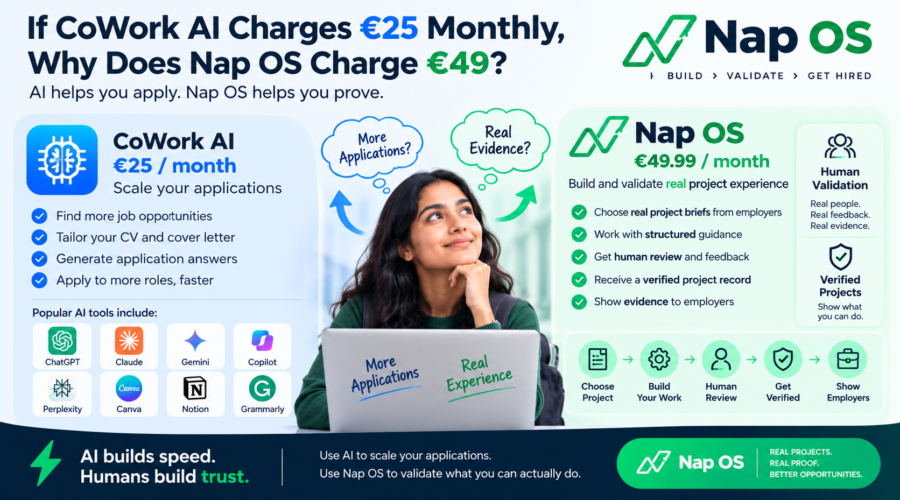
If an AI career tool can help me apply for jobs for around €25 per month, why should I pay €49.99 per month for Nap OS?
The answer is that the two products solve different problems.
AI helps candidates scale what they say. Nap OS helps candidates build and validate evidence of what they can do.
For international students, graduates and career changers facing the familiar “experience required” problem, that distinction matters.
AI can make job searching dramatically more efficient
Imagine a graduate applying manually.
They find a vacancy. They read the job description. They research the employer. They adjust their CV. They write a cover letter. They complete the application form.
Then they repeat the entire process.
AI can compress much of that work.
A candidate can use AI to analyse a job description, identify relevant keywords, improve the wording of their CV, draft a tailored cover letter and prepare for potential interview questions.
That is valuable.
If a candidate previously had the capacity to make five carefully prepared applications, AI might help them manage many more.
But there is a limit to what application optimisation can solve.
Suppose the employer asks:
“Can you show me a project where you actually did this?”
Better wording cannot create evidence that does not exist.
That is the gap Nap OS is designed to address.
Nap OS starts before the application
Nap OS is not intended to replace AI job-search tools.
Candidates should use AI.
Use it to research employers. Use it to understand unfamiliar concepts. Use it to improve writing. Use it to prepare applications. Use it to analyse data and accelerate project work where appropriate.
But Nap OS starts with a different question:
What can you build that demonstrates your ability?
A candidate chooses a project relevant to the career they want to pursue.
Instead of merely claiming:
“I have financial analysis skills.”
The candidate can complete a finance project.
Instead of writing:
“Experienced with Power BI.”
They can produce a Power BI deliverable.
Instead of adding:
“Strong market research skills.”
They can undertake research, document their methodology, analyse their findings and produce a report.
The candidate leaves with something that can be examined.
That changes the conversation from claims to evidence.
€25 AI versus €49.99 Nap OS
The easiest way to understand the difference is this:
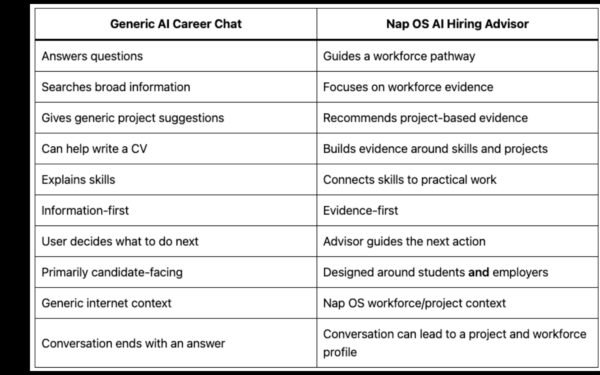
| AI career tools | Nap OS |
|---|---|
| Helps scale applications | Helps build project evidence |
| Assists with writing | Provides project briefs |
| Helps tailor CVs | Structures practical work |
| Generates suggestions | Candidate produces deliverables |
| AI-supported | Human-reviewed |
| Optimises presentation | Validates completed project work |
| Helps you say what you can do | Helps you show what you did |
This is why comparing the subscriptions purely by price misses the underlying difference.
You aren’t necessarily choosing between €25 and €49.99 versions of the same product.
They can form two different layers of the same job-search system.
AI = Scale
Nap OS = Evidence + Human Validation
Why does human validation matter?
Generative AI creates another challenge for employers.
It is becoming increasingly difficult to judge someone’s actual capability simply from polished written material.
A strong CV can be AI-assisted.
A strong cover letter can be AI-assisted.
A portfolio description can be AI-assisted.
Even a sophisticated-looking project can involve substantial AI assistance.
That doesn’t make AI use wrong. Modern professionals increasingly work with AI.
The more important question becomes:
What did the candidate actually do and understand?
That is where Nap OS can create value beyond AI generation.
A Nap OS project should not simply end when someone uploads a file.
The work can go through a human review process against defined criteria. The reviewer can examine the deliverable, ask questions, request clarification or revision and establish whether the candidate can explain the decisions behind the work.
The human is not there to certify that AI was never used.
The human is there to validate the candidate’s work and understanding.
That is a much more useful distinction.
Think of it as “AI builds speed. Humans build trust.”
Consider two candidates.
Candidate A sends 100 highly tailored applications using AI.
Candidate B also uses AI to make their applications more efficient, but has completed several relevant projects and can provide evidence of those projects.
Candidate B can potentially say:
“Here is the problem I worked on. Here is my approach. Here is what I produced. Here is what I learned. And here is the review record.”
Nap OS does not need to discourage Candidate A’s approach.
Ideally, Nap OS turns Candidate A into Candidate B.
Use AI to scale the job search.
Use Nap OS to strengthen what sits underneath the application.
The Nap OS €49.99 subscription therefore needs to deliver more than access
This distinction also creates a responsibility for Nap OS.
If Nap OS charged €49.99 simply for access to AI-generated project ideas, candidates could reasonably ask why they shouldn’t generate those projects themselves.
A large language model can create a project brief in seconds.
The defensible value of Nap OS has to exist after the brief is generated.
That means the service should provide a structured project process, clear deliverables, published assessment criteria, human review, feedback and a record of successfully completed work.
The candidate isn’t primarily paying for a PDF saying:
“Build a Power BI dashboard.”
They are paying for the system around the project.
Brief → Build → Submit → Human Review → Improve → Validate → Portfolio
That’s where €49.99 has a clearer value proposition.
Validation should not be confused with employment
This distinction is especially important for Nap OS.
Completing a Nap OS project does not automatically mean somebody was employed by Napblog Limited or another participating organisation.
Nap OS should be precise.
If it is a learning or project programme, call it that.
If the project is a practice brief, identify it as a practice project.
If an external business supplied a real project brief, identify that accurately.
If work was reviewed, state what was reviewed.
And if Nap OS verifies something, make it clear what has actually been verified.
For example:
Nap OS Verified Project Record
Project: Financial Performance Analysis
Candidate: Verified participant
Deliverables: Excel analysis + Power BI dashboard
Review: Human-reviewed
Outcome: Completed against published criteria
Verification ID: NAP-XXXXXX
That is more credible than trying to manufacture the appearance of traditional employment.
Employers don’t need another perfect CV
AI will continue making CVs better.
Eventually, polished applications may become the baseline rather than the differentiator.
That could make evidence more important.
An employer looking at hundreds of professionally written applications may increasingly want to know:
What has this person actually built?
Can they explain it?
Can somebody verify that the work was reviewed?
Can I inspect the evidence?
Nap OS is being designed around those questions.
The objective isn’t to promise somebody a job because they completed a project.
Hiring decisions remain with employers.
The objective is to give candidates something stronger to take into that decision.
So why €49.99?
Because Nap OS should not be selling more AI.
Candidates already have excellent AI tools.
Nap OS should sell the layer AI alone cannot reliably provide:
structured evidence + accountable human review.
A candidate might therefore spend €25 on an AI tool because they want to make their job search faster.
They might spend €49.99 on Nap OS because they want to build evidence behind that job search.
The strongest approach may be to use both.
Use AI to scale your applications.
Use Nap OS to validate what you can actually do.
Because in an AI-first hiring market, generating more words is becoming easier.
Proving capability is the harder problem.
And that is the problem Nap OS wants to solve.