9 min read
There is a common assumption that the Catch-22 problem belongs mainly to employment: you need experience to get a job, but you need a job to get experience.
But the same structural problem exists for aspiring entrepreneurs.
You need customers to prove your business, but customers often want proof before they buy. You need funding to build the product, but investors frequently want traction before investing. You need a team to execute, but strong people may be difficult to attract before there is funding or revenue. You need partnerships to establish credibility, but organisations may want credibility before entering a partnership.
This is not simply a problem for people looking for jobs. It is a problem of opportunity creation.
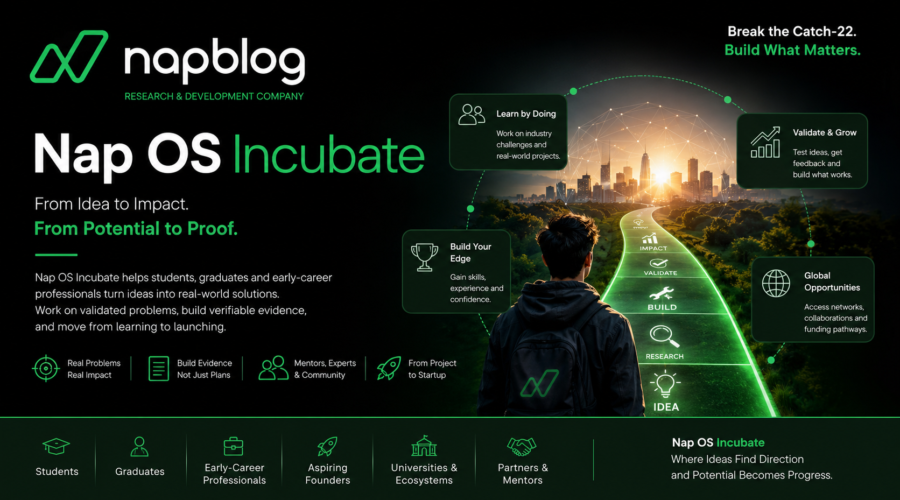
At Napblog Limited, we believe this entrepreneurial Catch-22 deserves the same attention as the employment Catch-22. This thinking is one of the foundations behind Nap OS Incubate — an initiative within Nap OS designed to help students, graduates, early-career professionals and aspiring founders move from an idea towards evidence, execution and potentially a real venture.
The objective is not to promise that every idea becomes a company. It is to create a structured environment where people can learn by doing, test assumptions, work on real problems and build evidence before asking the world to believe in them.
The Entrepreneurial Catch-22
Consider a student who has identified a genuine problem.
They have an idea for a technology product. Perhaps they have noticed an inefficiency in healthcare, education, sustainability, recruitment, manufacturing or another industry.
They want to build something.
But immediately, a series of questions appears:
Do you have customers?
Not yet.
Do you have revenue?
Not yet.
Do you have an MVP?
Perhaps only a prototype.
Do you have a team?
Maybe not.
Do you have investment?
No.
Do you have previous startup experience?
Perhaps this is their first attempt.
The entrepreneur is therefore caught between two sides.
They need resources to create evidence, while the ecosystem often asks for evidence before providing resources.
This creates a cycle:
Idea → Need resources → Need evidence → Need customers → Need product → Need resources.
Breaking that cycle is one of the most important challenges facing early-stage entrepreneurship.
It Is Not Only About Funding
One of the most visible entrepreneurial Catch-22s is fundraising.
A founder may believe:
“If I receive funding, I can build the product, hire people and acquire customers.”
But an investor may reasonably ask:
“What evidence do you have that customers want this?”
The investor’s question is understandable.
The founder’s problem is understandable too.
There is a gap between the potential of an idea and the evidence required to validate it.
However, funding is only one part of the problem.
Entrepreneurs can face Catch-22 situations around:
- Customers
- Product development
- Sales
- Partnerships
- Team building
- Market validation
- Mentorship
- Industry credibility
- Research
- Intellectual property
- Distribution
- International expansion
For example, a new founder may need a corporate partner to test a solution. The corporate partner may ask for previous customers. Previous customers may ask for an established corporate reference.
Again, the circle appears.
You need proof to obtain the opportunity, but you need the opportunity to create the proof.
The Student Entrepreneur Has an Even Bigger Challenge
The problem can be particularly significant for students and recent graduates.
A student may have technical knowledge, creativity and ambition but very little opportunity to apply those capabilities to a real commercial problem.
Traditional education can provide knowledge.
Entrepreneurship requires something additional:
execution.
A founder has to speak to users, understand problems, test assumptions, build prototypes, communicate a proposition, analyse feedback, manage uncertainty and make decisions.
These capabilities are difficult to develop entirely through lectures or examinations.
This is why Nap OS Incubate is built around the concept of learning through real-world problem solving.
Instead of asking:
“What startup should I create?”
the process can begin with:
“What real problem can I investigate?”
That change is important.
A problem creates a research question.
A research question creates an investigation.
An investigation creates evidence.
Evidence creates a potential solution.
A solution can become a prototype.
A prototype can be tested.
Testing creates learning.
And learning can eventually create a venture.
From Idea to Evidence
Nap OS Incubate is envisioned as a bridge between education, work, entrepreneurship and innovation.
The purpose is not simply to give aspiring founders another course.
The world already has enormous amounts of entrepreneurial content.
People can watch videos about pitching.
They can read books about startups.
They can attend webinars about fundraising.
They can learn how to create a business plan.
But knowing about entrepreneurship is different from actually practising it.
Nap OS Incubate therefore focuses on the progression from:
Problem → Research → Experiment → Evidence → Prototype → Validation → Venture
Not every participant will reach the final stage.
And that is acceptable.
A research project that demonstrates that an idea does not work can be valuable.
A customer interview that disproves an assumption can be valuable.
A prototype that reveals a technical limitation can be valuable.
A market experiment that identifies a different customer segment can be valuable.
Entrepreneurship is not simply about proving that an original idea was correct.
It is about discovering what is actually true.
Creating a Portfolio of Entrepreneurial Evidence
This is where the broader Nap OS philosophy becomes relevant.
Nap OS is being developed around the principle that capability should increasingly be demonstrated through evidence of what a person can actually do.
For workforce development, this can mean verified projects and evidence of work.
For entrepreneurship, the same philosophy can be applied differently.
An aspiring founder could build an entrepreneurial portfolio containing evidence such as:
- A documented problem investigation
- Customer discovery interviews
- Market research
- Competitor analysis
- Prototype development
- Product experiments
- User feedback
- Technical research
- Business-model experiments
- Partnership discussions
- Pilot projects
- Commercial proposals
- Demonstrated project outcomes
This creates something more meaningful than simply writing “Aspiring Entrepreneur” on a CV.
It demonstrates:
Here is what I investigated.
Here is what I built.
Here is what I tested.
Here is what I learned.
Here is what changed because of my work.
That is entrepreneurial evidence.
Entrepreneurship as a Workforce Capability
There is also an important connection between entrepreneurship and employment.
Not every person who joins Nap OS Incubate will become a founder.
But entrepreneurial experience can still develop valuable workforce capabilities.
Someone who has investigated a customer problem may become better at research.
Someone who has built a prototype may develop technical confidence.
Someone who has conducted customer interviews may improve communication.
Someone who has tested a business model may understand commercial decision-making.
Someone who has coordinated a project may develop leadership experience.
Someone who has experienced failure may become better at analysing assumptions and managing uncertainty.
In this sense, entrepreneurship can become another pathway for building evidence of capability.
The outcome does not have to be:
Founder or failure.
There can be many outcomes:
Founder.
Employee.
Researcher.
Innovator.
Consultant.
Product manager.
Engineer.
Community leader.
Entrepreneurial professional.
The experience itself can create value.
A Global Problem
The entrepreneurial Catch-22 is not unique to Ireland.
Different countries have different ecosystems, funding structures, universities and labour markets, but the fundamental challenge can appear anywhere.
A young person in India may have a business idea but limited access to international customers.
A student in Ireland may have access to education but struggle to find opportunities to test a commercial idea.
A graduate in Africa may identify a local infrastructure problem but lack access to technology resources.
A researcher in Europe may develop valuable intellectual property but struggle to convert research into a commercial product.
An international student may have skills from multiple countries but lack the network necessary to turn those skills into an opportunity.
The circumstances differ.
The underlying problem is similar:
Potential exists, but the pathway from potential to evidence is difficult.
This is the opportunity Nap OS Incubate wants to explore.
Ireland as a Testbed for Global Entrepreneurship
Napblog Limited is developing Nap OS from Ireland, and this creates an interesting opportunity.
Ireland has a highly international environment, with universities, technology companies, entrepreneurs, researchers, investors and international talent interacting within a relatively connected ecosystem.
That creates an opportunity to experiment with new models connecting:
Students + Universities + Employers + Entrepreneurs + Researchers + Innovation Ecosystems
Nap OS Incubate can potentially become part of that connection.
A student could identify a real problem.
A university could provide academic support.
An organisation could provide a real-world challenge.
A mentor could provide guidance.
A multidisciplinary team could investigate the problem.
Nap OS could provide the digital infrastructure for documenting the work.
The result could be a research project, prototype, employment opportunity, startup or partnership.
The important point is that the ecosystem creates opportunities for interaction before conventional credentials are available.
From Incubation to Global Opportunity
The long-term ambition is not simply to create another startup programme.
It is to explore whether workforce infrastructure and entrepreneurship infrastructure can become connected.
Imagine a person beginning as a student.
They participate in a real-world project.
They develop evidence.
They discover a problem.
They investigate it.
They build a solution.
They form a team.
They validate the concept.
They launch a company.
The same individual could eventually employ other people.
Their company could create projects for students.
Those students could develop experience.
Some could become employees.
Others could become entrepreneurs.
A cycle begins.
Instead of an ecosystem where opportunity is distributed primarily through existing networks, technology could potentially help create more structured pathways into those networks.
That is the bigger idea behind Nap OS Incubate.
The Goal Is Not to Remove Risk
Entrepreneurship will always involve uncertainty.
No platform can guarantee customers.
No incubator can guarantee investment.
No mentor can guarantee success.
No technology can guarantee that an idea will work.
Nap OS Incubate should therefore not be understood as a promise to eliminate the risk of entrepreneurship.
The purpose is different:
reduce the amount of unnecessary uncertainty by helping people generate evidence earlier.
Instead of spending months believing an assumption, test it.
Instead of saying that customers will want something, speak to customers.
Instead of saying that a product could work, build a prototype.
Instead of saying that a market exists, investigate it.
Instead of saying that you can execute, create something that demonstrates execution.
This is the discipline of evidence-led entrepreneurship.
The Nap OS Incubate Vision
Nap OS Incubate represents an extension of the broader Nap OS vision: connecting people with meaningful opportunities to learn, work, build and demonstrate capability.
The employment Catch-22 asks:
“How can someone get experience without already having experience?”
The entrepreneurial Catch-22 asks:
“How can someone build a company without already having the resources, customers, network and credibility that a company requires?”
Perhaps the answer to both problems begins in the same place:
Create opportunities to produce evidence.
Give people real problems.
Give them opportunities to investigate.
Give them the ability to collaborate.
Let them build.
Let them test.
Let them fail safely.
Let them learn.
Let them demonstrate what they can do.
And then allow the evidence to open the next door.
From Catch-22 to Catch-Forward
At Napblog Limited, we see Nap OS Incubate as an R&D-driven exploration of what entrepreneurship could look like when the starting point is not simply a business plan or a funding application, but a real-world problem.
The future entrepreneur may not begin with investment.
They may begin with curiosity.
They may not begin with a company.
They may begin with a project.
They may not begin with a customer.
They may begin with a conversation.
They may not begin with a team.
They may begin by solving a problem with one other person.
And they may not begin with credibility.
They may build credibility through evidence.
That is how we think about moving beyond the entrepreneurial Catch-22.
Nap OS Incubate is not about telling everyone to become a founder. It is about giving more people the opportunity to discover whether they can become one.
The ambition is simple:
Turn problems into projects.
Turn projects into evidence.
Turn evidence into opportunity.
And, where the conditions are right, turn opportunity into entrepreneurship.
That is the direction Nap OS Incubate is exploring — from Ireland to a potentially global ecosystem of people who do not have to wait for opportunity before they can begin demonstrating what they are capable of building.
Napblog Limited — Research & Development
Nap OS | Workforce • Recruit • Incubate