8 min read
Entrepreneurship does not always begin with a company registration, a funding round or a polished business plan.
Sometimes it begins much earlier.
It can begin with a second-year university student who starts asking questions.
Why does this problem exist?
Why hasn’t someone solved it?
Could I build something better?
Could an idea become a real business?
For many students, those questions remain ideas. They are discussed in classrooms, written into assignments and then forgotten when the semester ends.
Nap OS Incubate is designed to create a different path.
The ambition is simple: help students and early-career people move from learning about business to actually developing the capability, evidence and confidence to become entrepreneurs.
The journey of a second-year Business Computing student becoming an aspiring entrepreneur is therefore more than an individual career story. It can become an example for other students who are wondering whether entrepreneurship is something they can realistically pursue while still at university.
Entrepreneurship can start before graduation
There is a common assumption that students should first finish university, find a job, gain several years of experience and only then consider starting a company.
That route works for some people.
But it is not the only route.
A student studying Business Computing already sits at an interesting intersection.
They are learning about technology, business processes, systems, data and organisations. Those subjects can become the foundations for identifying real problems and developing technology-enabled solutions.
The important question becomes:
What happens if that student starts experimenting with entrepreneurship while still studying?
Instead of waiting until graduation, they can begin developing:
- a problem statement
- customer understanding
- market research
- a product concept
- an MVP
- a business model
- a founder portfolio
- evidence of execution
- relationships with mentors and organisations
- an understanding of funding and startup ecosystems
This is the opportunity Nap OS Incubate is trying to create.
From student to founder-development journey
Nap OS Incubate is positioned as the founder-development arm of Nap OS.
Its purpose is not simply to tell students how to start a company.
It is intended to help them build the evidence that demonstrates they are becoming capable founders.
That distinction matters.
Entrepreneurship is learned through action.
A student may understand what a business model is from a lecture. But developing one for a real idea is different.
They may understand customer research. But interviewing potential users and discovering that the original assumption was wrong is different.
They may understand MVPs. But actually deciding what to build, what not to build and how to get the first users is different.
They may learn about funding. But preparing a founder portfolio that an accelerator, enterprise agency or investor can evaluate is different.
Nap OS Incubate is designed around that transition:
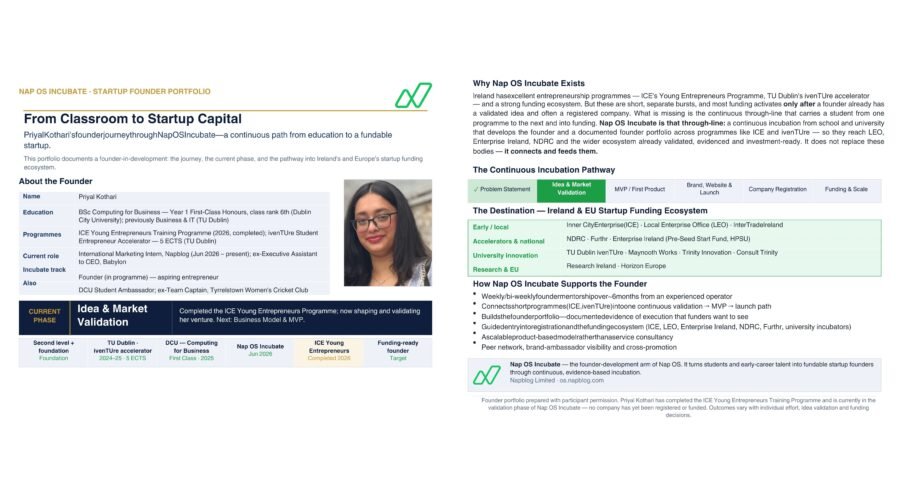
Education → Idea → Validation → MVP → Execution → Company → Funding & Scale
The objective is to make entrepreneurship more continuous rather than something that starts only after university.
A second-year student can start building now
Imagine a second-year Business Computing student.
They may not yet have a company.
They may not have investors.
They may not have a large team.
They may not even know whether their idea is commercially viable.
That is perfectly normal.
The first objective should not be to convince everyone that the student has already built the next billion-euro company.
The objective is to help the student test whether the problem is real and whether they can build a solution people value.
The student starts with a problem.
They research it.
They speak to potential users.
They study the market.
They identify competitors.
They develop a hypothesis.
Then they test it.
If the hypothesis is wrong, they learn.
If the problem is real, they move forward.
They develop an MVP.
They begin building a portfolio of evidence around the journey.
That portfolio becomes increasingly valuable because it shows something a CV often cannot:
what the student actually did.
The importance of founder evidence
This is where Nap OS Incubate connects with the wider philosophy of Nap OS.
Nap OS is built around the idea of verified workforce evidence.
The same principle can be applied to entrepreneurship.
Instead of simply saying:
“I am an aspiring entrepreneur.”
A student can demonstrate:
“I identified this problem, interviewed these users, tested this hypothesis, built this MVP, received this feedback, changed the product based on that feedback and progressed the idea to this stage.”
That is much stronger.
It creates a Founder Portfolio.
The portfolio can document the progression from an initial idea to a validated business opportunity.
It can include:
- problem definition
- market research
- customer interviews
- competitor analysis
- product development
- MVP milestones
- user feedback
- business model development
- branding and positioning
- company formation
- accelerator participation
- mentor feedback
- funding preparation
- measurable outcomes
This creates a record of execution rather than simply a declaration of ambition.
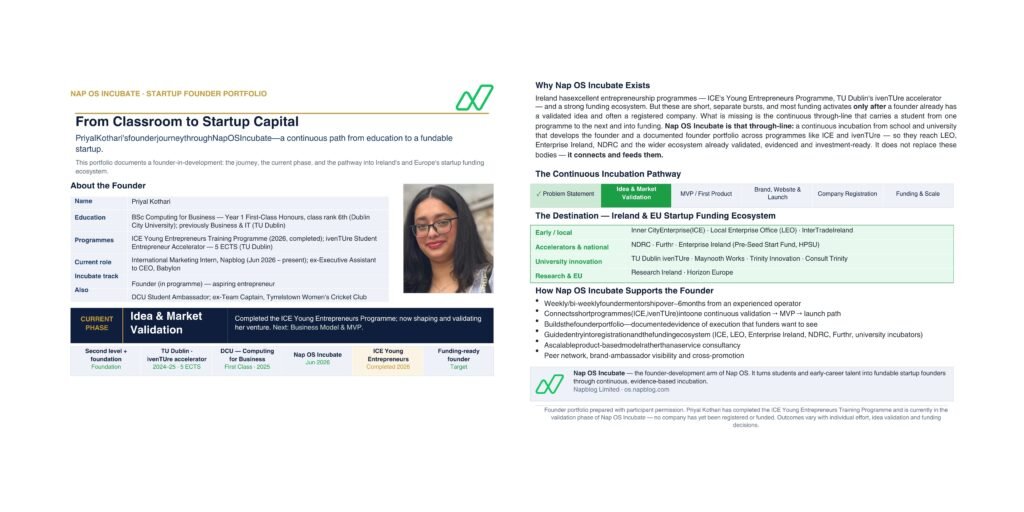
Building a bridge between university and the startup ecosystem
Ireland already has a significant network supporting entrepreneurship.
Students can encounter university entrepreneurship programmes, accelerators, enterprise agencies, innovation centres and research and funding organisations.
The challenge is often continuity.
A student might complete one programme and then wonder:
What do I do next?
They might finish a university accelerator but still have an unfinished product.
They might complete entrepreneurship training but have no customers.
They might have an idea but no structured pathway towards an MVP.
They might build an MVP but not know how to approach funding.
This is where a continuous incubation model can add value.
Nap OS Incubate can provide a structured thread connecting the stages.
The student does not have to treat every programme as an isolated experience.
Instead, each stage can contribute evidence to the same founder journey.
From idea and market validation to MVP
The first major milestone is not funding.
It is validation.
Does the problem exist?
Who experiences it?
How frequently?
How painful is it?
What are people doing today?
Would they change?
Would they pay?
What alternatives already exist?
These questions help transform an interesting idea into a potential business.
Once the problem has been sufficiently explored, the student can begin defining the MVP.
The objective is not to build everything.
It is to build enough to test the core hypothesis.
This is particularly important for student founders.
Time and resources are limited.
A disciplined MVP approach allows students to learn faster without spending years developing something nobody needs.
Becoming an entrepreneur by doing entrepreneurial work
There is a fundamental difference between studying entrepreneurship and doing entrepreneurship.
Studying entrepreneurship teaches frameworks.
Doing entrepreneurship creates judgement.
A founder eventually has to make decisions with incomplete information.
Which customer should we target?
What should we build first?
What should we remove?
Should we pivot?
Should we charge?
Should we raise funding?
Should we bootstrap?
Should we recruit?
Should we partner?
There are rarely perfect answers.
The founder develops capability by making decisions, observing outcomes and adapting.
That is why the Nap OS Incubate model is intended to be evidence-based and execution-oriented.
The student’s portfolio should show progression.
Not perfection.
Creating an example for other students
Perhaps the most powerful part of this journey is not what happens to one student.
It is what happens when other students see it.
A second-year student who begins building a company can become an example for the first-year student sitting nearby.
The message becomes:
You don’t have to wait until graduation.
You can start learning now.
You can test an idea now.
You can build something now.
You can speak to customers now.
You can create your first MVP now.
You can participate in the startup ecosystem now.
You can begin developing your founder portfolio now.
That creates a cultural effect.
One student becomes a visible example.
Then another student starts.
Then another.
Eventually entrepreneurship becomes less intimidating because students can see a pathway that someone like them has already taken.
From aspiring entrepreneur to fundable founder
The destination is not simply to call someone a founder.
The objective is to help them become funding-ready when the business genuinely reaches that stage.
Funding should follow evidence.
A founder should be able to demonstrate:
Problem → Market → Customer → Product → Traction → Business Model → Growth Opportunity
A founder portfolio can help organise that evidence.
It can show what has been tested, what has been learned and what remains uncertain.
This can make conversations with accelerators, enterprise organisations, universities, investors and other ecosystem partners more meaningful.
The founder is no longer presenting only an idea.
They are presenting a development journey.
The bigger opportunity for Ireland
Ireland has invested heavily in education, technology, innovation and entrepreneurship.
The next opportunity is to strengthen the connection between these ecosystems.
Universities produce talented graduates.
Technology creates new possibilities.
Employers create demand.
Entrepreneurship creates companies.
Startups create jobs.
The stronger the connection between these systems, the more opportunities students can create for themselves and others.
That is the broader ambition behind Nap OS.
Nap OS Workforce creates more jobs.
Nap OS Recruit creates more project-based hiring opportunities.
Nap OS Incubate helps create more entrepreneurs and startups.
These are not three unrelated ideas.
They form part of a wider workforce and economic development model.
A person can enter the system as a student.
They can develop skills.
They can gain real work experience.
They can build verified evidence.
They can become employable.
Or they can identify an opportunity and become an entrepreneur.
And, eventually, that entrepreneur may create opportunities for other people.
The beginning of a founder journey
The second-year Business Computing student does not need to have everything figured out.
They do not need to know whether their startup will succeed.
They do not need to know whether investors will eventually fund it.
They simply need to be willing to start.
Start with a problem.
Talk to people.
Test the assumption.
Build something.
Learn from the market.
Document the journey.
Improve the product.
Build the company.
Create evidence.
Keep going.
That is what makes the journey meaningful.
Nap OS Incubate is intended to provide the structure around that journey — helping turn education into execution, execution into evidence, and evidence into entrepreneurial opportunity.
And perhaps the most important outcome is not that one student becomes a successful founder.
It is that the next student sees them and realises:
I can start too.
That is how a startup ecosystem grows — not only through funding and institutions, but through visible examples of people who started before they felt completely ready.
From second-year Business Computing student to aspiring entrepreneur.
The journey can start now.