9 min read
In 2019, I joined TiE Chennai as a student member.
At the time, I was an aspiring entrepreneur in Chennai, learning what entrepreneurship really meant and trying to understand how ideas become businesses. TiE represented something important to me: an ecosystem where entrepreneurs could learn from entrepreneurs, build relationships, find mentors and eventually create opportunities for others.
A few years later, my journey took me to Ireland.
I moved to Dublin to pursue my education, professional experience and entrepreneurial ambitions. I studied International Business and Innovation, worked in technology and marketing, continued researching entrepreneurship and workforce development, and ultimately founded Napblog Limited, an Irish innovation and workforce technology company.
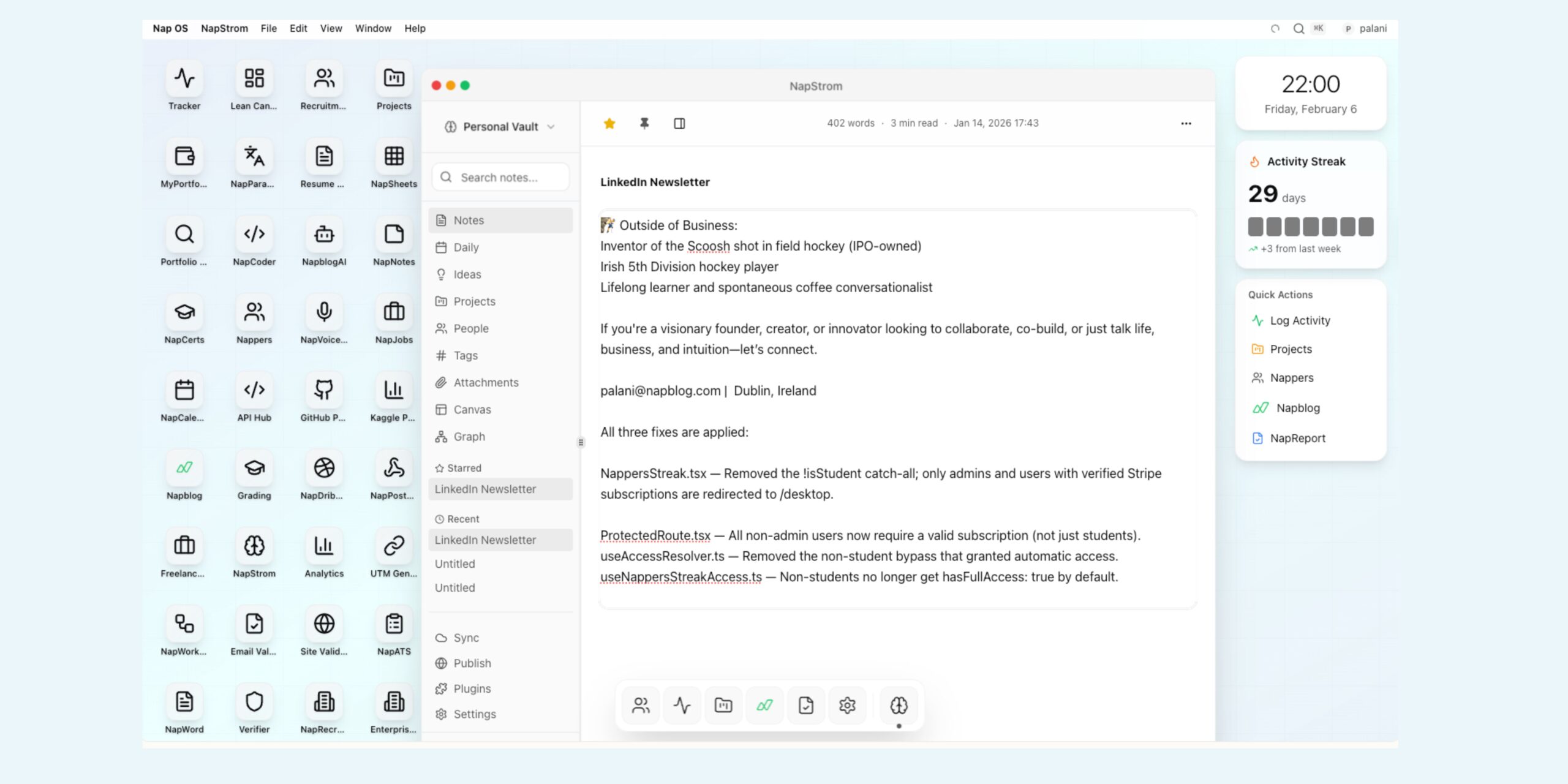
Today, I am building Nap OS — an AI-enabled Workforce Operating System designed to connect education, real-world experience, employment and entrepreneurship.
Looking back, there is a powerful connection between those two points in my journey:
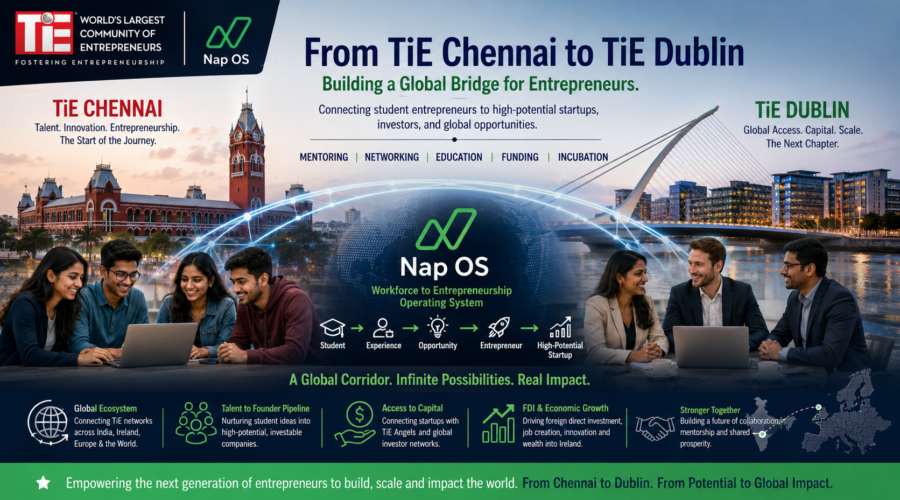
TiE Chennai → Student Entrepreneur → Ireland → Founder → Nap OS → TiE Dublin
This is why I am now exploring the possibility of reconnecting with the TiE community and contributing to the development of a TiE Dublin Chapter.
But I see this as more than establishing another local chapter.
I see an opportunity to create a Chennai–Dublin entrepreneurial corridor that connects student entrepreneurs, founders, mentors, universities, investors, technology companies and international markets — creating a pathway from early entrepreneurial potential to high-potential startups capable of attracting international capital and contributing to the Irish economy.
From Student Entrepreneur to High-Potential Startup Entrepreneur
One of the most important lessons I have learned since 2019 is that entrepreneurship should not begin only after someone has accumulated years of professional experience.
It can begin while someone is still a student.
A student can identify a problem.
They can validate it.
They can build a prototype.
They can work with customers.
They can develop a founder portfolio.
They can find mentors.
They can learn about investment.
And, eventually, they can build a company.
The traditional pathway often looks like:
Education → Employment → Experience → Entrepreneurship
I believe we can create an alternative:
Education → Experience → Entrepreneurship → High-Potential Startup → International Growth
This is particularly relevant for Ireland.
Ireland has a large international student and graduate population, a strong technology ecosystem, multinational companies, universities, research institutions, investors and access to the European market.
The opportunity is to connect these resources much earlier.
Instead of asking every international student only:
“How can we help you find your first job?”
we should also ask:
“Could you become the founder who creates the next ten, fifty or five hundred jobs?”
That is the opportunity I see at the intersection of TiE, Dublin and Nap OS.
Why Reconnect TiE Chennai With Dublin?
My relationship with TiE began in Chennai.
My entrepreneurial journey subsequently continued in Ireland.
That creates a natural bridge.
Chennai has an established technology, engineering, education and entrepreneurial ecosystem. Dublin provides access to the European Union, multinational technology companies, international capital, research institutions and a highly international business environment.
Connecting these ecosystems could create value in both directions.
Indian students and entrepreneurs could gain greater exposure to European markets.
Irish startups could gain access to Indian talent, founders, technology and markets.
Mentors could collaborate across borders.
Investors could discover companies earlier.
Universities could create international entrepreneurship programmes.
Corporates could identify emerging technologies and talent.
And founders could build international relationships before they reach the scale at which those relationships become difficult to establish.
The objective should therefore not be:
Chennai OR Dublin.
It should be:
Chennai + Dublin + the global TiE network.
This is where the global nature of TiE becomes particularly powerful.
TiE’s mission is built around mentoring, networking, education, funding and incubation, supporting entrepreneurs throughout the entrepreneurial lifecycle. TiE Angels similarly provides a mechanism through which entrepreneurs can access investment and the wider TiE network.
That combination creates an opportunity to connect entrepreneurship development with international capital.
From Student Potential to High-Potential Startup
Imagine a student in Chennai who has developed an idea in AI, climate technology, healthcare, fintech or workforce technology.
Today, that student may have access to local mentors and university programmes.
Now imagine that the same student can also connect with:
- A founder in Dublin
- A mentor in Silicon Valley
- An investor in India
- A European corporate customer
- A university researcher in Ireland
- An experienced entrepreneur in another TiE chapter
The founder’s potential market immediately becomes much larger.
The journey could look like this:
Student Idea
↓
TiE Student Entrepreneurship
↓
Mentoring & Validation
↓
Nap OS Founder Portfolio
↓
Prototype / MVP
↓
Customer Validation
↓
TiE Dublin International Market Access
↓
Irish / European Company Formation
↓
High-Potential Startup
↓
TiE Angels / Global Investor Network
↓
International Scale
This is the ecosystem I believe could be developed.
Nap OS as the Workforce and Entrepreneurship Infrastructure
Nap OS sits naturally within this vision.
I do not see Nap OS as the purpose of TiE Dublin.
Rather, I see it as a potential infrastructure layer supporting the entrepreneurial pipeline.
Nap OS is being developed across three interconnected areas.
Nap OS Workforce
Helping individuals build meaningful, real-world work experience and verified evidence of capability.
Nap OS Recruit
Helping organisations identify talent through demonstrated project capability rather than relying exclusively on traditional CVs.
Nap OS Incubate
Helping students and early-career professionals move from problem discovery and experimentation towards entrepreneurship.
Together, these create a broader pathway:
Workforce → Entrepreneur → Founder
This matters because the future founder population does not necessarily begin with existing founders.
It begins with students.
It begins with graduates.
It begins with people working on side projects.
It begins with people who have identified problems inside organisations.
It begins with international professionals who understand markets across multiple countries.
Nap OS can potentially help capture that entrepreneurial potential earlier and turn it into evidence, projects, networks and eventually companies.
Creating an International Founder Pipeline
The proposed TiE Dublin model could therefore focus on creating a continuous founder pipeline.
Stage 1 — Student Entrepreneur
Students are introduced to entrepreneurship before graduation.
They learn problem discovery, customer validation, product development, business models and founder fundamentals.
Stage 2 — Emerging Entrepreneur
Students and graduates begin working on real projects and developing evidence of their capabilities.
This is where Nap OS can provide a structured environment for projects, portfolios and experience.
Stage 3 — Startup Founder
The strongest ideas progress into structured incubation.
Founders receive mentorship, customer access, market validation and support with company development.
Stage 4 — High-Potential Startup
Companies demonstrating strong market potential can be connected with international mentors, customers, corporate partners and investors.
Stage 5 — International Scale
The company can use Ireland as a European base while accessing international markets through the TiE network.
This creates something much more valuable than a one-time startup competition.
It creates a pipeline.
Why This Could Matter to the Irish Economy
The most important part of this proposal is not simply entrepreneurship.
It is economic development.
If international founders come to Ireland, build companies, hire employees, conduct research, purchase services, attract investment and expand internationally, the economic impact can extend far beyond the individual startup.
A successful international startup ecosystem can contribute through:
Foreign Direct Investment
International entrepreneurs and investors can bring capital into Ireland.
Company Formation
More high-potential businesses can establish Irish operations.
Employment
Growing startups create jobs for graduates and experienced professionals.
Research and Innovation
Companies can collaborate with Irish universities and research institutions.
Technology Investment
International capital can finance Irish-based innovation.
Exports
Irish-founded companies can sell products and services globally.
Talent Attraction
Successful companies can attract additional international talent.
Founder Recycling
Successful entrepreneurs can eventually become mentors, investors and angel investors themselves.
This creates a powerful cycle:
Capital → Startup → Innovation → Jobs → Growth → Wealth Creation → Reinvestment
That is the kind of entrepreneurial flywheel Ireland can benefit from.
Dublin as a European Gateway
Dublin has a particularly interesting role to play.
Ireland provides an English-speaking environment within the European Union, alongside a substantial technology and multinational presence.
For an entrepreneur coming from Chennai, Bengaluru, Hyderabad or another international ecosystem, Dublin can become a gateway into Europe.
For an Irish founder, Chennai can provide access to Indian talent, technology capabilities, entrepreneurs and markets.
The relationship can therefore be reciprocal.
This should not be viewed as an India-to-Ireland programme.
It should become:
Ireland ↔ India ↔ Europe ↔ Global TiE Network
That is the larger opportunity.
TiE Dublin Could Become More Than a Networking Chapter
A future TiE Dublin chapter could potentially develop programmes across six areas.
1. TiE Dublin Student Entrepreneurs
Connect universities and student founders with experienced entrepreneurs.
2. TiE Dublin Founder Mentoring
Provide practical mentorship around customers, products, hiring, fundraising and scaling.
3. TiE Dublin International Founder Programme
Help international entrepreneurs understand Ireland and the European market.
4. TiE Dublin Incubation
Support founders from problem discovery through MVP, validation and investor readiness.
5. TiE Dublin Investor Network
Connect promising startups with angels, venture capital and international TiE investment networks.
6. TiE Dublin Global Market Access
Create structured relationships between Irish founders and TiE chapters across India, North America, Europe, Asia and other regions.
Nap OS could potentially support the underlying talent and founder-development layer, while TiE provides the broader entrepreneurial ecosystem of mentors, networks, education, funding and incubation.
Reconnecting With TiE as a Form of Giving Back
For me, there is also a personal dimension to this proposal.
In 2019, I joined TiE Chennai as a student.
I was not approaching TiE as an experienced founder.
I was someone trying to understand entrepreneurship.
Today, I am approaching the organisation from a very different position.
I have built a company in Ireland.
I have worked with more than 100 contributors across different functions and countries.
Through Nap OS, more than 50 participants have progressed into employment, internships, further opportunities and entrepreneurship.
We have built relationships with universities and are developing Nap OS Incubate to help students and early-career talent explore entrepreneurship earlier.
The journey has changed me from someone seeking an entrepreneurial ecosystem into someone who wants to help build one.
That is why reconnecting with TiE feels particularly meaningful.
From Chennai to Dublin — and Dublin to the World
The story I want to tell is not simply about one founder.
It is about what can happen when entrepreneurial ecosystems remain connected across borders.
A student entrepreneur in Chennai should be able to imagine becoming a European founder.
An Irish student should be able to access mentors in India.
An Indian startup should be able to test its European proposition through Dublin.
An Irish startup should be able to explore India through Chennai.
An investor should be able to discover opportunities before they become obvious.
A university should be able to connect its students with international founders.
And an entrepreneur should not have to build their global network only after they have already achieved success.
The network should help create that success.
A New Chapter
My journey began with TiE Chennai in 2019.
Ireland became the next chapter.
Napblog Limited and Nap OS became the vehicle through which I began turning my research and entrepreneurial experience into a workforce and entrepreneurship platform.
Now I believe there is an opportunity to begin another chapter:
TiE Chennai → TiE Dublin
Not as a replacement for the existing TiE ecosystem, but as a bridge within it.
A bridge connecting student entrepreneurs with high-potential entrepreneurship.
A bridge connecting Indian and Irish founders.
A bridge connecting universities with investors.
A bridge connecting talent with opportunity.
A bridge connecting international capital with Irish innovation.
And ultimately, a bridge through which successful entrepreneurship can generate investment, innovation, employment and long-term economic value for Ireland.
The ambition is simple:
Help more people move from being students who want opportunities to entrepreneurs who create them.
And if Dublin can become one of the places where that transition happens, then TiE Dublin could become more than a chapter.
It could become a global gateway for the next generation of entrepreneurs building from Ireland into the world.
For me, this is not the beginning of a new journey.
It is a reconnection with where my entrepreneurial journey started.
From TiE Chennai in 2019, to building Nap OS in Dublin, to exploring how Chennai and Dublin can become connected through a new generation of global entrepreneurs.