6 min read
Ireland’s employment permit system is, on paper, a meritocratic gateway: hold the right qualifications, the right experience, and a genuine job offer, and a non-EEA national can legally work in the state. In practice, the system rewards something narrower and harder to manufacture on demand — documented, role-matched evidence. A General or Critical Skills Employment Permit application does not ask whether a candidate is capable; it asks the candidate to prove, in writing, that their qualifications, skills, knowledge and experience map precisely onto the occupation being filled.
Vague self-description is treated as a red flag rather than a formality, and refusals are routinely issued on the grounds of what adjudicators describe as insufficient evidence of the critical-skills nature of a role. This is the exact gap that Nap OS, the operating system for employability and entrepreneurship built by Napblog Limited, is designed to close — not through a single document or a one-off consultation, but through a continuous, three-stage process spanning Workforce, Recruit and Incubate.
The Core Problem: Capability Without a Paper Trail
Most candidates pursuing an Irish work permit are not short on ability; they are short on artefacts. A university degree demonstrates that someone once completed a course of study, but it says very little about whether that person can perform the specific tasks an employer and, by extension, an immigration officer needs to see evidence of. Traditional CV-based hiring compounds the problem: a CV is a set of claims, not a set of verified outputs. When a work permit reviewer asks a candidate to detail their relevant qualifications, skills, knowledge and experience, a CV alone rarely survives scrutiny, particularly for occupations governed by a specific classification code where the burden is on the applicant to show the role’s genuinely critical or skilled nature. Nap OS treats this not as a paperwork inconvenience but as a structural design problem, and it answers with a system rather than a template.
Stage One: Workforce — Building the Evidence Base Over Time
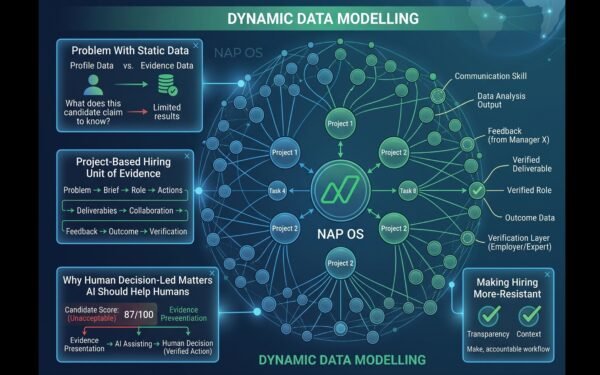
The first pillar, Workforce, is where the longitudinal part of the strategy begins. Rather than asking a candidate to retroactively justify their competence at the moment of application, Workforce accumulates proof continuously, well before a permit is ever needed. Through AI-driven career profiling and skills-gap analysis, a candidate’s starting position is mapped against the specific capabilities that employers and permit categories actually require. From there, personalised learning paths and structured project work generate a growing portfolio: completed simulations, work submissions, skill certificates, and eventually verified work experience tied to real outcomes rather than self-reported claims. This is deliberately sequential. Early users work through foundational projects, then intermediate simulations, then advanced, mentor-guided assignments, with each stage producing artefacts that can be attached to a résumé, a LinkedIn profile, or, crucially, a permit application. Because the underlying analytics engine tracks trajectory over 30, 60 and 90-day windows and benchmarks a candidate’s growth against peers, the process is not a snapshot but a documented trend line — exactly the kind of longitudinal record that turns a generic claim of “marketing experience” into a specific, dated, verifiable body of work matched to a named occupation.
This matters enormously for permit categories where the applicant must show a genuine correspondence between their background and the role’s classification. A candidate who can point only to a degree certificate and a job title is vulnerable to exactly the kind of vague-answer refusal that immigration advisers warn about. A candidate who can point to a structured sequence of verified projects, skill certificates, and employer-recognised work submissions, all timestamped and benchmarked, is presenting something closer to an audit trail than an assertion.
Stage Two: Recruit — Converting Verified Capability Into a Genuine Offer
A portfolio alone does not secure a work permit; Ireland’s system also requires an actual job offer from an employer, frequently following a Labour Market Needs Test in which the employer must show they could not fill the role from within Ireland or the EEA. This is where Recruit becomes the connective layer. By giving employers, recruiters and university partners direct access to capability-first profiles rather than CV keyword matches, Recruit is designed to shorten the distance between a candidate’s demonstrated skills and an employer’s willingness to formalise an offer. Because the talent pipeline is built on verification rather than self-report, an employer using Recruit’s dashboard is not gambling on a candidate’s description of themselves; they are looking at documented outputs, which makes it considerably easier for that employer to write a role description, and eventually a permit-supporting letter, that genuinely reflects what the candidate can do. For occupations sitting near the boundary of eligible and ineligible categories, or requiring a demonstrable skills match, this specificity is not a nicety — it is frequently the difference between an approval and a refusal.
The higher-tier Workforce and Industry Expert plans extend this further with dedicated program management, employer verification priority, and a formal work experience certificate, each of which strengthens the paper trail an employer can point to when justifying a hire to the state. In effect, Recruit does not simply match people to jobs; it produces the documentary scaffolding an employer needs to support a permit application credibly.
Stage Three: Incubate — A Parallel Pathway When Employment Alone Is Not Enough
Not every candidate’s strongest route runs through direct employment, and not every occupation of interest sits comfortably within Ireland’s eligible list. Incubate exists for candidates whose skills are better expressed through venture creation, structured entrepreneurial projects, or founder-track experience than through a conventional job title. By running candidates through idea validation, a business model builder, an MVP roadmap and a funding-readiness system, Incubate produces another category of verifiable output: demonstrated initiative, ownership, and applied expertise that can support a case for specialised or entrepreneurial routes, or that simply deepens the evidence base a candidate carries into any future permit or visa process. For governments and universities interested in skills policy execution, this pathway also converts learners into a form of self-generated economic contribution, which is a distinct but complementary story to the pure employment-permit narrative.
Why the Longitudinal, Closed-Loop Design Matters
The strategic value of Nap OS is not any single feature but the fact that Workforce, Recruit and Incubate form a closed loop rather than three separate products. A candidate develops skills in Workforce, gets hired or gains verified experience through Recruit, and either re-enters the ecosystem at a higher tier or moves into Incubate to build something of their own — with each cycle adding more documented outcomes, more benchmarked progress, and more employer-recognised evidence. This is precisely what a constructive longitudinal process means in practice: not a single moment of preparation before a permit application, but months of accumulating, verifiable, role-matched proof that can be assembled into a coherent application narrative on demand.
For a work permit system that explicitly rewards documented evidence over asserted competence, this design is well matched to the actual bureaucratic test being applied. Nap OS does not claim to change eligibility rules or occupation lists; what it offers is a way for candidates to arrive at the application stage already holding the specific, dated, verifiable material that reviewers are looking for, built through genuine skill development rather than assembled hastily to satisfy a form. Whether the eventual pathway is a Critical Skills Employment Permit, a General Employment Permit, or an entrepreneurial route through Incubate, the underlying logic is the same: qualification is not just a credential to hold, it is a case to build, continuously, over time.
Here’s an added closing paragraph you can append to the article as a call to action:
Getting Started
For candidates who want to begin building this evidence trail rather than assembling it under time pressure, the starting point is a personalised assessment rather than a generic sign-up. Reaching out to palani@napblog.com begins that process: an initial review of current qualifications and target occupation, followed by a tailored, one-to-one longitudinal learning and internship track through Nap OS Workforce, Recruit and Incubate. Rather than a fixed course, this is an ongoing, mentor-guided pathway — skills development, verified project work, and real work-experience placement built specifically around the candidate’s target role and, where relevant, their intended work permit category, so that by the time an application is submitted, the supporting evidence has already been built rather than reconstructed after the fact.