7 min read
Every employer knows the quiet dread of a bad hire. The role is filled, the paperwork is signed, and within a few months it becomes clear that the person on the payroll cannot actually do what their CV claimed. Recruiters and hiring managers have lived with this risk for decades because the entire hiring system is built around a document that is easy to embellish and hard to verify: the résumé. Nap OS Recruit was built to close that gap, giving employers access to a pool of candidates whose skills and work history have already been checked and demonstrated, rather than simply claimed.
The Problem With Hiring on Paper
Traditional recruitment runs on a simple but flawed loop. A candidate writes a CV, an applicant tracking system scans it for keywords, a recruiter skims the shortlist, and an interview panel tries to guess, in an hour or two, whether the person in front of them can genuinely do the job. At no point in that process is the candidate’s actual capability tested against real work. The result is a well-documented mismatch between what appears on paper and what shows up on day one. Industry estimates on the cost of a mis-hire vary, but most place the figure well into multiples of the employee’s annual salary once recruitment fees, onboarding time, lost productivity, team disruption, and eventual replacement costs are added together. For small and mid-sized employers in particular, a single wrong hire in a key role can set a team back for a full quarter or more.
The deeper issue is one of signal versus noise. A CV is a claim, not evidence. Two candidates can list an identical job title and an identical set of skills, yet have wildly different actual abilities. Employers have responded by adding more screening steps, more interview rounds, more assessments, and more background checks, but this only adds cost and time without solving the root problem, which is that the underlying information employers are screening was never verified in the first place.
A Different Starting Point: Capability Before CVs
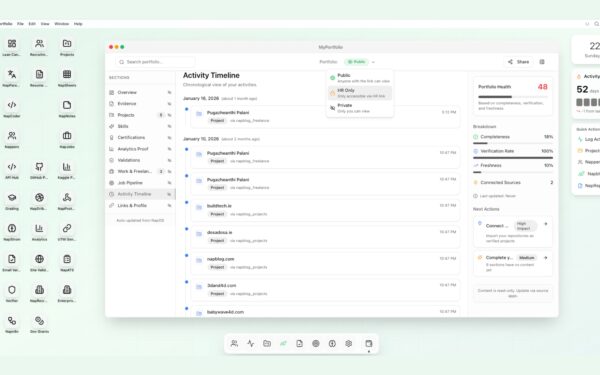
Nap OS Recruit approaches the problem from the opposite direction. Rather than asking employers to filter through a stack of unverified claims, it gives them access to a pool of candidates whose experience has already been built, documented, and checked through the wider Nap OS ecosystem. Candidates who come through the platform have typically worked through structured, AI-guided projects, produced real deliverables, and had those outcomes tracked and recorded as part of a verified digital profile. By the time an employer sees a candidate on Recruit, that person’s portfolio, project history, and skill signals are attached to demonstrated work rather than self-reported bullet points.
This is the essence of what the platform describes as moving from CV-based hiring to capability-based hiring. Instead of a recruiter trying to infer competence from a list of previous job titles, they can look at a body of verified work, see how a candidate approached real problems, and judge the quality of the output directly. It shifts the burden of proof from the employer, who previously had to guess, to the candidate’s track record, which has already been established before the employer ever gets involved.
What “Verifiable at Scale” Actually Means
The phrase “verifiable experience at scale” matters because verification has traditionally been the expensive part of hiring. Reference checks, background checks, and skills testing are all valuable, but they are slow, manual, and difficult to apply consistently across hundreds or thousands of applicants. Most employers only run rigorous verification on a handful of finalists, which means the vast majority of the applicant pool is filtered using nothing more reliable than a keyword match.
Nap OS Recruit is designed to make verification the default rather than the exception, applied across the whole candidate base rather than a lucky few finalists. Because the underlying Workforce product is where candidates build their skills and track record in the first place, the verification layer is baked into the profile from the start rather than bolted on afterward. Candidates accumulate project outcomes, employer or mentor feedback, gap analyses, and recorded work submissions as they progress, and that history travels with them into the Recruit marketplace. For an employer, this means the pool they are searching through has already had a layer of quality control applied before a single interview is scheduled, and that layer scales to as many candidates as the platform serves, not just the ones who make it to a final round.
Reducing the Risk and Cost of a Wrong Hire
The practical payoff for employers comes in two related forms: fewer bad hires, and a lower cost of finding the right one.
Fewer bad hires happen because the information employers are acting on is closer to the truth. When a candidate’s listed skills are backed by an actual portfolio of completed work rather than a description written by the candidate, the odds that the person can do what they claim rise substantially. Hiring managers are no longer forced to bet a salary and months of ramp-up time on the strength of an interview performance alone; they can point to a specific project, ask about the decisions the candidate made, and see the output for themselves. This is a fundamentally different kind of due diligence than reading a bullet-pointed CV, and it closes off many of the ways that unqualified or mismatched candidates currently slip through.
Lower cost comes from efficiency. Recruitment budgets are consumed by the sheer volume of manual screening required to sort signal from noise: sourcing fees, recruiter hours, interview time from hiring managers, and the assessments bolted on to compensate for CV unreliability. When the pool an employer is searching through has already been through a capability and verification layer, much of that manual filtering work has effectively been done in advance. Skills-based search and AI-assisted matching narrow the field to candidates who are both qualified and verified, which shortens time-to-hire and reduces the number of people who need to be interviewed before a solid offer can be made. For employers running high-volume hiring, such as graduate programs, apprenticeships, or seasonal recruitment, this compounding efficiency matters even more, since the cost of screening scales with every additional applicant reviewed.
The Employer Experience
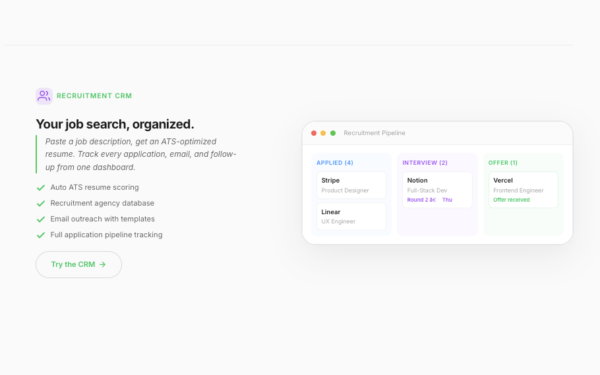
In practice, this shows up for employers as a dashboard rather than a stack of résumés. Recruit gives employers, recruiters, HR teams, universities, and talent agencies a portfolio-first view of candidates, built around skills-based search and talent pipelines rather than keyword filters. A hiring manager looking to fill a marketing analyst role, for instance, can search directly for candidates who have completed relevant verified projects, review the actual work produced, and build a pipeline of pre-qualified applicants rather than starting from an open call for CVs. The candidate verification layer sits underneath all of this, meaning that by the time two people are being compared side by side, the comparison is being made on demonstrated output rather than on how well each person wrote their own summary.
Part of a Larger System
Recruit does not exist in isolation. It sits alongside Workforce, where individuals build the skills and project history that eventually populate their verified profiles, and Incubate, which channels experienced talent toward founding or joining new ventures. This matters for employers because the pipeline feeding Recruit is continuously replenished by people actively developing job-ready capability, rather than a static database of old CVs. As more candidates move through Workforce, build project histories, and demonstrate outcomes, the pool available to employers through Recruit becomes deeper and more current, which is precisely the kind of scale that manual verification could never achieve on its own.
The Bottom Line for Employers
Hiring will always carry some uncertainty, but a large share of that uncertainty today comes from a system that asks employers to trust unverified claims and then spend heavily to compensate for that lack of trust. Nap OS Recruit’s proposition is straightforward: replace the guesswork with evidence. By giving employers access to a workforce whose experience has already been built and verified, rather than merely described, it aims to reduce both the likelihood of a costly mis-hire and the time and money spent trying to prevent one. For employers under pressure to hire faster, more accurately, and more affordably, that shift from CV-based screening to capability-based hiring is the core of the value Nap OS Recruit is designed to deliver.
Getting Started
Employers who want to see this approach in action don’t need to wait for a full platform rollout to get value from it. Companies interested in accessing Nap OS Recruit’s pool of vetted candidates, or in having their own hiring teams trained on how to evaluate verified work experience rather than relying on CVs alone, can reach out directly to palani@napblog.com to discuss early access and onboarding support.