6 min read
For decades, education and employment have been treated as two separate systems, connected only by the thin, unreliable bridge of a CV. Nap OS was built to close that gap. It is a workforce operating system that takes on the responsibility of connecting education, verified work experience, employment, and entrepreneurship inside a single, AI-native platform, so that what a person can actually do is never disconnected from what they are able to prove.
The widening gap between learning and working
Universities graduate capable people every year, yet they are judged on employability outcomes that are often outside their direct control. Employers, meanwhile, are left guessing whether a candidate is genuinely ready for the demands of a role, because a one-page CV cannot capture real, demonstrated ability. Hiring stays slow, expensive, and risk-averse as a result, while students and graduates have few structured ways to prove their practical skills. This growing distance between capability and provable evidence is what we call the education-to-employment gap, and it sits at the centre of the problem Nap OS was designed to solve.
An insight born inside the university system
The idea behind Nap OS did not start on a whiteboard; it started inside university placement programmes, working directly with students from University College Dublin and Griffith College. That experience made one thing clear: employers trust work they can actually see, not a list of credentials on a page. Real projects, it turns out, are a missing layer of data in the hiring world. Every placement, assignment, or piece of applied work a student completes generates evidence of skill that no CV, transcript, or job board can capture. What has changed recently is that artificial intelligence now makes it possible to structure and verify that evidence at scale, turning ordinary project work into a trusted signal that both universities and employers can rely on.
Nap OS: the workforce operating system
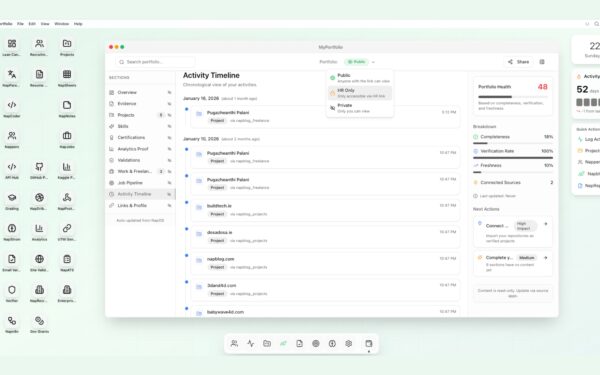
Nap OS brings this insight to life as a single, AI-native system where individuals build verifiable work experience while employers gain a reliable way to identify work-ready talent. At its core, the platform offers personalised work experience, matching real project work to each learner’s goals and interests rather than offering generic placements. As learners complete this work, Nap OS captures and validates it into verified project portfolios, structured evidence of capability that stands in for, and goes beyond, a traditional CV. Those portfolios feed into employer-ready profiles, giving companies structured, trustworthy signals they can act on immediately instead of relying on interviews alone to assess readiness.
Because Nap OS operates at the intersection of universities and industry, it also functions as a bridge between the two, housing placements, projects, and hiring pipelines in one connected environment. The data generated across this activity becomes a form of workforce intelligence, offering live visibility into emerging skills, outcomes, and labour market demand. And for the learners who thrive within this system, Nap OS opens a further path from employability toward entrepreneurship, supporting the strongest performers as they move from proving their capability to building ventures of their own.
How the system works
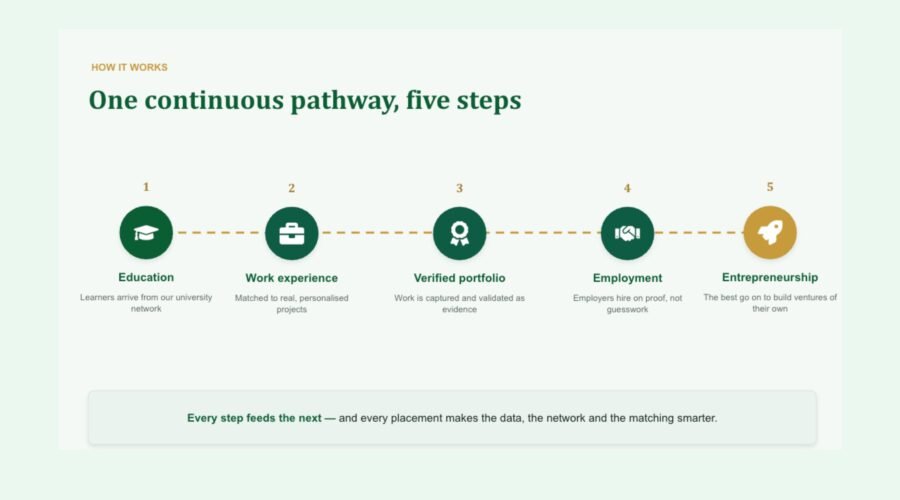
Nap OS is built around one continuous pathway made up of five connected steps. Learners first arrive through the platform’s university network, bringing their academic background into the system. From there, they are matched with real, personalised project work rather than simulated exercises, ensuring the experience reflects genuine workplace demands. As that work is completed, it is captured and validated to form a verified portfolio, tangible evidence of what the learner can actually do. Employers then use this evidence as the basis for hiring decisions, allowing them to recruit on demonstrated proof rather than guesswork. Finally, for those with the ambition and ability, the pathway extends into entrepreneurship, supporting graduates who want to build their own companies. Each step in this pathway feeds directly into the next, and every placement that runs through the system makes the underlying data, network, and matching technology progressively smarter.
Why this moment matters
Three separate trends are converging to make Nap OS’s approach both timely and necessary. Artificial intelligence has made verification scalable in a way that simply was not possible before, turning work that once required extensive human review into an automated process capable of producing trusted signals at scale. At the same time, hiring itself is shifting away from a reliance on degrees and toward demonstrated skills, with skills-based hiring increasingly becoming the norm across industries. Universities and governments are also under mounting pressure to demonstrate strong graduate employment outcomes, adding urgency to finding better ways to connect education with real career results. Set against this backdrop, the broader talent-acquisition and staffing-technology market is projected to grow toward roughly three hundred and eight billion dollars by 2035, according to industry estimates. Nap OS is positioning itself as the verified-experience layer that sits beneath this expanding market.
Market opportunity and early traction
Nap OS approaches this large global market through a deliberately focused entry point. Its total addressable market spans the worldwide talent-acquisition and workforce technology industry, while its immediate serviceable market centres on university-to-employment pathways across Europe, including placements, verified experience, and graduate hiring. Its initial beachhead is Ireland, built around relationships with University College Dublin, Griffith College, and partner institutions that represent Nap OS’s first paying university and employer relationships.
That early focus has already produced measurable outcomes rather than remaining a theoretical concept. More than seventy-five students have been supported through the platform, drawing engagement from over eighteen universities and participants from more than twenty countries. Nine University College Dublin graduates have been placed through the programme, spanning six of the university’s Master’s programmes, and the platform has generated over one hundred verified work projects. Graduates who have come through Nap OS have gone on to roles at organisations including Amazon, Tencent Games, Fáilte Ireland, the HSE, Sixth The Agency, E2G Logistics, and Zick Learn.
This traction is matched by institutional validation. Nap OS is an official University College Dublin partner, selected to host a formal Media Management Project placement with the School of Information and Communication Studies, and it serves as an incubation partner supporting innovation, entrepreneurship, and placement at Griffith College Dublin. The University College Dublin partnership has been confirmed as formally established, with an invitation extended to continue hosting future students, reflecting the trust the platform has built with the institutions it serves.
A business model built around three aligned groups
Nap OS generates revenue through three complementary lines that reflect its three core users. Universities access the platform through a SaaS subscription that provides placement, portfolio, and employability infrastructure, priced per institution or per student cohort. Employers pay through a combination of subscription access and success-based fees, gaining entry to verified, work-ready talent and hiring signals. Individuals, meanwhile, can build a portfolio for free, with premium options available for advanced matching, coaching, and visibility. This structure allows Nap OS to land inside universities first, expand toward employers, and ultimately monetise both sides of the marketplace it creates.
The go-to-market strategy follows the same logic. Nap OS embeds itself inside university placement and capstone programmes where it already operates, then proves its value by converting each cohort into verified portfolios and real employment outcomes that institutions can point to with confidence. From there, employers are brought in to hire that talent, generating subscription and success-fee revenue on the demand side. As this cycle repeats, every placement strengthens the underlying data, network, and matching capability, creating a two-sided flywheel that compounds over time.
Why Nap OS stands apart
Existing solutions each address only part of the problem. Professional networks and job boards offer visibility but little verified proof of real work. Credentialing platforms and courses demonstrate knowledge but not applied capability. Traditional internships provide experience but rarely produce structured, employer-ready evidence or scale through AI-driven matching. Nap OS is designed to combine all of these elements, genuine verified work, employer-ready signals, deep university integration, and AI-powered matching, into a single system, creating a competitive position that compounds through verified-work data, university partnerships, and the network effects of a two-sided platform.
Building personalised work experience, together
Nap OS was founded by Pugazheanthi Palani to close the gap between what people can do and what they can prove, connecting education, verified work experience, employment, and entrepreneurship inside one operating system. Universities, employers, and individuals who want to explore how a personalised work experience pathway could be built for their students, teams, or own career are welcome to reach out directly to palani@napblog.com to start the conversation.