5 min read
What the Technological University of the Shannon’s latest procurement tells us about the future of employability platforms—and why the market is evolving beyond traditional placement management systems.
The conversation around graduate employability is changing across Ireland and Europe.
Universities are under increasing pressure to improve student outcomes, strengthen employer engagement, provide measurable employability data, and streamline placement administration. At the same time, employers are looking beyond traditional CVs to identify graduates with verified skills and practical experience.
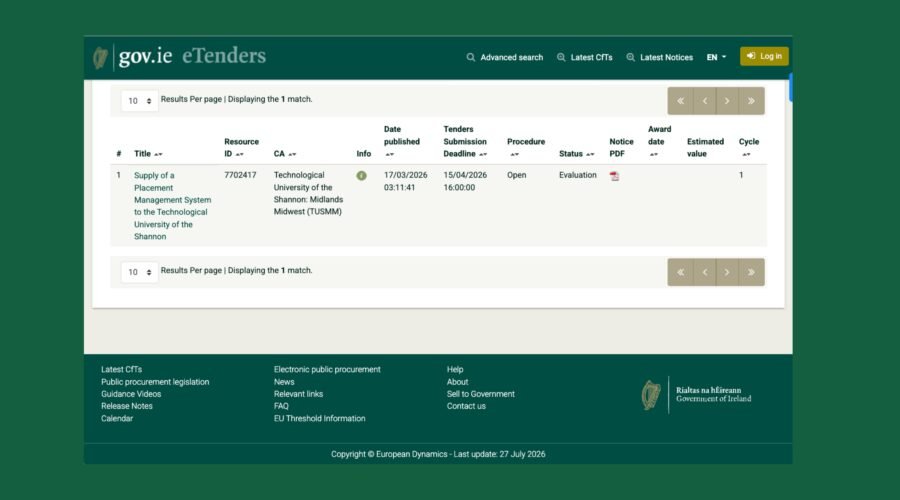
Against this backdrop, a recent public procurement from the Technological University of the Shannon (TUS) offers an important insight into the direction of higher education technology.
TUS has published an open tender seeking a Student Placement Management System to support approximately 2,500 student placements annually. The procurement has an estimated value of €200,000 over a 48-month contract and aims to provide a single platform for students, academic staff, placement providers, and careers teams to coordinate placement activities.
While this tender represents the requirements of one institution, it highlights a broader trend: universities are investing in digital infrastructure that improves the transition from education to employment.
For startups building workforce and employability technology, this is an important market signal.
Placement management is becoming mission critical
Student placements have become an essential part of many degree programmes.
Managing thousands of placements each year involves coordinating students, employers, academic supervisors, compliance requirements, documentation, approvals, reporting, assessments, and communication.
Many universities still rely on disconnected systems such as spreadsheets, emails, shared drives, and multiple software platforms to administer these processes.
As student numbers grow and employer expectations evolve, these manual approaches become increasingly difficult to scale.
Modern placement management systems are designed to centralise these workflows by enabling institutions to:
- Coordinate placement opportunities
- Match students with employers
- Manage approvals
- Track documentation
- Monitor placement progress
- Generate reports
- Improve communication between stakeholders
The publication of a €200,000 procurement demonstrates that universities recognise placement management as strategic infrastructure rather than an administrative task.
A growing market for employability technology
The significance of this procurement extends beyond a single university.
It demonstrates that higher education institutions are allocating dedicated budgets to digital employability platforms.
Across Ireland and Europe, universities face common challenges:
- Improving graduate employment outcomes
- Strengthening employer relationships
- Increasing placement capacity
- Meeting quality assurance requirements
- Supporting work-integrated learning
- Measuring student success
- Enhancing the student experience
Technology has become an essential part of solving these challenges.
As institutions continue investing in employability, placement management software represents one of the fastest-growing categories within education technology.
Is placement management enough?
Traditional placement systems are designed primarily to manage administrative workflows.
They answer questions such as:
- Which employer is hosting the student?
- Has the placement agreement been approved?
- Have the required documents been submitted?
- When does the placement begin?
- Who is supervising the student?
These are important operational functions.
However, today’s employment market demands something more.
Students increasingly need to demonstrate:
- Practical experience
- Verified skills
- Project outcomes
- Continuous learning
- Digital portfolios
- Professional evidence
- Employer feedback
Managing a placement is no longer the same as preparing someone for employment.
This distinction is becoming increasingly important.
The next evolution: Career Operating Systems
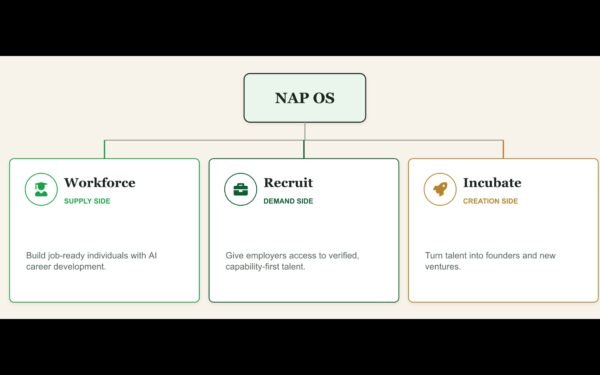
At Nap OS, we believe placement management is only one component of a much larger ecosystem.
The future is not simply managing placements.
The future is managing careers.
A modern Career Operating System should support learners before, during, and after placement.
Instead of focusing solely on administrative coordination, it should help individuals continuously build employability.
This includes:
- Personalised work experience
- AI-assisted portfolio development
- Skills verification
- Employer engagement
- Career coaching
- Project tracking
- Recruitment matching
- Continuous professional development
Rather than replacing placement management, these capabilities extend its value throughout a learner’s career journey.
From placements to verified work experience
One of the biggest challenges facing graduates today is demonstrating capability.
A CV often lists experience.
A transcript lists grades.
Neither necessarily proves what someone can actually do.
The employment market is gradually moving towards evidence-based hiring.
Employers increasingly value:
- Completed projects
- Demonstrated skills
- Verified achievements
- Practical problem solving
- Consistent execution
This creates an opportunity for platforms that help learners build trusted records of real work rather than simply documenting academic achievements.
Verified work experience has the potential to become one of the most valuable assets graduates possess.
Universities are evolving beyond academic outcomes
Universities are no longer evaluated solely on teaching quality.
Graduate employability has become an increasingly important performance indicator.
Institutions are expected to demonstrate:
- Employment outcomes
- Employer partnerships
- Student satisfaction
- Graduate success
- Industry engagement
- Work-integrated learning
Technology platforms that provide visibility across these areas can help universities make better decisions while improving the student experience.
This is one reason why procurement activity in this sector continues to grow.
Opportunities for innovation
Public procurements often define today’s requirements.
Innovation comes from anticipating tomorrow’s.
Future employability platforms could incorporate capabilities such as:
- AI-assisted career guidance
- Skills intelligence
- Portfolio verification
- Employer recommendation engines
- Automated project assessment
- Digital employability passports
- Workforce analytics
- Continuous learning records
These capabilities move beyond workflow automation towards measurable employability outcomes.
What this means for Nap OS
For Nap OS, this procurement validates an important market assumption.
Universities are actively investing in technology that supports career development and placement coordination.
Rather than viewing placement management as the final product, we see it as one module within a broader Career Operating System.
Our long-term vision is to help learners build verified professional experience throughout their education while enabling universities and employers to identify work-ready talent using evidence rather than assumptions.
In this model:
Students build portfolios instead of simply submitting assignments.
Employers evaluate demonstrated capability instead of relying only on CVs.
Universities gain deeper insight into graduate outcomes.
Career services become data-driven.
Recruitment becomes increasingly evidence based.
A roadmap for the future
Public procurement notices provide valuable insight into how institutions think about technology.
They reveal:
- Operational priorities
- Budget allocation
- Digital transformation goals
- Procurement trends
- Market demand
For education technology companies, these documents are more than procurement opportunities—they are indicators of where the sector is heading.
As universities continue investing in employability, there is an opportunity to build solutions that extend beyond placement administration and create lifelong career infrastructure.
Final thoughts
The TUS Placement Management System tender demonstrates that universities are making significant investments in employability technology.
Today’s requirement may be a placement management system.
Tomorrow’s requirement may be a comprehensive Career Operating System that combines placement management, verified work experience, AI-driven career development, employer engagement, digital portfolios, and workforce intelligence within a single platform.
At Nap OS, we believe the future of employability lies not simply in managing placements but in helping every learner build trusted evidence of their capabilities throughout their career journey.
As higher education continues its digital transformation, the institutions that connect education, experience, and employment through intelligent technology will be best positioned to prepare graduates for the workforce of tomorrow.