6 min read
Most people don’t wake up excited about the work they do. Recent workplace research suggests that a large share of employees, often estimated between 70 and 80 percent, feel disengaged or unfulfilled at their jobs, showing up mainly to cover bills rather than to build something they care about. Only a small minority, roughly one in five workers, describe themselves as genuinely passionate about their day-to-day work. That gap between the job someone has and the career they actually want has quietly become one of the defining frustrations of modern working life.
The reasons behind this gap are rarely about laziness or a lack of ambition. Multiple employee surveys point to a guidance problem rather than a motivation problem. Studies on manager support suggest that roughly half of employees feel their managers don’t give them adequate direction on where their career could go next, and separate research on workplace perception finds a similar share of employees feel their manager never really understands the value they bring. Other career development surveys report that over half of workers feel entirely on their own when planning their next move, left to guess which skills matter or which direction to grow in.
Without that guidance, many people default to whatever job pays the bills and stay there far longer than they’d like. Financial pressure makes leaving feel riskier than it should. Some research on job expectations found that close to half of workers who quit a role did so because the day-to-day work never matched what they were promised, often because there was no real support helping them find a better-fitting path in the first place. People generally aren’t choosing to feel stuck. They simply haven’t had a system built to help them choose well.
What Nap OS Actually Is
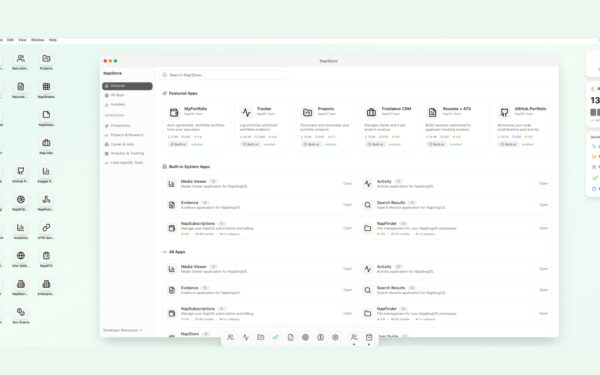
Nap OS was built around a simple idea: people shouldn’t have to guess their way through a career, and they shouldn’t need a lucky break or an unusually supportive manager to find work that fits who they are. Rather than functioning as a single app or a job board, Nap OS is structured as a personalised operating system for careers and ventures, built around three connected parts. Workforce helps individuals build job-ready skills and a verified profile of what they can actually do. Recruit connects that verified capability to employers looking past the traditional CV. Incubate takes people who discover a stronger pull toward building something of their own and gives them a structured, supported path into entrepreneurship.
Workforce: Clarity Before You Choose
The biggest source of career confusion usually isn’t a lack of options, it’s a lack of clarity about which option actually fits a person’s strengths and interests. Nap OS Workforce is designed to close that gap using AI-driven career profiling and skills-gap analysis, so a person can see where their real strengths sit and what’s missing to get where they want to go, instead of comparing themselves against a generic job description. From there, Workforce builds a personalised learning path and generates real work experience opportunities, so skills are developed and demonstrated rather than simply claimed on paper. Interview simulation and a portfolio builder round out the picture, turning a vague sense of wanting something different into a verified, structured digital identity a person can actually stand behind.
Incubate: Support Instead of a Blind Leap
For a lot of people, clarity eventually leads somewhere unexpected: not another job, but the realisation that what they actually want is to build something themselves. That transition is usually where support disappears entirely, which is part of why so many aspiring founders either never start or quit within the first few months. Nap OS Incubate is built to remove that cliff edge. An AI startup coach and idea validation engine help someone pressure-test a concept before they’ve risked anything, while a business model builder and MVP roadmap generator turn a rough idea into a working plan. Mentor matching and a funding-readiness system mean the support doesn’t stop after the first week; it continues alongside the person as their venture actually develops.
That ongoing structure is what makes leaving a job that no longer fits feel like a considered decision rather than a gamble. Instead of quitting into uncertainty, someone can build clarity and momentum around a new direction first, week by week, with a system tracking their progress and a mentor network around them. It’s the difference between jumping and stepping, and it’s a large part of why continuous, personalised support can change the outcome for people who’ve spent years in work that never felt like theirs.
Recruit: Making Capability Visible
For people who find that the right next step is a new job rather than a new venture, Nap OS Recruit is built to make sure their real capability doesn’t get lost behind a stack of CVs. Employers get access to skills-based search, portfolio-first hiring, and a candidate verification layer, so hiring decisions can be based on demonstrated ability rather than keyword matching. For job seekers, that means the work they’ve actually done through Workforce becomes visible and credible to the employers who are looking for exactly those skills.
Why Personalised and Continuous Beats One-Off Advice
Most career support people receive today is a single conversation: a university careers session, a generic personality quiz, or a brief chat with a manager during an annual review. None of that reflects how careers actually unfold, gradually, with new information arriving every month as someone tries new things and learns what does and doesn’t suit them. Nap OS treats career development as continuous rather than a single event. Its analytics layer benchmarks a person’s progress against peers at a similar career stage, projects how their profile is likely to strengthen over the coming weeks, and surfaces patterns in their own activity, such as which skills they’re building fastest, so guidance keeps adjusting as the person changes rather than going stale the day it’s given.
A System That Compounds Instead of Resetting
What ties the three parts together is that none of it is meant to be a one-time event. In Nap OS’s unified system logic, someone develops skills through Workforce, gets matched to real opportunities through Recruit, and can move into building something of their own through Incubate, then re-enters the ecosystem at a higher level with more experience, a stronger profile, and clearer direction. Each cycle adds more data and more outcomes, which makes the guidance sharper the next time around. Instead of starting from zero every time someone considers a career change, the system carries their progress with them.
Ready to Explore What You Could Actually Do?
If any of this sounds familiar, the standard advice to just follow your passion was never really the missing piece. The missing piece was a system that gives people clarity about their strengths, real experience to back it up, and ongoing support once they decide to act on it. Guidance, not motivation, is usually what stands between someone and a career that actually fits. For anyone who wants to start exploring what a better-fitting career or venture could look like, Nap OS invites people to send their CV and story to palani@napblog.com to begin the conversation.