9 min read
Ireland is facing a paradox. Its universities have lost more than €8 million in fee income this academic year after a sharp rise in student-visa refusals, even as employers face persistent skills shortages and the Government proposes targeted flexibility in employment-permit rules. Nap OS offers a practical response: help international students and graduates build verifiable proof of work so that Ireland can make better use of the international talent already in its universities, workplaces, and communities.enterprise.
The issue is not simply whether Ireland admits more international students. It is whether Ireland can create a credible pathway from study to demonstrable capability, meaningful work experience, and employment that meets genuine skills needs. Nap OS is designed to strengthen that pathway by turning learning into reviewed project work, portfolios, and employer-checkable evidence.
What Has Happened
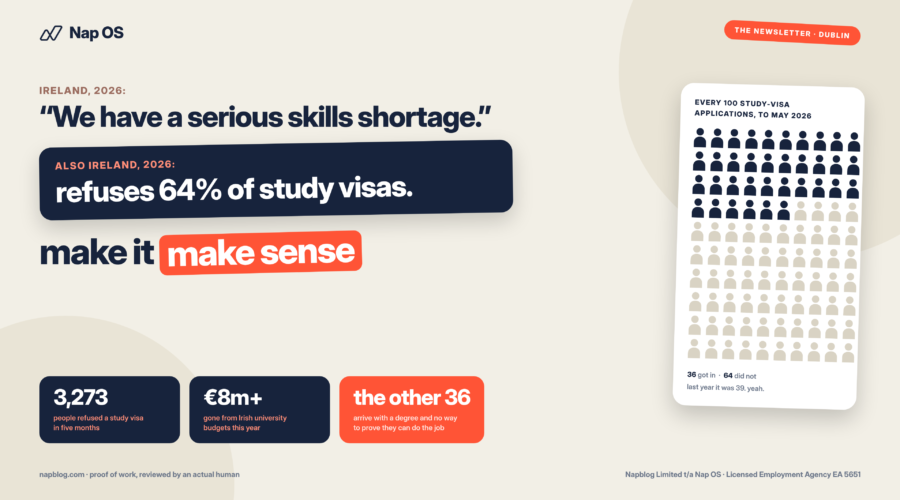
Department of Justice figures show that 3,273 of the 5,097 study-visa applications received by the end of May 2026 were refused—a 64% refusal rate, up from 39% in 2025. The figures cover all study visas, including English-language courses.
The financial consequences for universities are substantial. University College Cork expects a €3.7 million loss, TU Dublin estimates around €2.1 million after approximately 144 students could not take up their places, Munster Technological University estimates €1.39 million, and Atlantic Technological University estimates €1.2 million from 90 refused applicants.
Maynooth University has been notified of 94 refusals, while the Technological University of the Shannon has said some master’s programmes will be cut. The Technological University Association expects losses across its sector to exceed €5 million in 2027.
| Institution | Reported impact |
|---|---|
| University College Cork | €3.7 million expected loss in fee income rte+1 |
| TU Dublin | About 144 students unable to take up places; approximately €2.1 million lost rte+1 |
| Munster Technological University | €1.39 million estimated loss |
| Atlantic Technological University | 90 refused applicants; approximately €1.2 million lost rte+1 |
| Maynooth University | 94 refusals notified |
| Technological University of the Shannon | Some master’s programmes to be cut rte+1 |
The Department of Justice says there has been no change to policy or criteria and that refusals can be appealed. Whatever the explanation, the outcome is clear: accepted students are not arriving, universities are losing revenue, and Ireland risks weakening a talent pipeline that supports its labour market.
Why This Matters Beyond Fees
International students are not only a source of tuition income. They are future graduates, researchers, employees, entrepreneurs, consumers, and potential long-term contributors to Ireland’s economy.
At Trinity College Dublin, non-EU students made up 22.7% of students in 2024/25 but paid 50% of all fee income. That dependence highlights how vulnerable universities can become when international recruitment is disrupted.
But the issue extends beyond university budgets. Ireland’s employers need people with skills in healthcare, technology, finance, engineering, data, operations, and business support. If international students are unable to enter or remain in the country, Ireland loses access to a talent pool that has already chosen Ireland as a place to study, integrate, and build a career.
The challenge is therefore not only recruitment. It is conversion: turning international students into credible, employable contributors who can demonstrate the skills employers need.
The Employment-Permit Context
Ireland’s employment-permit system includes the “50:50 rule.” Under current rules, an employer must ensure that at least 50% of its workforce consists of Irish, EEA, UK, or Swiss nationals when applying for a new or renewed employment permit. If granting the permit would push the employer beyond that ratio, the application can be refused.
The rule is intended to implement Union Preference and protect against displacement of Irish and EEA workers. It applies across all employees of an employer, regardless of role or employment terms, and includes non-EEA workers on employment permits, certain immigration permissions, and beneficiaries of international or temporary protection.
The Government’s General Scheme of the Employment (Miscellaneous Provisions) Bill 2026 proposes a targeted adjustment to this framework. It would give the Minister a regulatory power to adjust the required percentage for specific employments in sectors vital to public services. The initial policy intention is a 60% non-EEA to 40% EEA/UK/Swiss ratio, with a legislative maximum of 75% non-EEA to 25% EEA/UK/Swiss.enterprise.
This is not a universal open-door policy. The proposed flexibility is sector-specific, temporary, and time-bound for up to five years. It is primarily aimed at sectors such as health and social care, where demographic pressures, labour shortages, and service-continuity risks are acute.enterprise.
Why the 50:50 Rule Is Under Pressure
The Government’s rationale is based on demographic and labour-market realities. An ageing population is increasing demand for elder care, nursing homes, disability services, and homecare. At the same time, employers report difficulty recruiting enough Irish and EEA candidates to maintain the current 50% threshold.enterprise.
The Regulatory Impact Analysis also warns that permit refusals could leave migrant workers with invalid permissions and threaten service provision. The proposal is designed to reduce the risk that care providers lose staff or reduce capacity because of rigid workforce-ratio rules.enterprise.
For employers, the issue is practical: they need enough staff to deliver services safely and continuously. For policymakers, the issue is balance: Ireland must protect domestic and EEA labour-market priorities while ensuring that essential services can operate.
The Missing Link: Proof of Work
Visa policy and employment-permit policy address who can enter and who can be hired. They do not, by themselves, solve a deeper problem: how employers can assess whether an international graduate can actually perform the work required.
A degree proves that a student has completed academic requirements. It does not always prove that the graduate can analyse a business problem, build a financial model, manage a project, interpret data, communicate with stakeholders, or deliver a professional output.
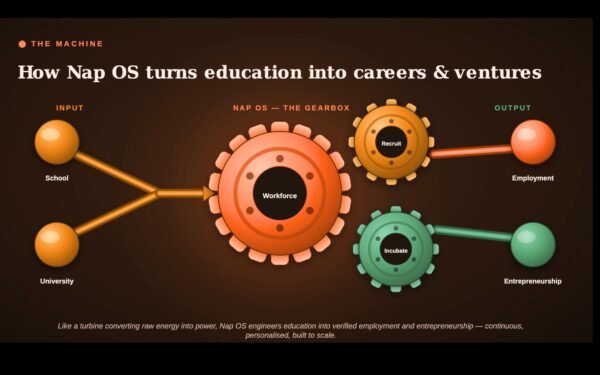
This is where Nap OS becomes relevant. Nap OS is an execution-driven career and recruitment operating system that helps candidates convert knowledge into evidence. It provides project briefs, structured tasks, project-manager review, feedback, and a verifiable record of completed work.
Instead of relying only on qualifications, students can show employers what they have done. That matters in a competitive labour market where employers need confidence that a candidate can contribute from an early stage.
How Nap OS Works
Nap OS offers project briefs across five domains: startup and entrepreneurship, strategy and operations, marketing and sales, product and research, and data and AI. Each brief is structured as ten tasks over two weeks.
Participants choose a brief, complete the tasks, submit work, and receive feedback from a project manager with at least five years of relevant field experience. The project manager reviews submissions against published assessment criteria and returns written feedback within seven days.
On completion, the participant receives a verified record identifying the brief, the work produced, and the criteria used for assessment. The record includes a code that an employer can check.
This creates a more transparent form of evidence than a self-declared skill list. It gives employers a way to see not only that a candidate claims to have a skill, but that they have applied it to a defined problem and had their work reviewed.
Using the Talent Already Here
Ireland already has an international talent pool: students studying in Irish universities, graduates seeking their first professional role, workers on valid permissions, and professionals with international experience. The policy challenge is to use this pool more effectively.
Nap OS can support this in several ways.
For Current Students
Students can begin building work evidence before graduation. A business student might complete a market-entry project, a data student might build a dashboard, and an operations student might map a supply-chain process.
This gives students a portfolio before they enter the job market. It also gives universities a way to connect academic learning more directly to employability.
For Graduates
Graduates who have completed their studies but have not yet secured employment can use structured projects to keep their skills current. Rather than having an unexplained gap, they can show ongoing professional development and completed deliverables.
This is particularly important in competitive markets where employers may hesitate to hire candidates without local experience. A reviewed project does not replace employment, but it can demonstrate initiative, capability, and readiness to contribute.
For Employers
Employers need reliable signals. A candidate’s CV may list tools and qualifications, but an employer still needs to assess practical ability. Nap OS records can provide context: the brief, the tasks, the deliverable, the review criteria, and the project manager’s assessment.
This can reduce the uncertainty that often surrounds international candidates, especially those whose education or work history comes from unfamiliar institutions or markets.
From Credentials to Capability
The Irish labour market does not only need more people. It needs people whose skills match real business needs.
Nap OS’s approach is evidence-first. Its stated aim is to give people access to meaningful project briefs, help them translate knowledge into execution, and enable them to leave with a record of what they have done.
That approach can help address the disconnect between education and employment. A student may study international business, but a Nap OS project can require them to research a market, identify customer segments, assess competitors, build a go-to-market plan, and present a recommendation.
A student may study data analytics, but a Nap OS project can require them to clean a dataset, identify trends, build a visualisation, and explain the business implications. A student may study operations, but a Nap OS project can require them to map a process, identify bottlenecks, and propose a measurable improvement.
These are the types of tasks employers value because they resemble real work.
A Better Model for Ireland
Ireland needs a talent system that is both fair and practical. It should protect opportunities for Irish and EEA workers, but it should also recognise that international students and graduates can help meet genuine skills needs.
A better model would include:
- Clear, transparent student-visa criteria and timely decisions.
- Stronger university–employer connections through projects, placements, and work-based learning.
- Structured opportunities for international students to build local work evidence.
- Employer confidence in verifiable portfolios and reviewed project work.
- Targeted employment-permit flexibility where labour shortages are genuine and service continuity is at risk.enterprise.gov+2
- Better use of the talent already in Ireland, rather than relying solely on new recruitment from abroad.
Nap OS cannot solve visa refusals or change employment-permit law. But it can help ensure that international students who do come to Ireland, and graduates already in Ireland, are not left with only a degree and a job-search struggle. It can help them build a credible record of capability.
What Universities Can Do
Universities should treat employability as part of the student experience, not as an afterthought. They can integrate project-based learning, employer challenges, industry mentors, and portfolio development into programmes.
Nap OS offers a model for this. Its platform can help universities deliver industry-partnered internships, collaborative projects, and research opportunities by providing a digital operating system for career execution.
For universities facing financial pressure from lost international enrolments, this is also a reputational issue. Students choose Ireland because they expect high-quality education and a credible route into professional life. If graduates cannot convert their studies into work, Ireland’s attractiveness as a study destination weakens.
What Employers Can Do
Employers can broaden how they assess potential. Instead of requiring local experience as a default filter, they can consider verified project work, portfolios, technical assessments, and structured probation periods.
They can also partner with universities and platforms such as Nap OS to define real business problems that students can work on. This creates a pipeline of candidates who have already practised the kind of thinking and delivery required in the workplace.
The goal is not to lower standards. It is to assess standards more fairly and accurately.
A Practical Path Forward
Ireland’s current situation exposes three connected problems: visa refusals are reducing the inflow of international students; universities are losing revenue and programme capacity; and employers still need skills that are difficult to fill.enterprise.
Nap OS addresses the part of the problem that policy alone cannot solve: the evidence gap between education and employment. By helping students complete reviewed, employer-relevant project work, it gives Ireland a way to develop and recognise the talent already available.
The country does not need to choose between protecting domestic workers and using international talent. It needs a system that does both: protects fair access to employment while giving capable international graduates a transparent route to prove their value.
Nap OS’s proposition is simple: execution meets evidence. For Ireland, that may be one of the most practical ways to turn an international talent pool into a workforce that meets the country’s real skills needs.