7 min read
An admission letter opens a door. Preparing a student for what comes after that door requires a different kind of support.
International education consultancies help students make significant decisions: where to study, which programme to choose and how to prepare for departure. But a student’s ambitions usually extend beyond reaching a university campus.
They want to develop professionally, explain their capabilities and compete for relevant opportunities. Parents want to understand how the investment in overseas education connects to their child’s development.
Nap OS is inviting education consultancies to explore that next chapter together.
Our proposed Partner Programme connects suitable students with a twelve-month International Workforce Development Programme: structured project work, experienced Project Manager guidance, human review and portfolio development.
The aim is better preparation—not a promise of employment.
Beyond admission: prepare students to demonstrate capability
A qualification communicates academic achievement. A portfolio can add something different: examples of how a person approaches a practical task.
What happens when a student receives an unfamiliar brief? How do they identify assumptions, organise information and explain a recommendation? Can they respond constructively when a reviewer challenges their approach?
These are the questions Nap OS is designed to help participants explore.
Through the programme, students develop outputs they can discuss in applications and interviews. They practise explaining not only what they produced, but why they made particular decisions.
For consultancies, this creates a potential extension to the student journey: a defined learning service alongside existing admissions support, without presenting the two as the same activity.
One programme. Twelve months. €999.
Nap OS has one student pricing model: €999 for the twelve-month programme.
The proposed structure combines six months of pre-departure preparation with six months of continued development after arrival.
Students begin while they are still planning their overseas journey. They continue alongside their studies, building on earlier work rather than starting their career preparation from nothing after landing.
The initial proposed pathway focuses on Ireland-bound students. Expansion to other destinations should follow suitable reviewer capacity and delivery arrangements—not marketing ambition alone.
Travel is not a requirement for meaningful learning. If departure is delayed or plans change, the projects can remain useful, with continuation or pauses governed by the programme’s agreed terms.
Months 1–6: turn preparation into practical progress
The first stage gives students a structured way to begin.
Participants select a relevant domain, understand a project brief and work toward defined deliverables. They can request guidance, submit their outputs and use feedback to improve them.
A data-focused participant might analyse a synthetic dataset. A marketing participant might develop a campaign proposal. A product learner might prepare a research plan and explain the reasoning behind it.
The purpose is not to create busywork.
It is to practise approaching a task with clarity, making decisions and responding to professional expectations.
By departure, a participant may have reviewed work to discuss—not simply an intention to start developing a portfolio later.
Months 7–12: continue after arrival
The second stage connects preparation with the student’s changing circumstances.
Participants continue project work alongside their academic timetable and other responsibilities. Mentoring can help them review priorities, discuss obstacles and make realistic plans.
Career-readiness support then connects to evidence already being developed.
A CV statement can refer to an actual output. A mock-interview answer can explain a genuine decision. A portfolio discussion can show how feedback changed the work.
Nap OS does not assume that every participant has unlimited time.
The programme needs manageable expectations and clear scheduling arrangements. Consistency should come from useful support—not pressure to appear constantly active.
Learn with professionals who understand the destination
The proposed reviewer model centres on experienced professionals, with the initial bench strongest in Ireland.
Where available, students can receive guidance from Project Managers with relevant experience of the market they are preparing to enter.
That experience can help contextualise feedback: how to present a recommendation, communicate uncertainty, explain a limitation or ask a stakeholder a clearer question.
Professional relevance matters more than nationality. “Destination-experienced” should mean appropriate knowledge and practice, not an unsupported claim that a native reviewer automatically guarantees better outcomes.
Matching will depend on domain, availability and actual capacity.
Nap OS should make those limits visible rather than imply that every destination is already covered.
What participants are intended to receive
The proposed service schedule includes:
- Twelve individual career and progress sessions.
- Four individual mock interviews.
- Twenty-four group career-readiness workshops.
- Twelve small-group project-review clinics.
- Three CV and LinkedIn review cycles.
- Two assessed practice projects.
- Learning resources during the programme.
- Between-session support through a defined channel.
The contact schedule comprises twelve individual hours and thirty-six shared group hours if all included sessions are attended.
Access to a wider project library should not be confused with unlimited formal assessment.
Final entitlements, delivery capacity, booking arrangements and support limits must be confirmed before enrolment. Students and partners should know exactly what is being offered.
A learning record—not an inflated employment claim
The value of a reviewed project depends on how accurately it is described.
A useful record identifies the brief, project type, outputs, assessment criteria, reviewer and relevant dates.
A practice scenario must remain labelled as practice. A fictional-client exercise must not imply employment with a real business. An authorised external assignment needs its own clearly stated terms.
The record is not a degree, accredited qualification or guarantee of workplace performance.
It is an account of work that was completed and reviewed within a defined context.
This clarity helps students explain their development honestly and gives prospective employers something specific to inspect.
The partner app: referrals with a clear next step
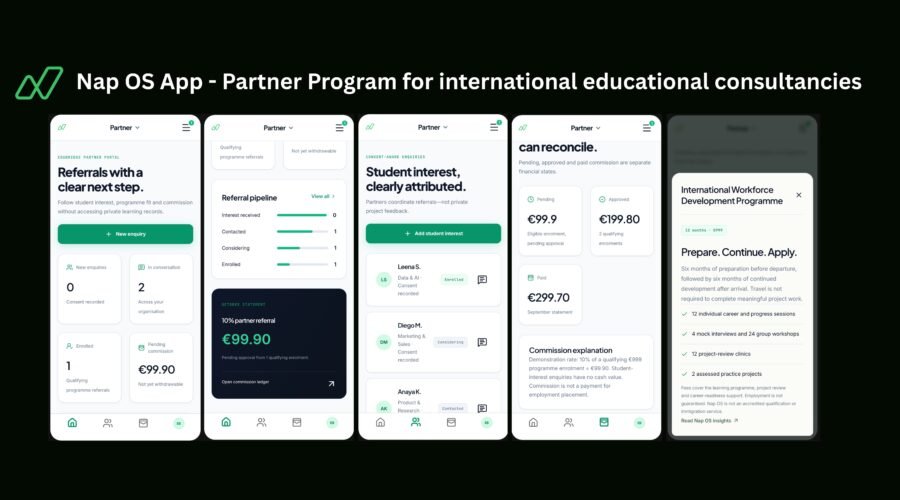
The Nap OS partner interface is being developed to organise student interest, referral progression and commission visibility.
The preview shows the intended experience: partners can follow enquiries, distinguish students who are considering the programme from those enrolled, and inspect separate pending, approved and paid commission states. It also makes clear that referral coordination does not include unrestricted access to private learning records.image.jpg
The objective is straightforward administration.
A counsellor should be able to understand what happens next without relying on scattered messages. A partner should also be able to raise a query when an attribution or financial record needs clarification.
Early access will help test these workflows before wider rollout.
A transparent 10% referral model
The proposed partner fee is 10% of eligible programme revenue actually collected under the written agreement.
For a qualifying full-price €999 enrolment, the illustrative fee is €99.90 before relevant adjustments.
That means:
- Ten qualifying full-price enrolments: €999.
- Twenty-five: €2,497.50.
- Fifty: €4,995.
These are commercial illustrations, not sales forecasts or guaranteed earnings.
The agreement must define attribution, existing contacts, refunds, chargebacks, discounts, applicable tax treatment and payout timing.
An enquiry has no commission value by itself. Pending commission is not the same as an approved or completed payment.
The fee rewards an eligible programme introduction—not a student obtaining employment.
Complement the consultancy’s work
The proposed partnership is non-exclusive.
The consultancy continues providing its own services under its own brand. Napblog remains responsible for the separate Nap OS programme.
A partner would nominate a coordinator, introduce suitable students, use approved materials and follow the agreed referral process.
Napblog would provide programme information, coordinator training, onboarding and delivery.
Before launch, both organisations should map existing services. If a consultancy already provides career support, the discussion should identify genuine additional value rather than duplicate it.
Student information should be shared only through appropriate, transparent arrangements.
A referral relationship should simplify the journey—not create uncertainty about who is responsible.
Give parents clarity rather than guarantees
Parents deserve a plain explanation of what the programme buys.
It buys a defined learning service: projects, professional guidance, assessment and career-readiness activities.
It does not buy a job, visa, admission decision or insurance against an unsuccessful outcome.
Parents can be reassured by named contacts, clear entitlements, documented progress and an accessible process for questions.
For adult participants, any parent-facing progress access should follow the student’s permission. Paying for the programme does not automatically grant access to every private learning discussion.
Trust should come from accountable delivery and honest boundaries—not from promises no provider can responsibly make.
Start with a pilot and build from evidence
Nap OS welcomes discussions with consultancies, language schools and training organisations serving suitable students.
The recommended beginning is a controlled, capacity-confirmed pilot—not a large enrolment commitment.
Together, we would examine student profiles, relevant courses, departure timelines, counsellor involvement and programme fit.
A demonstration should show the brief, review process, sample output and proposed partner workflow.
Success should then be measured through suitable referrals, paid enrolments, participation, feedback quality, delivery performance and partner experience.
A signed agreement is a beginning. A useful programme that students engage with—and partners choose to introduce again—is stronger evidence.
Join the early-access conversation
Nap OS is inviting international education consultancies to explore a partnership that connects overseas-study preparation with a structured year of practical development.
Help students reach their destination. Work with us to help them arrive with work they can explain—and continue improving after arrival.
To request early access or a partnership discussion, email palani@napblog.com.
Please include your organisation, countries served, principal study destinations and the student groups you support.
Let us begin with a clear question: where can reviewed project learning genuinely add value to your students’ journey?