7 min read
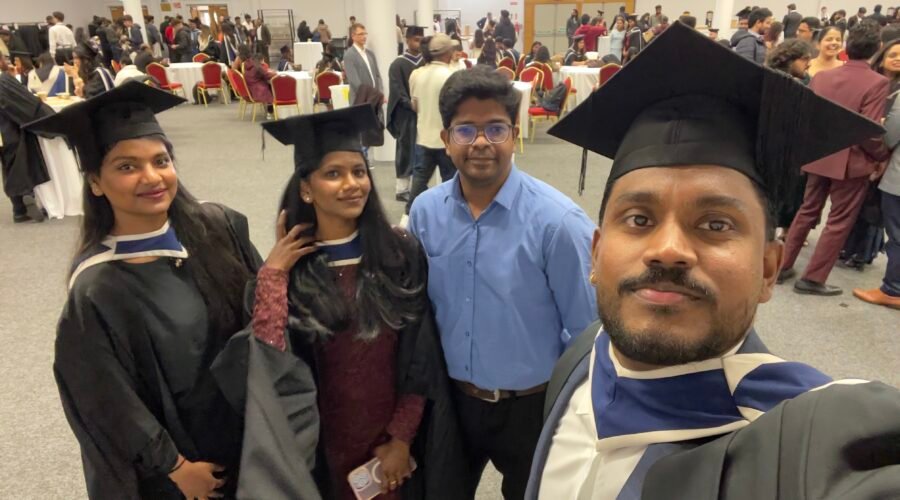
On 28 October 2026, Nap OS founder Pugazheanthi Palani and members of the team joined the graduation celebrations of participants in the Nap OS community, marking an important milestone in their academic and professional journeys.
It was an occasion for congratulations, photographs and recognition of the commitment behind a postgraduate degree. It was also an opportunity to reflect on what graduates carry into their next chapter: not only a qualification, but the work, decisions and learning that can help them explain their capabilities.
For Nap OS, that combination matters.
A degree deserves recognition in its own right. A project portfolio can complement it by making practical development visible.
Today’s celebration brought those two stories together: academic achievement and evidence of learning through doing.
Celebrating the people behind the progress
Graduation provides a moment to pause.
The next application, interview or professional exam can wait long enough to acknowledge what has already been accomplished. Completing a course of study involves sustained effort, and the ceremony gives that effort a visible milestone.
For the Nap OS founder and team, attending was an opportunity to recognise the people behind the project submissions and profile updates.
Participants are not simply accounts on a platform. They are individuals making choices about education, work and their future.
The graduation photograph captures a shared celebration. It does not need an exaggerated success claim to be meaningful. Being present, offering congratulations and recognising the achievement are important in themselves.
An accounting and finance journey
Among the experiences highlighted is that of Pavithra Suresh, whose shared profile lists an MSc in Accounting and Finance at Dublin Business School.
Her profile also describes participation in the “Nap OS Workforce — Finance Project Programme” alongside her studies. It sets out practical activities including financial and market research, data collection, analysis and visualisation using Excel and Power BI, and reporting trends and recommendations.
These details give the learning journey substance.
“Finance projects” can otherwise remain an abstract phrase. Naming the activities helps a reader understand what the participant has been practising and what kinds of outputs they may be able to discuss.
The academic qualification and the project programme remain distinct. Each contributes a different part of the participant’s development story.
A portfolio alongside the qualification
A qualification communicates completion of an academic programme. A portfolio can provide selected examples of applied work.
For a graduate, that might mean showing how information was organised, how a visualisation was constructed or how a recommendation was explained.
The portfolio does not need to compete with the degree.
It can sit alongside it.
That is a more credible ambition than claiming that project work automatically places someone above every other graduate. Candidates have different strengths, backgrounds and opportunities. No single document captures all of them.
What a well-described portfolio can do is give its owner more specific material for a professional conversation.
Instead of relying only on “I have studied this,” a participant can add, “Here is an example of how I approached it.”
Why accurate descriptions matter
One important detail in Pavithra’s shared profile is its explanation of the programme’s status.
It describes a self-directed learning programme, with practice-project briefs and portfolio outputs, rather than a job. It also describes written procedures, coaching and one-to-one review against published criteria.
That clarity matters.
Members of a startup community may informally be called interns or contributors, but a public description should reflect the actual arrangement.
Practice projects should not be presented as employment. Learning support should not be confused with an accredited qualification. A portfolio record should state what happened rather than borrow a more impressive label.
This does not diminish the work.
It gives future readers a clearer basis for understanding it.
From tools listed to work explained
Excel and Power BI are listed in Pavithra’s account of her project activity. Financial analysis, data visualisation, report writing and presenting to a reviewer are also identified.
The next useful step is explaining how those skills were used.
What question was the analysis intended to answer?
How was the information organised?
Which chart made the findings easier to understand?
What limitations remained?
How did the recommendation follow from the analysis?
These are the questions a portfolio can help prepare someone to discuss.
The name of a tool is a starting point. The reasoning behind the output gives the discussion depth.
A graduate should be able to describe not just what software appeared on their screen, but what they were trying to accomplish with it.
The importance of review
Independent work develops initiative. Review introduces another perspective.
A participant may believe a report is clear until a reviewer asks what a particular recommendation means. They may consider a chart complete until someone questions the assumption beneath it.
That exchange can turn an output into a learning opportunity.
The value is not merely receiving approval.
It is understanding why a decision works, where it is weak and what should change.
Pavithra’s programme description specifically refers to one-to-one review against published criteria. That is a useful distinction from simply collecting completed files.
A portfolio becomes more informative when the participant can explain both the original approach and the improvements made after feedback.
Presence matters to a young company
For a founder, product development often means concentrating on systems: onboarding, project briefs, scheduling, reviews and delivery.
Graduation brings the focus back to people.
Pugazheanthi Palani’s attendance with the Nap OS team connected the company’s work with a personal milestone in its community.
That does not establish a hiring outcome or prove that the programme caused academic success. It demonstrates something simpler: a willingness to recognise participants beyond the immediate tasks of the programme.
A young company’s relationships are shaped through ordinary actions as well as formal processes.
Showing up to celebrate is one of those actions.
The challenge is to carry that care into everyday delivery, not leave it in a photograph.
Standing out without claiming superiority
Graduates understandably want their applications to stand out.
A distinctive portfolio can help someone communicate the combination of interests and activities that makes their story individual.
But standing out should not require saying that everyone else is unprepared.
Academic work, previous employment, volunteering, caring responsibilities, independent study and personal projects can all contribute to someone’s development.
Nap OS’s contribution is narrower and more practical: a structured setting in which participants can work on briefs, receive feedback and organise selected outputs.
The strongest message is not “our graduates are better than the rest.”
It is “these graduates have additional work they can explain.”
That respects the participant’s achievement without making a comparison the evidence cannot support.
The next chapter needs specific conversations
After graduation, a portfolio can become a starting point for reflection and applications.
The graduate can select an output relevant to a role, describe their contribution and explain what they would improve.
An employer may then ask more detailed questions.
For an accounting and finance graduate, a discussion could explore how a finding was presented, how uncertainty was communicated or how a conclusion was checked.
Those conversations are valuable because they move beyond broad claims.
They also leave room for honesty.
A practice project may not reproduce the complexity of a workplace. A participant may still need training. Recognising those limits is compatible with showing initiative and development.
Confidence and accuracy can exist together.
Keep the achievement in the graduate’s hands
The participant should remain at the centre of how their story is shared.
A graduation photograph, professional profile and project portfolio serve different purposes. None should automatically become permission for unlimited promotional use.
When Nap OS tells a participant’s story, it should preserve the distinction between their academic achievement, their project learning and any later employment outcome.
It should also respect their choice about which outputs and personal details are public.
The graduate has done the studying and the work.
The company’s role is to describe its contribution proportionately, recognise the wider achievement and avoid taking credit for more than it can demonstrate.
That approach supports trust over time.
What this celebration means for Nap OS
Today’s celebration is not the end of a product story.
It is a reminder of the standard the product needs to meet.
Useful briefs must be understandable. Feedback must be thoughtful. Records must be accurate. Participants should know what they are receiving and how to make use of it.
The technology matters when it supports those responsibilities.
For Nap OS, the aspiration is to help learners connect practical activity with an account they can explain confidently: the question, the output, the review and the improvement.
Graduation makes that purpose tangible.
There is a person behind every project, and a future beyond every submission.
Congratulations to the graduates
On behalf of Napblog Limited and the Nap OS team, congratulations to the graduates celebrating on 28 October 2026.
Congratulations on the qualification, the effort behind it and the decision to keep developing.
To Pavithra and fellow members of the Nap OS community, the next chapter does not require pretending that every question has been answered.
It begins with recognising what has been achieved and being ready to build on it.
A degree to celebrate.
A portfolio to discuss.
A learning journey that continues.
That is what made today worth sharing.