7 min read
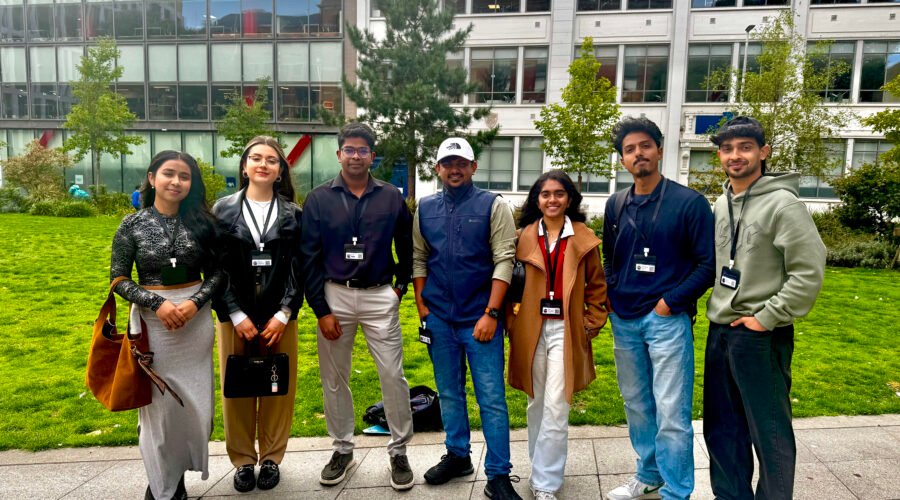
We met in person on Sunday 4 October. Not to plan — to conclude.
That distinction mattered. By the time twelve of us were in a room together, the building was done: the stand collateral was at the printer, the landing page was live, the tracking was wired, the follow-up email was authenticated and tested. The purpose of Sunday was to close the open questions, agree who does what, and walk out with nothing left hanging.
On Tuesday 6 October the RDS opens at 11am and runs to 5pm. Over 80 employers. Close to 10,000 graduates moving through that hall across six hours. We get one run at it.
Here is what we concluded.
Every conversation at that stand is attributable to the person who had it
This was settled first because everything else hangs off it.
Each of the twelve carries their own ID card, and each card carries its own QR code. Not one shared company code — twelve distinct destinations, each with its own reference. Mine is GI-ID-PP. Anirudh’s is GI-ID-AV. Karthik’s is GI-ID-KS. They all land on the same page, but the campaign parameters differ, so when the leads arrive we can see which conversation produced them.
That sounds like a detail. It is the difference between two kinds of Wednesday.
The usual outcome of a careers fair is a pile of contacts and a general feeling that it went well. We wanted to sit down on Wednesday morning and know that a particular person, standing in a particular spot, having a particular kind of conversation, produced a particular number of sign-ups — and that someone else, three feet away, did not. That is uncomfortable information. It is also the only kind that tells you what to do differently.
The same logic runs through every surface we print. The roller banner has its own code. The A5 flyer has its own. The A3 poster going up in a Dublin print shop has its own. If we learn that the banner outperformed the flyer three to one, that changes what we print for the next fair.
We did not bolt measurement on at the end. It was the constraint we designed around from the first file, and Sunday was where we confirmed every code resolves to the right person. We decoded all twelve off the finished print file and checked them character by character against the list, because a QR that silently points at the wrong team member looks identical to one that works.
The one sentence we are not allowed to say
Napblog Limited trades as Nap OS and holds an Irish employment agency licence — EA 5651, under the Employment Agency Act 1971. That licence carries a rule which shaped more of our collateral than any marketing decision did: an employment agency in Ireland may not charge a jobseeker for finding them work.
So every priced piece carries the same line. Fees cover project briefs, Project Manager review and career support — not recruitment or job placement. Employment is not guaranteed.
An earlier price card was headed “until you get a job”. It had to go. Not because it misrepresented our intent, but because tying a fee to the outcome of being hired is precisely what the licence forbids.
Losing it improved the pitch. “Until you get a job” is a promise about something we do not control. What we do control is the work: you choose a real project brief, you build something, a named Project Manager reviews it with you one-to-one, and you leave owning what you made plus a written reference from the person who reviewed it. That is a smaller claim and a truer one — and on Tuesday every one of us will be making it to graduates who have heard a great many promises already.
The compliance constraint did the editing we should have done ourselves.
Three trades we confirmed on Sunday
The flyer. We built a founder-led side first — my own story, a QR to my LinkedIn, the full personal-brand play. We set it aside. The side that went to print carries a collaboration with The Place Street Food on Grand Canal Street: swap the flyer, get 20% off a meal, one per person.
The reasoning was unsentimental. A graduate at a careers fair is carrying a dozen flyers by lunchtime and will bin eleven. A flyer worth money at a food market on the same street does not get binned. The founder story can wait for a channel where someone has already chosen to listen.
We also print no validity date on the offer. An expiry is a reason to deal with it later, and later means never.
WhatsApp stays out of the first touch. We have a working WhatsApp integration and the temptation to use it at the stand was real — scan, message, instant conversation. We confirmed on Sunday that we will not. Messaging a stranger on WhatsApp intrudes on a private space and suppresses sign-ups rather than driving them. The first touch is an ordinary form: name, email, optional phone, a consent tick. WhatsApp is support after someone has opted in, never cold first contact.
All three prices on the table. Our marketing has historically led with the €49.99 monthly plan alone. The fair collateral shows the free tier, the €49.99 monthly plan and the €999 option together. A graduate standing at a stand for ninety seconds should see the whole ladder — including the rung that costs nothing — and place themselves on it without having to ask.
The print shop nobody puts on a plan
One of the more useful conversations of the whole preparation was not with a university or an employer. It was with a Dublin print shop.
They mentioned in passing that fifty-odd people a day come in to print their CVs. Fifty people a day, standing at a counter, holding a freshly printed CV, at the exact moment they are most aware that the document in their hand says what they studied and not what they can do.
So we made an A3 poster for the wall above that counter. The headline is “Just printed your CV?” and it carries its own tracked code. One afternoon of design and the price of a single A3 print.
The lesson I keep taking from it: the best lead sources are rarely on the plan. They surface in conversations you were having for another reason, and you only catch them if you are listening for them.
The unglamorous half — making sure the email actually lands
Here is the part of final preparation I suspect most exhibitors skip, and the part I am gladdest we did not.
When someone scans a code and fills in the form at the stand, a project brief goes to them by email within seconds. That email has to arrive. Not “probably arrive” — arrive, verifiably, into an inbox rather than a spam folder.
So we tested it as a real lead and read the raw headers at the receiving end. SPF passes. DKIM passes, aligned to napblog.com on our own signing key rather than only to our email provider’s domain. DMARC passes. We ran it again from an entirely unrelated consumer Gmail account, because testing deliverability by sending to your own domain proves less than you think.
Then the finding that actually mattered: it lands in the Promotions tab, not Primary. Not spam — the inbox, correctly authenticated, exactly where a legitimate marketing email belongs. But our own confirmation page was telling people to check junk, which points them at the one place it definitely is not.
A graduate who looks in Spam, finds nothing and shrugs is a lead we paid for and then lost at the last inch. Two days out, that is a copy change. Two days late, it is a week of wasted conversations.
Why the twelve are who they are
The team at the stand is deliberately mixed. Project Managers who will actually do the reviewing. HR. A student ambassador from National College of Ireland and a pilot thesis student from UCD — people the same age as the graduates they are talking to, who can answer “is this real?” far more credibly than I can. Marketing interns running the campaign. A candidate currently going through the Nap OS Incubate pilot himself.
That mix is the argument, not a staffing convenience. Our whole position is that what a graduate cannot get from AI is human feedback and an understanding of how Irish workplaces actually work. AI can do the task. It cannot teach you that. If the claim is that a named human reviews your work, the stand should be staffed by the humans who will review it — not by people hired to hand out paper.
What we will know on Wednesday
Scans per surface. Scans per person. Completions against scans — the drop-off between interested enough to scan and willing enough to type. Which of the five project domains graduates pick when you let them pick more than one. Which price tier they say they want before anyone has sold to them.
None of that is vanity. It feeds the funnel we are building for investors and for an Enterprise Ireland application, and it decides what we print next time.
We spent Sunday closing questions so that Tuesday is pure execution. Six hours. Twelve people. Twelve codes. Almost ten thousand graduates walking past.
We are ready, and we are looking forward to it. See you at the RDS.
Napblog Limited, trading as Nap OS. Licensed Employment Agency EA 5651. EdTech Ireland Network Member. Fees cover project briefs, Project Manager review and career support — not recruitment or job placement. Employment is not guaranteed.