7 min read
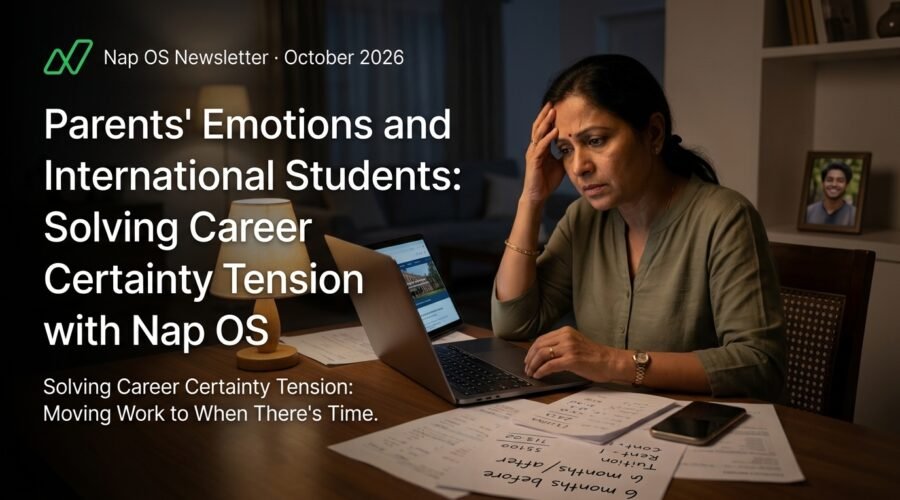
Somewhere tonight a parent is awake at three in the morning doing arithmetic.
Not the tuition arithmetic. That one is settled — the fees are known, the loan is arranged or the savings are moved, and the number has been said out loud enough times to stop being frightening. The three-in-the-morning arithmetic is the other one. What happens after they land? The degree takes a year or two. The permission to stay after it is shorter than it used to be. And somewhere in between, their child has to turn a foreign qualification into a job in a country where nobody has heard of their school, their college, or them.
That is the fear. It is not irrational and it is not snobbery. It is a parent correctly identifying that the expensive part of this decision is not the part they have already paid for.
I want to write about what Nap OS does for that specific worry. But first I have to deal with a phrase.
The word we are not going to use
People keep describing what we do as career insurance. I understand why — it is a vivid shorthand, it sits neatly beside the health cover every student has to buy anyway, and it makes the decision feel structural rather than optional.
We are not going to use it, and the reason is simple enough to state in one line.
Insurance pays out. That is the entire idea of it. Something bad happens, and money arrives to make you less badly off than you would otherwise have been. If your child’s visa is refused, Nap OS sends you nothing. If they graduate and the applications go quiet, Nap OS sends you nothing. We are not an insurer, we are not regulated as one, and we could not carry that risk if we wanted to.
So a word that promises a remedy we do not provide is a word I would be using to make you feel something I cannot deliver. Our homepage says this in plain text, in the section written for the person paying: not a job, not a visa, not a qualification, not insurance. I would rather you read that and decide we are honest than read “insurance” and decide we are reassuring.
Here is what I think you are actually buying. It is narrower, and I think it is worth more.
The real problem is a clash of calendars
Ask anyone who has done this and they will tell you the hard part was not getting in. It was the first year after landing, when the time you need and the time you have stop matching.
Three things happen at once, and they happen in a bad order.
Rent starts before the career does. Your child arrives with good grades, a degree nobody locally has heard of, and no work anyone in that country can check. The job that is available is the one that is available — retail, delivery, a warehouse. It pays, and that matters. It also takes their evenings.
The application windows open early. Internship and graduate recruitment in most markets opens in the first months of a course, not at the end of it. So the moment your child most needs something to show is the moment they have had the least time to build it.
And the window after graduation is narrower than it was. The UK’s post-study Graduate route drops from twenty-four months to eighteen for applications from 1 January 2027. Less room to catch up later; more weight on arriving ready.
None of this is anybody’s fault. It is a scheduling problem. And scheduling problems are solved by moving work to the time when there is time.
Six and six
So that is what the programme is. Twelve months, split deliberately.
Months 1–6, while they are still at home. Between an offer and a flight there is a long, strange stretch of waiting — on college intakes, on paperwork, on a visa decision. That wait is the single most wasted asset in the whole journey, and it is the only part of it with real hours in it. Your child uses it: one brief a fortnight — ten tasks, in a field they choose from five, with the assessment criteria published before they start — each one read and judged by a named Project Manager. By the time they board the plane they are carrying finished work with dates on it.
That is the half you can only do early. It is the entire reason to start twelve months out rather than on arrival.
Months 7–12, after they land. They keep going alongside their semesters, at whatever pace the course leaves them, right up to the point that matters: the weeks when internship and graduate applications open. Most students reach that week with a local CV showing whatever part-time work paid the rent. Your child reaches it adding to a portfolio that already has reviewed work in it — with the earliest entries dated before they arrived.
I want to be careful here, because this is where most companies in my industry start promising things. We are not telling your child to turn down the part-time job. On an Irish student permission they may work twenty hours a week in term time and forty during the holidays, and for most families that income is not optional. Nap OS does not pay rent and does not claim to remove the need to earn. What changes is what sits beside that job on the CV when the window opens. A CV that reads warehouse shifts and three reviewed projects is a different document from one that reads warehouse shifts.
What the money buys, in full
€999 for the twelve months, paid once. Or €49.99 a month, rolling, if you would rather not commit a year at a time.
A brief every fortnight. Written feedback within seven days. Live one-to-one calls with a named Project Manager who has at least five years actually doing that work — three a month on the monthly plan, ten a month on the twelve-month plan, booked when they are needed. Reviewers are paid by the hour rather than per submission, which is deliberate: paying per submission rewards speed, and the thing you are buying is somebody taking the time to read it properly.
And at the end of each brief, a record: what your child did, what it was judged against, and a link an employer can follow to check it. Theirs permanently, whether they stay a member or not.
What it does not buy: not a job — we are a licensed employment agency (EA 5651) and Irish law forbids us from charging a jobseeker to find them work, so employment is not guaranteed and anyone who guarantees it to you should worry you. Not a visa — no third party improves an immigration decision, and the people telling you otherwise are selling something. Not a qualification — we are not accredited, there are no credits, and we have chosen not to sell a certificate at all, which means there is no premium tier to upgrade to and nothing to buy again when an application goes quiet.
That last one matters more than it sounds. Career help usually arrives after the rejections start, and it is usually sold separately, at the worst possible moment to be making a financial decision. Ours is bundled into the work, in advance, while the project can still change.
It holds whichever way the next two years go
This is the part I would actually want to hear, if it were my money.
If they travel on schedule, they arrive with finished work instead of a plan.
If the dates slip — and dates slip constantly — the work carries on from home. Nothing about it requires them to be anywhere in particular.
And if they decide not to go at all, or a rule changes and the decision is made for them, the projects and the record are still theirs. Still reviewed by somebody with real experience. Still worth showing to an employer in their own country.
Nothing in this programme depends on anyone being granted anything. That is not a promise about outcomes. It is a statement about structure, and you can verify every word of it before you pay.
What peace of mind is actually made of
I do not think peace of mind comes from a guarantee. Guarantees in this industry are mostly decorative, and parents in India, Nigeria and Brazil have heard enough of them to have stopped believing any of them.
I think it comes from being able to see something. Twelve months from now, you will be able to open a link and look at what your child produced, who assessed it, and what they were judged against. That is not protection. It is a receipt — and a receipt from a programme that told you in advance exactly what it would and would not do is worth more than a promise from one that would not.
We have two hundred active members, six hundred briefs generated, and twenty-eight alumni now working at twenty-four employers. Those are small numbers and I am not going to dress them up. They are also real, and checkable, which is more than most of what you will be shown this year.
Start free: os.napblog.com — or read the whole thing, including the four things we refuse to claim, at napblog.com.
Pugazheanthi Palani is Founder and CEO of Napblog Limited, trading as Nap OS, a licensed employment agency (EA 5651) at 77 Camden Street Lower, Dublin 2. Fees cover project briefs, Project Manager review and career support — not recruitment or job placement. Employment is not guaranteed. Nap OS is not accredited and is not a qualification. Figures: Nap OS platform data, October 2026. Irish student work limits: Citizens Information. UK Graduate route duration: gov.uk, Statement of Changes HC 1333, 14 October 2025.