7 min read
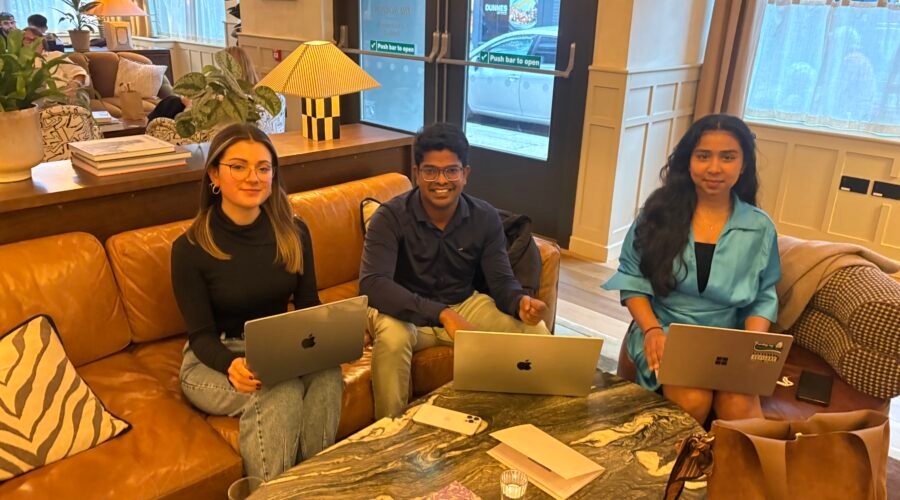
The value of Nap OS becomes clearest when a learner has real work in front of them, a deadline that matters and an experienced person reviewing the decisions while they are still fresh. That is what happened when Nefise Adiloglu and Namrata Ghoghari moved into the second working session of the Nap OS gradireland campaign. The task was no longer to discuss social media in theory. They had to help prepare a post, launch it, distribute it and understand what happened next.
Pugazheanthi Palani, Founder and CEO of Nap OS, acted as the Project Manager for the session. He did not replace the students’ work or turn the meeting into a lecture. He connected their individual tasks to the commercial purpose of the campaign, challenged their assumptions and helped them make decisions in real time. The work itself remained theirs. His role was to make the learning specific, accountable and useful.
From the careers fair to the working session
The gradireland Graduate Careers Fair 2026 gave the campaign a demanding public test. Twelve Nap OS team members worked together at the RDS, distributed 3,000 flyers and recorded more than 100 early-adopter expressions of interest. The day generated conversations, form submissions and content, but those outputs did not organise themselves. They created a second problem: how should the team explain what happened, reach the right audience and continue the campaign after the exhibition hall closed?
That problem became the next project. Nefise and Namrata had already participated in the campaign as marketing interns. At the fair they spoke with graduates, supported lead-generation activity and saw which questions repeatedly appeared. They therefore entered the second session with direct knowledge of the audience. The social media launch was not an invented classroom case. It was the continuation of work they had helped deliver in person.
The distinction matters. A hypothetical assignment can test whether a student understands a framework. A live campaign tests whether the student can make a choice when the information is incomplete, the timing is fixed and other people depend on the result. That is where knowledge begins to look like professional capability.
What the students were learning
Social media work can look deceptively simple from the outside. A finished LinkedIn post may contain only a photograph, several paragraphs and a few tags. The professional work sits underneath it. Someone must identify the audience, choose the message, decide what evidence can be claimed, obtain the correct assets, coordinate contributors, publish at the right time and distribute the post without turning the campaign into noise.
During the working session, the launch became a sequence of decisions. What was the purpose of the post? Was it documenting an event, generating interest in Nap OS or recognising the team? Which facts from the fair were strong enough to publish? What should a reader do after seeing it? Which people and organisations should be tagged? How should the message change when distributed through a founder profile, a company page or an intern’s own network?
These questions are difficult to learn from a slide because every answer depends on context. Pugazheanthi could explain why a particular message supported the Nap OS position, then ask Nefise and Namrata to apply that reasoning to the actual post. They could see the content move from draft to publication and then into distribution. The feedback arrived while the decisions were still visible, rather than weeks later as a grade.
Different starting points within one project
Namrata is completing an MSc in Marketing at the National College of Ireland and has experience across digital marketing, social media, SEO, Google Ads and market research. Her Nap OS work included campaign planning, outreach and performance tracking. She also represented the team at the NCI Part-Time Jobs Fair, where more than 100 students expressed interest and more than 30 took an early-adopter step.
Nefise is a business student at Griffith College Dublin with interests in marketing, sales and business development. At gradireland she engaged with graduates and supported lead generation. She described the experience as a way to apply classroom marketing concepts and build confidence in professional communication.
The two students did not need identical backgrounds to work on the same brief. They needed a shared objective, clear responsibilities and review criteria. Nap OS can keep the commercial problem common while allowing each learner to build evidence relevant to her own direction. One portfolio may emphasise social media planning and content distribution. Another may emphasise audience conversations, CRM follow-up or campaign measurement.
Why Project Manager association changes the experience
Self-directed work is valuable, and Nap OS keeps project briefs accessible to people who want to learn independently. The limitation appears when the learner has nobody qualified to challenge the work. Friends can encourage one another, and software can check structure, but neither automatically provides accountable professional judgement.
A Project Manager adds context that a task list cannot hold. Pugazheanthi knew why Nap OS attended gradireland, what the campaign had promised, which claims could be supported and what the next commercial step required. He could therefore review the students’ choices against the real purpose of the project. The session linked each social media action to audience, product position and follow-up rather than treating posting as an isolated activity.
The launch as a portfolio record
A social media post is only the visible end of the project. For Nefise and Namrata, the stronger portfolio record can show the campaign objective, the intended audience, the message selected, the distribution plan, the live post and the results observed after publication. It can also include a short reflection explaining which decision changed after Project Manager feedback and why.
This gives a future interviewer several useful points to examine. The candidate can explain how she converted an event outcome into content, adapted a message for different channels, coordinated with stakeholders and responded to performance data. The employer does not have to accept a broad claim such as ‘experienced in social media marketing.’ The employer can ask about a specific launch and see the material that supports the answer.
The quality of the evidence matters more than the volume. A folder of screenshots without context proves very little. A structured record explains the problem, the candidate’s responsibility, the choices made, the deliverable produced, the feedback received and the outcome measured. That structure is what turns activity into evidence of capability.
Real time learning after publication
Publishing was not the end of the second session. Distribution created new information. The students could observe how the founder’s network, the Napblog Limited page and their own professional networks responded differently. They could examine reactions, comments, profile visits, link activity or follow-up conversations where available. More importantly, they could ask whether the response matched the objective set before launch.
For Nap OS, this feedback loop is central to work experience. The learner plans, executes, receives human review, observes a result and improves the next version. Repeating that cycle develops judgement. It also produces a trail that is easier to discuss in an interview than a certificate stating only that a course was completed.
Human review in an AI changing workplace
Nap OS does not treat automated output as verified experience. The learner must understand the work, make the decisions and explain the reasoning. A human Project Manager reviews what was produced and whether the evidence supports the claim. In the social media session, the value came from discussing the actual campaign context and seeing the consequences of a live distribution decision. A generic tool could not be accountable for that commercial judgement.
This approach also helps students use AI without hiding behind it. They can disclose where a tool assisted, retain the drafts and show the edits they made. The portfolio then demonstrates judgement and ownership rather than merely displaying polished text.
What Nap OS provides and where the claim ends
Nap OS is free for self-directed learners who want to explore project briefs and begin building. Paid participation covers human Project Manager review, structured feedback, verified project evidence and, where justified by the documented work, a factual reference. Fees do not buy recruitment or job placement, and participation does not guarantee employment.
That boundary protects the value of the record. Nefise and Namrata are not valuable examples because they attended a session or appeared in a photograph. Their experience becomes useful when it can show what they were responsible for, what they produced and how the work changed through review. The Project Manager’s name should increase accountability, not decorate the certificate.
The product value made visible
The second working session showed a practical version of the Nap OS promise. Two students selected work aligned with marketing, contributed to a real campaign and learned beside the person responsible for the commercial outcome. They saw a social media post move through planning, launch and distribution. They could connect feedback to a live decision and carry the resulting evidence into their professional portfolios.
Students should not have to wait indefinitely for an employer to grant them the first opportunity to practise. They can begin with a relevant problem and build. The difference between an isolated project and defensible work experience is the quality of the brief, the evidence retained and the judgement applied during review. Nefise and Namrata’s live campaign session shows what that difference looks like in practice.
Explore the free project briefs at os.napblog.com. Learners who want human review can choose the relevant Nap OS Work Experience option. Project participation builds experience and evidence; it does not guarantee a job.