7 min read
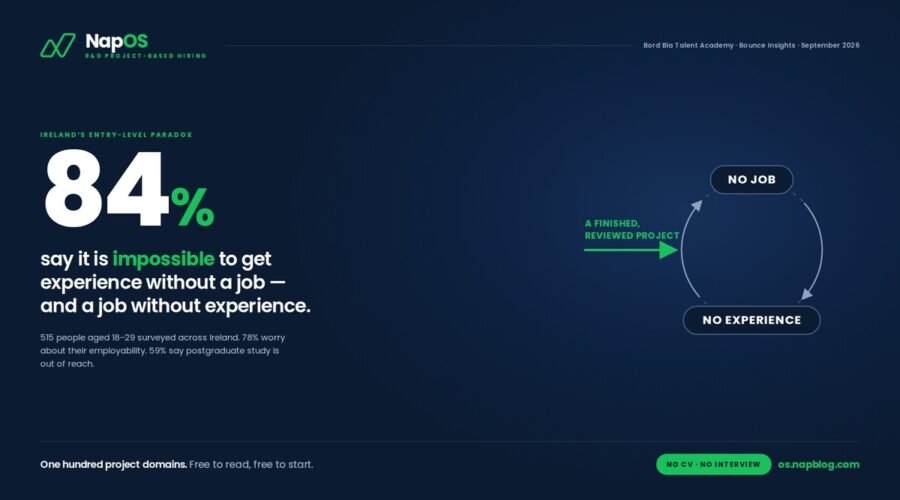
In September, Bord Bia’s Talent Academy published research with Bounce Insights that put a number on something anyone who has stood at a careers fair in Ireland already knew. Of 515 people aged 18 to 29 — current students, recent graduates, and people in their first or second job — 84% said it feels impossible to gain experience without a job, and impossible to get a job without experience.
Not difficult. Impossible.
A further 78% said they worry about their employability specifically because they lack real-world experience. Seven in ten said they feel they are falling behind when they see peers announcing jobs on social media. And 59% said postgraduate study — the obvious escape hatch — is financially out of reach.
I read that research the week before we took a stand at the gradireland Graduate Careers Fair at the RDS. Then I spent two days watching all of it walk past our table.
The programme is excellent. That is not the issue.
Bord Bia’s answer to its own research is the International Graduate Programme, and it is a genuinely good one. A fully funded MSc in Global Business Practice with UCD Michael Smurfit. National and international placements across Bord Bia’s global network. Twenty-four and a half months. A tax-free bursary between €2,078 and €2,300 a month, which over the full programme is somewhere above €50,000 in the participant’s hand, on top of tuition. A 95% employment rate.
If you are a final-year student who wants a career in food, drink or horticulture, apply. I mean that without qualification. Karen Connaughton, their Industry Talent manager, describes it as offering “financial stability, practical experience and a clear route into industry”, and on the evidence that is exactly what it is.
But read the research and the programme side by side and the arithmetic does not close.
The research describes a condition affecting essentially everyone entering the Irish workforce. The programme is a funded, selective, sector-specific cohort. Those are different orders of magnitude. Every graduate who is not selected, or who does not want to work in food and drink, or who reads the words “September 2027 intake” and realises that is eleven months of waiting — all of them still have the 84% problem, and nothing in the research suggests anyone has an answer for them.
This is not a criticism of Bord Bia. It is the nature of the instrument. Funded placement programmes are the best thing we have and they cannot scale to a population, because the cost per participant is the whole point of them.
So the question I care about is the one the research raises and nobody is really answering: what does the person who does not get a place do on Monday morning?
There is only one side you can break the circle from
Look at the loop honestly. Employers want experience. Experience requires a job. A job requires experience.
You cannot break that from the employer’s side — not as a graduate, anyway. You have no leverage there, and the entire apparatus of applications, CVs and interviews exists precisely to ration access to the one thing that would fix your problem.
What you can do is attack the premise. The loop assumes experience is something granted to you by an employer. For a large and growing share of knowledge work, that is simply no longer true. You can produce real work — researched, built, tested, documented — without anyone’s permission. What you cannot easily do on your own is make it credible. A portfolio of self-directed projects reads to a recruiter as a hobby unless somebody who is not you has judged it against a standard.
That gap, between producing work and producing evidence, is the entire thing Nap OS is built around.
What that looks like in practice
Every project brief on Nap OS is free to read and free to start. No CV, no application, no interview, no card. One hundred project domains in Homeschooling OS alone, ten briefs in each.
Every brief has the identical shape: ten tasks over two weeks, roughly two hours a task. Week one runs Research, Build, Design, Test, Present. Week two runs Analyse, Launch, Optimise, Document, Review. Each task states its deliverable, the criteria it will be judged against, and a suggested tool before you begin. Tasks unlock week by week and you can hold two at once.
What you build stays yours, permanently, whether you ever pay us anything or not.
The paid tier, €49.99 a month, buys one thing: a named human’s time. Submitting work for review, two 15-minute one-to-one sessions a month with a project manager, written feedback within seven days, and a verified completion record stating which brief you did and what you produced.
Now put that against the research findings one at a time.
On the 78% who lack real-world experience. Two weeks produces a finished, reviewed piece of work. Not a certificate of attendance — a deliverable, judged against criteria published in advance.
On the 59% for whom postgraduate study is financially out of reach. This is where the comparison gets stark. A taught master’s in Ireland runs to five figures. Nap OS is free to start and €49.99 a month if you want the review. I am not pretending these are the same product. A master’s is a qualification and this is not. But if the barrier is money and the goal is demonstrable capability, there is now something between “postgraduate study” and “nothing”.
On the 78% overwhelmed by career choice. A hundred domains sounds like it makes this worse, and it would, except that every brief names the role it points at. Choosing badly in week one is the main reason people stall in week two, which is why the single most useful thing we do is a fifteen-minute conversation about which brief, not a longer catalogue.
On the seven in ten who feel they are falling behind. The cure for watching other people announce things is having something of your own to announce in a fortnight. That is not a motivational line; it is the actual mechanism. Two weeks is short enough to beat the comparison spiral.
On the 20% who do not know what roles exist. Bord Bia found this within food and drink. We found the mirror image of it at the RDS: of 124 people who gave us their details across two fairs, Data and AI was ticked more than twice as often as any other area. Marketing, strategy, product and startup interest were all healthy and all far behind. That is not breadth of awareness; it is a very narrow beam. A catalogue organised by career domain is partly a map of jobs people do not know exist.
The two findings we do not answer
A piece like this is worthless if it claims a clean sweep, so here is where we fail the research.
Financial stability was the single highest priority respondents named. Nap OS does not pay you. Bord Bia hands participants over €50,000 across the programme. We charge €49.99 a month for review, or nothing at all if you self-learn. On the thing graduates said mattered most, a funded programme wins and it is not close. If you can get a funded place, take the funded place.
Respondents also prioritised a guaranteed placement with a real company. We do not offer one. Napblog Limited trades as Nap OS and holds Licensed Employment Agency licence EA 5651, which makes this a legal statement as much as an ethical one. Our fees cover project briefs, project manager review and career support. Not recruitment. Not job placement. Employment is not guaranteed, implied, or hinted at.
What I can tell you is what has happened. Twenty-eight people who worked through Nap OS briefs are now with outside employers — among them Accenture, Amazon, ServiceNow, ESB Networks, Uisce Éireann and Bosch Rexroth, twenty-four companies in all. That is a named roster, not an audited study, and it does not establish causation. Earlier this month a recruiter emailed us unprompted asking to verify that a Nap OS reference one of our members had given him was genuine. We confirmed it, with the brief she completed and the criteria it was judged against. An employer treating our record as a thing worth checking is the closest we have come to proof of the core claim.
What we still have to prove
Bord Bia can point to a 95% employment rate. We cannot point to anything like it, and I am not going to manufacture a comparison.
What we have is early and it is real: 124 people in two days, a third of everyone who scanned a QR code completing a six-field form in a noisy hall, and demand concentrated so heavily in Data and AI that it tells us where to build next. What we do not yet have is the number that matters — how many people will pay for review, and keep paying. Five of those 124 ticked a paid plan. Five is a signal, not a business.
So I would put it this way. The Bord Bia research is the clearest statement of the problem anyone in Ireland has published this year, and their programme is the best available answer for the people it can take. The open question is the one their own data forces: what about everyone else?
Our answer is that you stop waiting to be picked and start building the evidence, and that the review which turns that work into something checkable should cost about as much as a phone contract rather than a year’s salary.
Start free: os.napblog.com
Pugazheanthi Palani is Founder and CEO of Napblog Limited, trading as Nap OS, a licensed employment agency (EA 5651) at 77 Camden Street Lower, Dublin 2. Research cited: Bord Bia Talent Academy with Bounce Insights, 515 respondents aged 18–29 surveyed 27 August – 1 September 2026, reported by ThinkBusiness on 11 September 2026.