6 min read
At the end of a post about work he had just completed, James Cody asked the question most people in his position avoid:
“I am open to feedback from professors and industry experts — how much do companies value project verified experience like this rather than another AI certification?”
It is a fair question and a slightly dangerous one to ask in public, because the honest answer might have been not much. We are going to answer it properly, and to do that we need to be straightforward about what James actually produced, and equally straightforward about what the record of it does and does not mean.
A disclosure first, because it matters. James is an International Marketing Intern at Napblog. He is not an arm’s-length customer whose story we discovered. He works with us, and he completed the Verified Portfolio track alongside that. We are publishing this anyway, with the relationship stated up front, because a company whose entire proposition is check the evidence cannot credibly hide the one thing a reader would most want to know. Weigh it accordingly. The work below is real and documented; the person describing it has a connection to us.
What “ten projects” actually means
The Nap OS Verified Portfolio runs a single brief through ten stages: research, build, design, test, present, launch, analyse, iterate, document, review. James worked the B2B account-based marketing track against one subject company, Homeschooling OS, which is pre-MVP — meaning the work had to hold up before there was any product in market to hide behind.
His own summary of the outputs is specific enough to argue with, which is the point:
“3 target accounts identified, built around two ICPs: the boutique micro-school founder and the regional co-op director. 3 lean iterations, each documented and honed to the ICPs. Every claim checked against a verified real company in this market, all before the MVP launches.”
Read that again as a hiring manager would. Not “experience in account-based marketing”. Two named buyer profiles, three named target accounts, three documented revisions, and a sourcing rule applied to every claim. Each of those can be opened and inspected. Each of them can be wrong.
That is the entire difference between this and a certificate of completion, and James put his finger on it in his written reflection before he ever posted about it:
“Credibility in B2B marketing is earned in stages, never simply declared. A deck alone proves little. But trace from raw research through to a finished, cross-checked deliverable, and something genuinely falsifiable emerges: an active demonstrated method, not a static finished artifact.”
Falsifiable. A CV line cannot be falsified — it can only be believed or doubted. A chain of documents where a number in the deck traces back to a source in the research brief can be checked, and can fail the check. That exposure is what gives it weight.
The chain is the evidence, not the documents
The most useful thing in James’s post is a single sentence about dependency:
“The data brief informed the deck, which allowed clear outcome based insights from the case study.”
A conventional graduate portfolio is a gallery. Here is a deck I designed. Here is a campaign I planned. The artefacts stand alone, and because they stand alone, none of them can be wrong — there is nothing for them to be inconsistent with.
James built the opposite structure. The ICP work constrained the deck. The deck constrained what the case study could claim. The case study’s claims were then tested back against the reference material. Break any link and everything downstream stops making sense. That interdependence is precisely what makes the portfolio checkable, and it is why he concluded that “this collection of work says more than any one document alone.”
He also identified, correctly, what skill that trains:
“That’s the unfair advantage: evidenced, clear claims. Messaging that has to survive PESTLE, legal, product and market verification all at once.”
Anyone who has worked inside a marketing function will recognise that list. A message does not simply need to persuade. It needs to get past legal, survive the product team pointing out that the feature does not do that yet, hold up against a competitor’s counter-positioning, and still mean something to a buyer who has heard the category’s promises before. Messaging has adversaries. Graduates are rarely taught this, and almost never get to practise it, because coursework has a marker rather than an opponent.
The part still outstanding
James named his own next step in both his reflection and his post: one genuine weak-tie partnership, plus continued SOP work with the ICP accounts.
That is worth taking seriously rather than treating as a modest sign-off. Drawing on Meg Jay’s framework, the portfolio builds identity capital — the accumulated, demonstrable evidence of who you are becoming professionally. What ten projects against a single brief cannot do on their own is build a network. Weak ties, in Jay’s account, are what actually move careers, and they are formed outside your existing circle by doing something with someone new.
So the honest position is this: the track produces depth, documentation discipline and defensible claims. It does not produce relationships. Those are different exercises, and pretending one delivers the other would undermine everything else on the page. James has been clear-eyed about it, which is the behaviour an employer most wants in an early-career hire and most rarely sees — someone who can tell you where their own work is thin will also tell you where a campaign is thin.
So — is it worth more than another AI certificate?
Here is our answer to his question, with the caveats intact.
A certificate from a short online course certifies attendance. You watched the modules, you passed the quiz. Thousands of people hold the identical credential and it distinguishes none of them, which is why an interviewer glances at it and moves on. The recent flood of AI-generated and AI-marked certifications has made this worse, not better: when a credential costs an afternoon, it signals an afternoon.
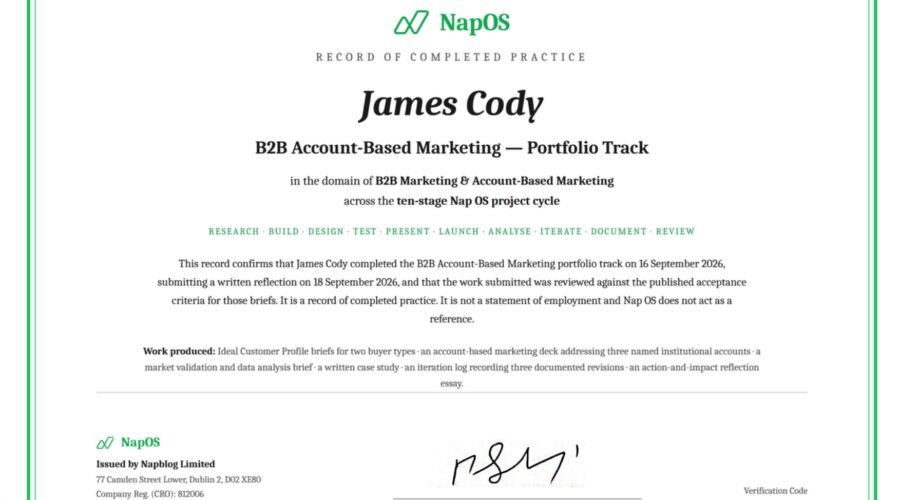
What James holds is a Record of Completed Practice. It states that he completed the B2B Account-Based Marketing portfolio track, on a stated date, and that the work was reviewed against the published acceptance criteria for those briefs. It carries a verification code. Critically, it points at output rather than attendance: two ICP briefs, a deck addressed to three named accounts, three documented iterations, a case study, a written reflection.
Be precise about the limits, though. It is not an academic qualification. It is not an accredited award. It is not a statement of employment, and completing it places nobody in a job. Napblog Limited is a licensed employment agency — licence EA 5651 — but project work of this kind is not recruitment, and we would be doing James no favours by blurring that line.
What the record does is narrower and more practical than a qualification, and more useful than a certificate. It converts a period of work into something with a date, a scope and an identifier attached, so that a claim made in an interview has a document behind it and a specific decision to talk about. The value is not in the PDF. It is in being able to answer the follow-up question — why those two ICPs, and what changed in iteration three? — with something other than a summary of a module.
That is also the honest test of whether any of this is working. Not whether a graduate can show a credential, but whether they can survive five minutes of informed questioning about their own work. James asked professors and industry experts to tell him whether employers value that. We would rather they answered him than us.
If you hire early-career marketers: does this change anything for you? James is genuinely asking, and he is more use to the argument than we are. Tell him.
Nap OS is at the gradireland Graduate Careers Fair, RDS Dublin, on 6 October 2026. Come and see how project-based evidence works, or start free at napblog.com/gradireland.
James Cody is an International Marketing Intern at Napblog Limited and completed the Verified Portfolio track described above. Fees cover project briefs, Project Manager review and career support — not recruitment or job placement. Employment is not guaranteed. Napblog Limited trading as Nap OS · Registered in Ireland No. 812006 · Licensed Employment Agency EA 5651.