5 min read
The recruitment landscape across Ireland and the broader European market has reached a critical inflection point. For decades, the primary bridge connecting higher education to early-career employment was the traditional Curriculum Vitae (CV). Candidates compiled bullet points of self-reported duties, uploaded them to job portals, and waited as automated applicant tracking systems parsed text and ranked profiles based on surface-level keywords.
However, as generative AI tools flooded the market, allowing applicants to generate polished, keyword-optimized CVs in seconds, traditional screening mechanisms broke down. Employers found themselves inundated with hyper-tailored applications that looked exceptional on paper but provided little insight into actual capability.
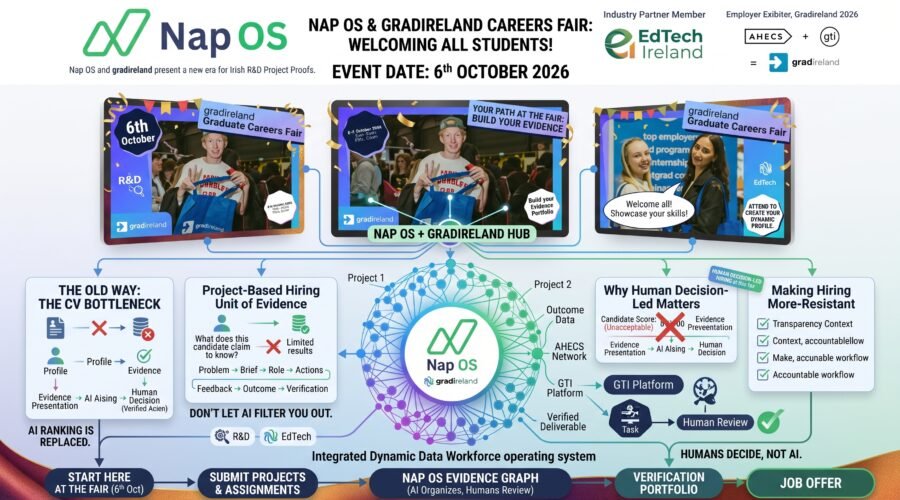
It was against this backdrop that Nap OS made its high-profile debut across the GradIreland ecosystem. By introducing a licensed, AI-native Workforce Operating System centered on dynamic data modelling and human-led verification, Nap OS fundamentally altered how graduate talent is evaluated.
In the wake of its landmark GradIreland showcase, Nap OS experienced widespread market adoption among enterprise employers, higher education institutions, and early-career jobseekers.
1. The GradIreland Catalyst: Bridging Higher Education and Enterprise
GradIreland serves as the central hub connecting third-level students and graduates with top-tier employers throughout Ireland. When Nap OS debuted its platform within this ecosystem, it targeted the exact pain point felt by both recruiters and university career services.
               [ Traditional Hiring Bottleneck ]
Candidates  ──> Static CVs ──> AI Resume Parsing ──> Opaque Scores ──> High Noise / Mis hires

                                   VS.

               [ The Nap OS Workforce Model ]
Candidates  ──> Real Projects ──> Dynamic Data Graphs ──> Human Review ──> Verified Placement
Historically, higher education institutions excel at teaching, but they have often struggled to provide standardized, tamper-proof mechanisms for students to prove what they built during their studies. Conversely, employers—ranging from global technology firms in Dublin’s Silicon Docks to leading professional services providers—spent millions filtering through thousands of identical-looking graduate CVs.
Nap OS introduced a simple premise to the GradIreland network: “Universities teach. Nap OS proves. Employers hire.”
Rather than presenting employers with static PDF resumes, the platform showcased dynamic, multi-layered workforce profiles built directly from verified project deliverables. Enterprise recruiters attending GradIreland events saw firsthand how the platform transformed abstract claims into reviewable proof. The response was immediate: major graduate recruiters recognized that project-based evidence drastically reduced first-round screening friction and improved the quality of shortlisted candidates.
2. Why Employers Scaled Nap OS: Resolving the Hiring Pipeline Crisis
Following its initial launch, employer onboarding accelerated rapidly. The surge in adoption was driven by three primary structural advantages:
A. Replacing “Profile Data” with “Evidence Data”
Traditional recruitment software evaluates candidates on profile claims—job titles, listed skills, and university names. Nap OS shifted the unit of evaluation to the project execution chain:
$$\text{Problem} \longrightarrow \text{Brief} \longrightarrow \text{Role} \longrightarrow \text{Actions} \longrightarrow \text{Deliverables} \longrightarrow \text{Feedback} \longrightarrow \text{Verification}$$
When assessing a graduate candidate, an engineering lead or head of marketing no longer had to wonder what a bullet point like “Managed digital campaign” actually meant. Through Nap OS, hiring teams could click directly into the underlying project graph to view:
- The specific scope and constraints of the project.
- The individual candidate’s precise contributions versus team inputs.
- Raw code, analytical models, or strategic deliverables produced.
- Qualitative feedback and structured sign-offs from academic advisors, mentors, or client stakeholders.
B. Eliminating Opaque “Black-Box” AI Scores
Many contemporary HR-tech tools attempt to fully automate screening by issuing hidden algorithmic candidate scores. Employers have increasingly rejected this approach due to regulatory concerns surrounding automated decision-making and bias.
Nap OS took the opposite path. The platform positions AI as an evidence-enabling engine rather than an automated judge. The software organizes complex project assets, maps demonstrated skills to job taxonomies, and highlights gaps or unverified claims. However, the ultimate decision always remains with the human recruiter.
   [ AI Discovery Engine ]           [ Structured Evidence ]           [ Human-Led Decision ]
Organizes assets & highlights  ──>  Presents verified project  ──>  Recruiter evaluates context
  skills from candidate work           graphs & uncertainties         & makes the final hire
This transparent methodology appealed directly to risk-averse enterprise hiring teams that require strict audit trails and explainable hiring workflows.
C. Regulatory Trust via Licensed Employment Infrastructure
Operating under Napblog Limited, Nap OS secured a formal Employment Agency Licence in Ireland under the Employment Agency Act framework. This regulatory foundation signaled to multinational enterprises that Nap OS was built for enterprise-grade compliance, consent-aware candidate data handling, and strict data governance.
3. The Network Effect: The Dynamic Workforce Graph
The rapid rise of Nap OS after its GradIreland presence was propelled by a strong multi-sided network effect. The value of the platform scales exponentially as more candidates, universities, and enterprise reviewers interact within the dynamic data ecosystem.
                     ┌───────────────────────────────┐
                     │    Individual Professional    │
                     └───────────────┬───────────────┘
                                     │
      ┌──────────────────────────────┼──────────────────────────────┐
      ▼                              ▼                              ▼
┌───────────┐                  ┌───────────┐                  ┌───────────┐
│ Projects  │                  │   Tasks   │                  │  Outputs  │
└─────┬─────┘                  └─────┬─────┘                  └─────┬─────┘
      │                              │                              │
      └──────────────────────────────┼──────────────────────────────┘
                                     │
      ┌──────────────────────────────┼──────────────────────────────┐
      ▼                              ▼                              ▼
┌───────────┐                  ┌───────────┐                  ┌───────────┐
│ Feedback  │                  │ Reviewers │                  │ Verified  │
└─────┬─────┘                  └─────┬─────┘                  └─────┬─────┘
                                     │
                                     ▼
                     ┌───────────────────────────────┐
                     │ Employer & Role Opportunities │
                     └───────────────────────────────┘
The Student and Candidate Advantage
For graduates and career changers, traditional CVs present a cold-start problem: without formal prior job titles, their applications are routinely filtered out by legacy ATS software. Nap OS solved this barrier by enabling jobseekers to build a continuous, living evidence portfolio starting from their very first university project or practical assignment.
Instead of treating skillsets as static text tags (e.g., “Data Analysis — Intermediate”), the platform anchors skills to the actual dynamic nodes where those competencies were demonstrated. A student who completed three rigorous practical projects during their degree could present verified proof of data modeling, stakeholder presentations, and cross-functional execution long before securing their first formal corporate title.
Furthermore, the platform’s diagnostic capability gives candidates direct feedback on their career readiness:
$$\text{Target Role Competencies} – \text{Verified Project Evidence} = \text{Identified Skill/Evidence Gap}$$
This transforms the hiring profile from a passive historical archive into an active development compass, guiding students on what specific practical projects they should undertake next to qualify for target roles.
4. Market Impact: Redefining Early-Career Workforce Mobility
The post-debut trajectory of Nap OS illustrates a broader industry transition: the move away from self-reported credentials toward verifiable, project-based workforce operating systems.
| Metric / Dimension | Traditional CV & ATS Systems | The Nap OS Platform |
| Primary Data Unit | Static text summaries & self-reported titles | Dynamic project evidence graphs & verified outputs |
| Role of AI | Automated ranking, parsing, and opaque filtering scores | Evidence structuring, skill extraction, & decision support |
| Verification Layer | Unverified claims; manual reference checks at final stages | Continuous provenance tracking with reviewer sign-offs |
| Decision Authority | Frequently automated or reliant on keyword matching | Strictly human-decision-led with auditability |
| Candidate Identity | Snapshot frozen in time | Evolving, dynamic professional identity graph |
Following its entry through GradIreland, Nap OS demonstrated that when employers are provided with transparent, contextualized evidence, hiring cycles become shorter, mis-hire rates decline, and non-traditional candidates gain fair access to career opportunities based on actual talent rather than pedigree.
By uniting dynamic data modeling with an unyielding commitment to keeping human judgment at the center of recruitment decisions, Nap OS established itself not merely as another sourcing tool, but as essential infrastructure for the modern workforce.