8 min read
September is an unusual month for students and recent graduates in Ireland.
Academically, one chapter may be almost complete. Graduation ceremonies, postgraduate decisions and the transition out of university are approaching. Professionally, however, another clock is already running.
Employers do not wait for graduation ceremonies before beginning recruitment conversations.
Career fairs, graduate programmes, internships, networking events and application cycles can all begin while students are still thinking about final results, dissertations, graduation photographs and what comes next.
That creates an important question:
Should a student wait until graduation to start behaving like a professional job seeker?
From the Nap OS perspective, the answer is no.
Graduation should ideally be the moment when somebody arrives with evidence, rather than the moment they start trying to create it.
With Q3 moving towards its end and Q4 graduation season approaching, here are five things students, graduates and early-career job seekers should start working on now.
1. Don’t Just Update Your CV — Build the Evidence Behind It
Updating a CV is usually the first piece of career advice given to graduating students.
That advice is useful.
The source material highlights the importance of updating a CV before graduation and including final-year projects, dissertations, internships and relevant employment experience.
But Nap OS believes there is a deeper question:
What evidence sits behind every sentence on your CV?
Consider a typical graduate CV.
A candidate might write:
Strong communication skills.
Excellent teamwork ability.
Experienced in digital marketing.
Analytical thinker.
Project-management skills.
All of those statements may be true.
But an employer cannot necessarily verify them simply by reading them.
Now imagine a candidate says:
Digital Communication Project — planned content strategy, researched target audiences, produced campaign assets, presented recommendations and received supervisor feedback.
That is different.
The candidate has started converting a claim into evidence.
This is one of the principles behind Nap OS.
Your CV should not be the beginning of your professional identity.
It should be a summary of evidence that already exists elsewhere.
That evidence might include:
- university projects;
- supervised practical work;
- internship outputs;
- employer feedback;
- project documentation;
- presentations;
- reports;
- software developed;
- marketing campaigns;
- research;
- portfolio materials;
- references;
- measurable outcomes.
By graduation, students should ideally be able to answer:
“What have you actually done?”
not simply:
“What subjects have you studied?”
2. Secure References Before Everyone Moves On
The transition out of university changes relationships surprisingly quickly.
A lecturer who knows your work today may be supervising another large cohort next year.
A manager from a summer internship may move company.
A project supervisor may remember your contribution clearly now, but less precisely twelve months later.
The material provided recommends contacting academic supervisors, tutors and previous employers while the work is still fresh and confirming whether they are willing to provide references.
That is excellent advice.
But Nap OS would extend it further.
Don’t think only about a traditional reference letter.
Think about structured verification.
A useful professional record might capture:
Who supervised the work?
What was the project?
What responsibility did you personally hold?
What did you deliver?
When was it completed?
What feedback did you receive?
What capability did the work demonstrate?
This matters because early-career candidates often face the same problem:
They have done useful work, but several months later they struggle to explain it.
The experience disappears into a single line:
“Intern — May to August.”
That is a lost opportunity.
The real value might have been three months of projects, deadlines, feedback, meetings and professional development.
The future of workforce verification should capture much more of that journey.
This is why Nap OS sees work experience as something that should be recorded progressively, not reconstructed from memory when somebody suddenly needs a job.
3. Prepare for Graduation — But Don’t Confuse Graduation With Career Readiness
Graduation is important.
It represents years of study, persistence and academic achievement.
Students also need to prepare for the practical side of graduation — ceremonies, gowns, tickets, family travel and university communications. The supplied material specifically recommends watching university communications and arranging ceremony logistics early.
But there is an important distinction:
Graduation confirms academic achievement.
It does not automatically create professional experience.
Those are two different things.
A graduate can hold an excellent qualification and still encounter employers asking:
“Do you have experience?”
That question creates one of the most frustrating Catch-22 situations in the early-career labour market:
You need work experience to obtain work.
But you need someone to give you work before you can gain experience.
Nap OS exists because we believe there should be another pathway.
Students should be able to build practical experience before the graduation ceremony.
That can happen through:
University → Projects → Practical Work → Feedback → Verification → Portfolio → Employment
rather than:
University → Graduation → Start looking for experience → Rejection → Try to find experience
The order matters.
A graduation ceremony should ideally be a milestone inside a developing professional journey — not the starting line.
4. Treat LinkedIn and Career Fairs as Conversations, Not Online Applications
The supplied material recommends improving LinkedIn profiles, using professional photographs, strengthening profile summaries and attending career fairs such as GradIreland to meet graduate employers.
But attending a career fair is not enough.
The real question is:
What will you talk about when you arrive?
Imagine walking up to an employer at GradIreland.
They ask:
“Tell me about yourself.”
Many candidates answer:
“I recently completed my master’s degree and I’m looking for opportunities.”
There is nothing wrong with that.
But compare it with:
“I recently completed my master’s, and alongside my studies I worked on a practical communications project where I researched an audience, developed a content strategy and delivered recommendations. I can show you the project and explain what I learned.”
The second conversation starts somewhere entirely different.
You are no longer asking an employer to imagine your capability.
You are helping them inspect it.
This is what students should prepare before attending career fairs.
Not merely:
Which employers are attending?
But:
Which three projects will I talk about?
What problem did I solve?
What was my contribution?
What did I learn?
What evidence can I show?
What role am I trying to progress into next?
This turns networking from:
“Please give me an opportunity.”
into:
“Here is what I have already started learning to do. Where could that capability fit inside your organisation?”
That is a much stronger career conversation.
5. International Students Need a Career Timeline and an Immigration Timeline
For international graduates, career planning can involve an additional layer.
The source material highlights the importance of understanding the Third Level Graduate Programme and Stamp 1G requirements, including timelines, fees and required university documentation.
The important principle is that employment planning and immigration planning cannot be separated.
A student may be thinking:
Finish dissertation.
Graduate.
Find job.
But the real sequence may involve:
Academic completion
→ immigration-status transition
→ job-search timeline
→ employer requirements
→ employment-permit considerations
→ career progression
That makes waiting particularly risky.
If somebody begins building professional evidence months before graduation, they potentially enter the job market with more preparation than somebody who starts after their ceremony.
For international students especially, the months before graduation should be used deliberately.
Build the portfolio.
Build relationships.
Understand employers.
Attend career events.
Talk to recruiters.
Learn how the Irish labour market describes roles.
Understand which employers hire graduates.
Understand visa and permit requirements.
And above all:
build credible evidence that you can contribute.
Q3 Should Be Your Preparation Quarter
The end of Q3 is not simply another date on the calendar.
For graduating students, it can be treated as a career preparation deadline.
By the beginning of Q4, ideally you should already have:
A professional CV
supported by actual evidence.
A strong LinkedIn profile
that communicates what you have done rather than merely what you are studying.
Academic and professional references
identified before relationships become distant.
A work portfolio
containing projects and outputs.
A career-fair strategy
including employers and roles you want to explore.
A 60-second professional introduction
you can deliver confidently.
A clear understanding of your legal right to work
where relevant.
Real conversations with employers
already underway.
Most importantly, you should start building experience before somebody asks you why you don’t have any.
The Nap OS View: Don’t Wait for the Job to Start Building Experience
Traditional career development often looks like:
Study
→
Graduate
→
Write CV
→
Apply
→
Interview
→
Get Job
→
Finally gain experience
Nap OS asks whether that sequence can be changed.
What if students could begin with:
Study
→
Complete Real Projects
→
Receive Feedback
→
Build Evidence
→
Verify Experience
→
Create Portfolio
→
Meet Employers
→
Graduate
→
Progress Into Employment
That is a fundamentally different transition.
It addresses the Catch-22 earlier.
Instead of asking employers to take somebody entirely on potential, we can help candidates demonstrate emerging capability through actual work.
Before Graduation, Build Something You Can Talk About
For students entering their final weeks before graduation season, the most valuable career question may not be:
“How many jobs have I applied for?”
A better question is:
“What can I show an employer today that I couldn’t show them three months ago?”
Perhaps it is a project.
Perhaps it is an internship.
Perhaps it is research.
Perhaps it is a portfolio.
Perhaps it is verified feedback.
Perhaps it is evidence of leading a student organisation.
Perhaps it is a real problem you helped an organisation solve.
The format matters less than the principle.
Do something.
Capture it.
Get feedback.
Verify it.
Learn how to explain it.
Then carry that evidence into the next opportunity.
Because graduation tells the world:
“I completed my education.”
Your professional evidence should help you say:
“And here is what I have already started doing with it.”
Nap OS Product Perspective
The future graduate workforce should not need to choose between education and experience.
The two should develop together.
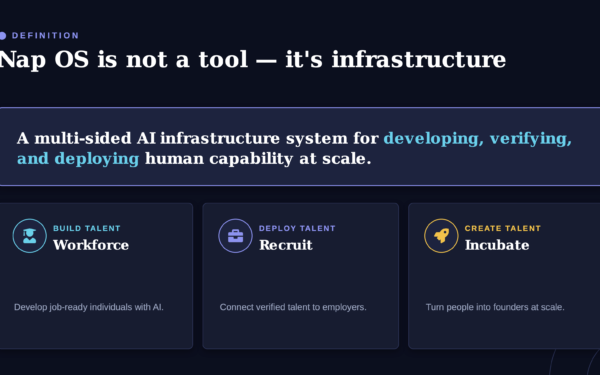
Nap OS is working toward a workforce model where individuals can progressively build project experience, capture evidence, receive feedback and develop a trusted work portfolio before and throughout their careers.
The goal is simple:
Don’t graduate with only potential. Graduate with proof.
Learn.
Do.
Document.
Verify.
Show.
Progress.