8 min read
For an international student arriving in Ireland, the first week can feel like the beginning of an entirely new life.
There is a university to understand, a new city to navigate, people to meet, coursework to begin and, eventually, a career to build.
But there is another question that often arrives much earlier than graduation:
“How do I get Irish work experience when I have not yet had an Irish job?”
This is the experience Catch-22.
Employers want evidence that a candidate can work in a professional environment. Students need opportunities to create that evidence. Yet many students only begin thinking seriously about professional experience when graduation is approaching.
From the perspective of Nap OS, this is exactly where the journey needs to change.
The career journey should not begin at graduation.
It should begin in the first weeks of university.
The First Week Is More Important Than It Looks
A new international student has an unusual advantage: time.
A student arriving with almost a year, or several years, before graduation has an opportunity to deliberately build professional evidence rather than waiting for a job application to expose the experience gap.
The research material provided for this article identifies four broad stages for an international student in Ireland: getting essential administration in place, building local experience, positioning for the job market and developing professional networks.
Nap OS sees these not simply as separate tasks, but as parts of one larger workforce-development journey.
Arrival → Participation → Experience → Evidence → Verification → Employment
The earlier that journey begins, the more evidence a student can accumulate before graduation.
That changes the question from:
“How can I get a job without experience?”
to:
“What experience and evidence can I start building before I need the job?”
That is a fundamentally different approach.
1. Build Local Context, Not Just a CV
One of the recommendations in the research is for students without local corporate experience to explore alternative ways of developing local experience, including college societies, volunteering and on-campus projects.
This is important because “experience” should not be interpreted narrowly.
A student who organises an event, manages a society budget, contributes to a university initiative, volunteers with an organisation or completes a meaningful project is already developing behaviours that employers can understand.
The challenge is that these experiences often disappear into a CV as a single line.
For example:
“Member of university society.”
That tells an employer very little.
But:
“Led a four-person team to organise a university event, coordinated stakeholders, managed deadlines and delivered the event to 150 attendees.”
is evidence.
The difference is not necessarily the activity.
The difference is how the activity is captured and demonstrated.
This is one of the fundamental ideas behind Nap OS.
We believe students should not simply collect activities.
They should build verifiable evidence of what they actually did.
2. University Projects Should Become Professional Evidence
The research specifically recommends treating university projects, hackathons and dissertations as real-world case studies and structuring them around the Situation, Task, Action and Result framework.
Nap OS takes this idea further.
A university project should not disappear when the assignment receives a grade.
It can become part of a student’s professional evidence portfolio.
Imagine a student completing a data analytics project.
Instead of retaining only:
“Data Analytics Project — Grade: 72%”
the student could capture:
- What problem was being addressed
- What responsibilities they personally owned
- What tools they used
- What decisions they made
- What challenges they encountered
- What output they produced
- What feedback they received
- What they learned
- What measurable result they achieved
- Who reviewed the work
Now the project becomes much more than an academic submission.
It becomes a work story.
That distinction matters because employers are not simply hiring qualifications.
They are hiring people to solve problems.
3. Experience Needs a Verification Layer
This is where Nap OS believes the traditional CV has a structural limitation.
A CV is primarily a claim.
A portfolio can provide evidence.
Verification can provide confidence.
Consider three statements:
“I have strong communication skills.”
“I worked on a communications project.”
“I worked on this project, produced these outputs, received this feedback and had my contribution independently reviewed.”
Each statement provides a different level of confidence.
Nap OS is designed around the third.
Our vision is to create a workforce platform where practical project experience can be recorded, developed, reviewed and presented as structured evidence.
That means a student’s professional identity can begin developing before their first formal graduate job.
This is particularly important for students who have strong academic capability but limited local professional networks.
4. Don’t Wait Until September of Final Year
Another important point in the research is that the Irish graduate recruitment market can move quickly, with graduate-programme recruitment taking place well before the eventual employment start date.
For students, this creates a strategic lesson:
The final year should not be the year you start building your profile.
It should be the year when you demonstrate what you have already built.
A student who starts in first year can potentially spend years accumulating:
- Projects
- Internships
- Volunteering
- Society leadership
- Industry interactions
- References
- Portfolios
- Employer feedback
- Professional networks
- Verified work
By graduation, the conversation with an employer can therefore become much more specific.
Instead of:
“I am a recent graduate and I am looking for an opportunity.”
the student can say:
“Here is what I have worked on. Here is what I contributed. Here is what I learned. Here is the evidence.”
That is the transition Nap OS wants to enable.
5. Networking Should Start Before You Need a Job
The research also highlights LinkedIn optimisation, alumni outreach and industry meetups as ways for international students to develop professional networks in Ireland.
Nap OS sees networking differently from traditional job searching.
Networking should not begin when someone needs a referral.
It should begin when someone wants to learn.
A first-year student can meet professionals.
A second-year student can ask questions about an industry.
A third-year student can show a project.
A final-year student can discuss their experience.
Over time, relationships become more meaningful because there is a progression behind them.
This is also why evidence matters.
It is much easier to have a useful professional conversation when you can discuss something you actually built.
The International Student Experience Catch-22
For an international student, the challenge can feel even more significant.
They may have previous experience from another country but lack familiarity with the Irish professional environment.
They may have a strong academic background but limited local references.
They may understand their technical subject but have little opportunity to demonstrate how they operate in a team.
The research material describes several routes students can use to develop local context, including societies, volunteering, on-campus opportunities and academic projects.
Nap OS’s proposition is not that every student must follow one particular route.
It is that every meaningful experience should have the opportunity to become evidence.
That is the missing layer we are trying to build.
Nap OS: From Education to Evidence
The traditional journey often looks like:
University → Graduation → Job Search → Employment
We believe the future should look more like:
University → Real Projects → Feedback → Verification → Portfolio → Employer Discovery → Employment
This is why our positioning is simple:
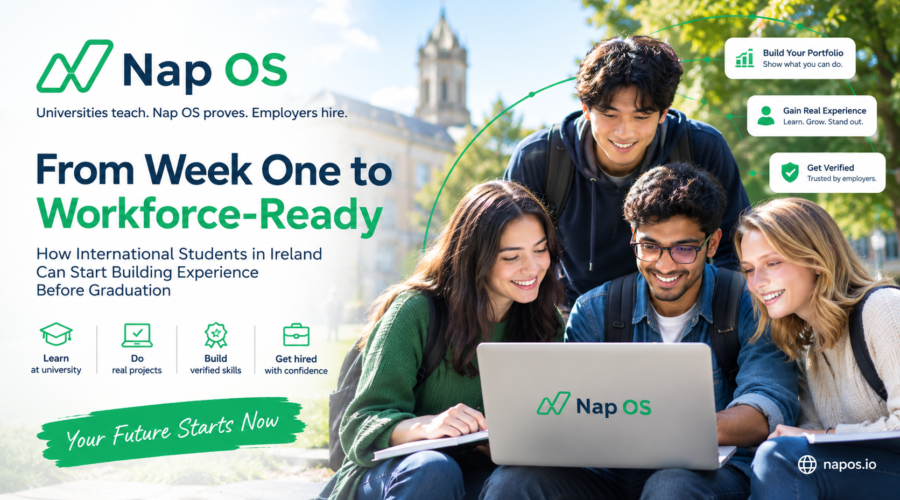
Universities teach. Nap OS proves. Employers hire.
Universities remain fundamental.
They provide knowledge, academic development, critical thinking and qualifications.
Nap OS does not attempt to replace that.
Instead, we are building the layer between learning and employment.
The question is:
What happens between learning something and being trusted to do it professionally?
Our answer is:
Experience. Evidence. Verification.
The First Week Should Be the Beginning of the Career Journey
A new international student does not need to become an expert in the Irish job market during their first week.
They do not need to have their entire career planned.
But they can start asking better questions.
What kind of work do I want to do?
What skills will employers expect?
What projects can I participate in?
What can I build?
Who can review my work?
What evidence can I create?
Who should I learn from?
What professional relationships can I start developing?
These questions turn university from a period of waiting into a period of career preparation through action.
And this is where Nap OS sees a significant opportunity.
From Catch-22 to Catch-Up
The experience Catch-22 says:
You need experience to get the job, but you need the job to get experience.
Nap OS challenges that assumption.
Professional experience does not have to begin with a full-time job.
It can begin with a real project.
It can begin with a university-industry collaboration.
It can begin with volunteering.
It can begin with a society leadership role.
It can begin with a practical challenge.
It can begin with an internship.
What matters is whether the experience can be transformed into something another person can understand and trust.
That is the purpose of the Nap OS Workforce Operating System.
We want students and emerging professionals to stop thinking of experience as something that happens after education.
Instead, experience should be built alongside education.
The Nap OS Product Perspective
Ireland has a strong higher-education ecosystem and a significant international student population.
The opportunity is not simply to help students find more jobs.
It is to help them become more demonstrably ready for work.
For Nap OS, the long-term product journey is therefore:
Learn → Build → Work → Receive Feedback → Verify → Showcase → Connect → Get Hired
And once employment begins, the journey does not have to stop.
The same infrastructure can support continuous workforce development, allowing individuals to continue building evidence throughout their careers.
The CV then becomes only one representation of a much richer professional identity.
Don’t Wait for Graduation to Prove Your Potential
For an international student arriving in Ireland, the first week can feel like the beginning of an academic journey.
But it can also be the beginning of a professional journey.
The goal is not to rush students into employment.
The goal is to give them enough time to build meaningful evidence before they need to compete for employment.
Because a degree can tell an employer what someone studied.
A CV can tell an employer what someone claims.
But real project evidence can begin to answer the question that ultimately matters:
“What can this person actually do?”
That is the problem Nap OS is building to solve.
Education gives us knowledge.
Experience gives us context.
Evidence gives others confidence.