8 min read
There are moments in building a product when the most important evidence is not a feature release, a new design or a product roadmap.
It is what happens to the people using it.
Today, Nap OS is marking a significant milestone:
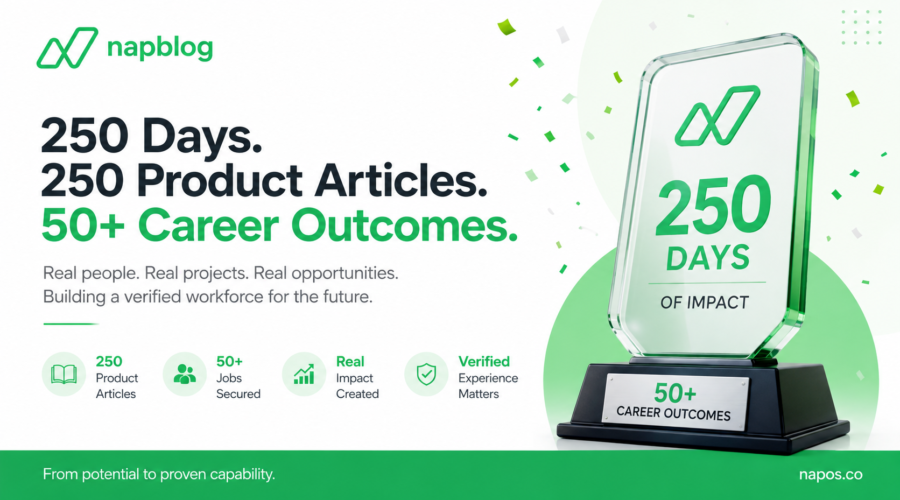
250 days.
250 Nap OS product and ecosystem articles.
50+ jobs and career outcomes.
Across those 250 days, Nap OS has been evolving from an idea into a workforce platform designed around a simple principle:
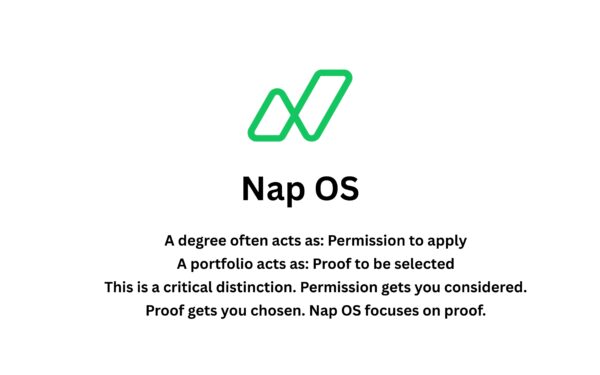
People should be able to demonstrate what they can do—not simply tell employers what they have studied.
The outcomes from our users provide an early indication of what that model can create.
Nap OS users have gone on to work with organisations including Amazon, Accenture, JPMorgan Chase, ServiceNow, Bosch Rexroth, ESB Networks, Circle K, Blip Payments, Teleperformance, Enet, E2G Logistics, UCD and others, while students and graduates have also taken up internships, project roles, marketing positions, software-development opportunities, AI roles, data positions and other forms of practical experience.
The milestone is therefore about more than publishing 250 articles.
It is about documenting a growing body of real workforce outcomes.
250 Days of Building in Public
When we started publishing consistently, the objective was not simply to create a content marketing machine.
The purpose was to explore the problems surrounding work, employability, recruitment, students, graduates, employers, AI and the future of the workforce.
Over 250 days, that became 250 product, research and ecosystem articles.
The articles have explored questions such as:
- How can graduates obtain meaningful work experience?
- Why do employers ask for experience before giving people their first opportunity?
- How can international students demonstrate local capability?
- How can employers assess candidates beyond CVs?
- What happens when AI becomes part of recruitment?
- How can universities connect students with practical projects?
- What does verified work experience look like?
- How can research and education translate into employment?
- How can emerging technologies create new workforce opportunities?
Each article has contributed to a larger conversation.
But content alone is not the outcome we are interested in.
The real test is whether ideas can translate into action.
That is where the 50+ career outcomes become important.
From Content to Product
Nap OS was created around the idea that a workforce platform should connect people, projects, experience, evidence and employers.
Traditional recruitment often begins with a CV.
A candidate writes:
“Marketing experience.”
“Software development skills.”
“Data analysis.”
“AI experience.”
The employer then has to decide how much of that statement to trust.
Nap OS takes a different approach.
Instead of starting with a claim, the platform can start with work.
A person participates in a project.
They perform a role.
They create an output.
Their contribution can be evaluated or verified.
That experience becomes part of their professional portfolio.
The result is a progression from:
Learning → Project → Experience → Evidence → Verification → Opportunity
That is the foundation of the Nap OS workforce model.
More Than 50 Career Outcomes
The people represented in our outcomes have taken very different routes.
Some moved into established companies.
Others gained internships.
Others developed experience within universities.
Some became founders.
Some moved into specialist technology positions.
Others built marketing, sales, data, customer-support or operational experience.
This diversity matters.
The workforce does not consist of one type of candidate.
Our recorded outcomes include roles such as:
- AML/KYC Investigation Specialist
- Full-Stack Developer
- Technical Support Engineer
- Data Analyst
- Data Engineer
- AI/ML Engineer
- AI Automation Engineer
- AI Sales Specialist
- Software Engineer Intern
- Cloud Technology Intern
- Digital Marketing Associate
- Marketing Executive
- Sales Executive
- Sales Development Representative
- Supply Chain Planning Specialist
- UX/UI Designer
- Business Analyst
- Gen AI Annotator
- Customer Support
- Accounts and Administration Assistant
- Project Manager
- Founder
- Community Manager
- Social Media Consultant
This is important because the future of work is not being created by one profession.
It is being created across many functions.
From Student to Professional
One of the most important areas of Nap OS’s work has been helping students and graduates gain practical experience.
The outcome list includes students and graduates from institutions including:
University College Dublin, Dublin Business School, Trinity College Dublin, Technological University Dublin, University of Limerick, University of Galway, Dublin City University, Griffith College Dublin, University College Cork and other institutions.
For many students, the biggest challenge is not necessarily a lack of education.
It is a lack of evidence that they can operate in a professional environment.
A student may have completed modules in marketing.
But an employer wants to know:
Can they actually execute a marketing campaign?
A computer science student may have completed programming assignments.
But an employer wants to know:
Can they contribute to a real software project?
A business student may understand strategy.
But an employer wants to know:
Can they analyse a real business problem?
This is the gap practical work experience can help address.
Building Experience Across Multiple Disciplines
The outcomes also demonstrate the breadth of projects and roles being developed around the Nap OS ecosystem.
Technology
Users have progressed into roles involving:
- software engineering;
- full-stack development;
- cloud technology;
- data engineering;
- data analysis;
- AI/ML;
- AI automation;
- technical support;
- WordPress development;
- AI agents.
Marketing
Other users have developed experience in:
- digital marketing;
- international marketing;
- social media;
- marketing communications;
- performance marketing;
- SEO and SEM;
- e-commerce;
- marketing strategy.
Sales
Sales-related outcomes include:
- Sales Executive;
- Sales Development Representative;
- Sales Representative;
- AI Sales Specialist;
- retail sales.
Business and Operations
There are also outcomes across:
- business analysis;
- project management;
- supply chain;
- operations;
- customer support;
- administration;
- audit;
- finance.
This is what makes the workforce model interesting.
Work experience is not a single category.
Different people need different opportunities based on their skills, ambitions and career direction.
The Employer Names Matter
Perhaps the strongest evidence in the milestone is the range of organisations represented in the outcomes.
Nap OS users have secured positions or career opportunities associated with organisations including:
Amazon
Accenture
JPMorgan Chase
ServiceNow
Bosch Rexroth
ESB Networks
Circle K
Blip Payments
Enet
Teleperformance
E2G Logistics
Covalen
Independent College Dublin
Carrolls Irish Gifts
Baguley Athletic Football Club
Space Case
Asilah Invest
CMOS
Talerre
Imagine Craft
alongside universities and education organisations.
These outcomes span technology, financial services, energy, logistics, retail, payments, telecommunications, education, professional services and startups.
That diversity is important for Nap OS because our ambition is not to build a platform for one particular job category.
We are building a workforce infrastructure layer that can operate across different sectors.
University Experience Can Become Professional Experience
Another important element of the 250-day journey has been the connection between universities and practical work.
The outcomes include students from institutions such as UCD, Trinity College Dublin, Dublin Business School, DCU, University of Limerick, University of Galway, Grenoble Ecole de Management, Aston Business School, The Manchester Metropolitan University and others.
For students, this creates an opportunity to turn academic learning into something visible.
Instead of:
“I studied international marketing.”
the portfolio can become:
“I completed an international marketing project, contributed to defined deliverables, worked with stakeholders and produced measurable outputs.”
That difference can be significant when a graduate enters the labour market.
Education establishes knowledge.
Experience demonstrates application.
Nap OS is designed to connect the two.
The 250 Articles Are Part of the Product Journey
It is tempting to look at 250 articles as a marketing achievement.
For us, it is more than that.
The articles have acted as a way to continuously examine the problems the product is attempting to solve.
Every article creates another opportunity to ask:
What is changing in the workforce?
What are employers struggling with?
What are candidates struggling with?
Where are universities facing gaps?
What new technologies are changing work?
Where can practical experience create better outcomes?
This creates a feedback loop:
Research → Content → Conversation → Product → Users → Outcomes → New Research
That loop is becoming part of how Nap OS is built.
250 Days, One Bigger Question
The milestone also raises a larger question.
If more than 50 people can move into jobs, internships, professional roles and other opportunities through an emerging workforce platform, what happens when the model operates at much larger scale?
What happens with:
500 users?
5,000 users?
50,000 users?
The ambition is not simply to create more profiles.
It is to create more verified experiences and successful transitions into work.
That means the most important metrics for Nap OS will increasingly be connected to outcomes:
How many people gained meaningful experience?
How many projects were completed?
How many employers engaged with the platform?
How many users progressed into employment?
How much verified evidence did users build?
How long did it take someone to move from learning to opportunity?
These are the metrics that matter.
From CVs to Verified Workforce Profiles
The traditional CV was designed for a labour market where professional experience could be summarised on one or two pages.
The modern workforce is more complicated.
People learn continuously.
They work on projects.
They freelance.
They intern.
They contribute to startups.
They participate in research.
They build products.
They work remotely.
They collaborate internationally.
They use AI.
They develop new skills rapidly.
A static CV cannot always capture that journey.
Nap OS is built around the idea of a living workforce profile.
A profile that can evolve as the individual gains new experience.
A profile where projects can become evidence.
Where evidence can become verification.
And where verification can help build trust between workers and employers.
What 50+ Outcomes Tell Us
The 50+ outcomes do not mean that every employment journey follows the same formula.
They don’t.
Some people secure permanent roles.
Some begin with internships.
Some build experience through universities.
Some work with startups.
Some become founders.
Some develop specialist expertise.
But there is a common thread:
Opportunity becomes easier to communicate when people have evidence of what they have actually done.
That is the problem Nap OS is trying to solve.
Not simply:
“How do we help someone find a job?”
But:
“How do we help someone become demonstrably ready for work?”
And then:
“How do we help employers trust that evidence?”
The Next 250 Days
The first 250 days were about proving that we could consistently build, publish, experiment and create outcomes.
The next 250 days are about going deeper.
That means continuing to develop Nap OS as a workforce platform while expanding:
- verified work portfolios;
- employer participation;
- project opportunities;
- workforce memberships;
- employer memberships;
- university relationships;
- AI-powered career profiling;
- workforce matching;
- employer feedback;
- and measurable employment outcomes.
The objective is simple.
More people should be able to move from potential to proven capability.
And more employers should be able to discover people based on evidence rather than relying entirely on CVs and conventional recruitment signals.
250 Days Is Only the Beginning
250 articles are not the destination.
50+ career outcomes are not the destination.
They are evidence that the model is beginning to move from concept into reality.
Over 250 days, Nap OS has documented the changing world of work, developed its product, worked with students and graduates, engaged with employers and helped users build practical experience.
The next stage is about compounding those outcomes.
More projects.
More verified experience.
More employers.
More universities.
More talent.
More jobs.
The most meaningful measure of a workforce platform should ultimately be the people whose careers it helps move forward.
So, on our 250th day, we are not celebrating 250 articles simply because we published them.
We are celebrating what those 250 days have helped make possible.
250 Days. 250 Product Articles. 50+ Career Outcomes.
And the journey from potential → experience → evidence → opportunity continues.
Nap OS — building a workforce where capability can be demonstrated, verified and connected to opportunity.