11 min read
By Napblog Limited | Research & Development | Nap OS Workforce Operating System
What if education did not end with a textbook, an examination or a certificate?
What if a student’s education could become a living record of the problems they explored, the projects they contributed to, the people they collaborated with, the skills they developed and the solutions they helped create?
And what if technology could connect that journey not only to employment, but also to entrepreneurship, healthcare awareness, social innovation and real-world community challenges?
This is the opportunity we see at Napblog Limited, an Irish research and development company building Nap OS — a Workforce Operating System designed around real-world experience, verified capability and human opportunity.
Our ambition is bigger than building another digital learning or employment platform. We are exploring how a workforce operating system can become part of a wider social ecosystem connecting education, experience, opportunity and impact.
The starting point is simple:
Every learner should have the opportunity to solve a real problem.
The social problem is bigger than homeschooling
Homeschooling is often discussed as an alternative educational model. But the deeper question is not simply whether a child learns at home or in a classroom.
The deeper question is:
How do we ensure that every child has access to quality learning, social connection, mentorship, real-world exposure and pathways to opportunity?
UNESCO’s 2025 work on homeschooling examines the subject through a human-rights lens and highlights questions around educational quality, regulation, socialization, child well-being and the responsibilities of governments and stakeholders.
This matters because the educational environment is changing.
Children may be learning at home because of family circumstances, geography, disability, health requirements, conflict, displacement, personal choice or limitations in local education infrastructure.
At the same time, millions of learners remain disconnected from meaningful digital opportunities. UNESCO reported in 2025 that approximately 2.6 billion people — around 32% of the global population — still lacked internet access, with rural communities disproportionately affected.
Therefore, simply putting education online does not solve the problem.
We need to ask:
What happens after the lesson?
Where does the student go to apply what they learned?
Who helps them discover problems worth solving?
Who introduces them to mentors?
Who helps them build something?
Who verifies what they have achieved?
Who connects that experience to future opportunities?
This is where Nap OS begins to explore a different model.
From learning to doing
At Napblog Limited, we believe the future of education and workforce development will increasingly move from a passive model of learning → examination → certificate toward a more active model:
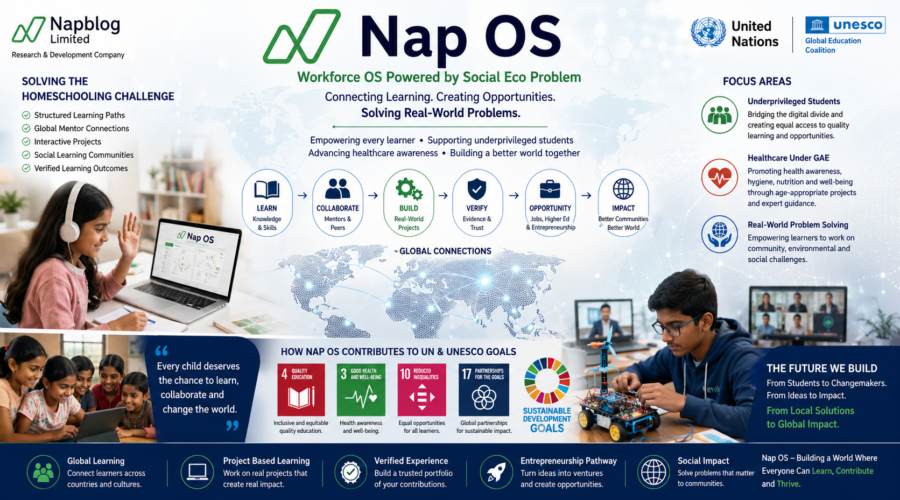
Learn → Explore → Build → Collaborate → Solve → Verify → Opportunity.
Nap OS is being developed around this philosophy.
Rather than treating a learner as simply a student profile, we can imagine a living workforce identity that develops over time.
A student could begin with an educational interest.
They could then participate in a community project.
They might work with another student in another country.
They could contribute to a research project.
They could investigate a local environmental challenge.
They could help an NGO understand a technology problem.
They could develop a prototype.
They could document their contribution.
A mentor, educator or organisation could validate the experience.
Over time, those experiences could become part of a verified portfolio.
That portfolio could eventually support university applications, internships, employment, entrepreneurship or further research.
This is the foundation of the Nap OS concept.
Connecting underprivileged students to the real world
One of the most important opportunities is supporting students who are systematically excluded from traditional opportunity networks.
A talented student may have intelligence, curiosity and ambition but lack access to:
- Experienced mentors
- Professional networks
- Technology
- Research opportunities
- Employers
- Entrepreneurs
- International peers
- Project experience
- Funding information
- Entrepreneurship programmes
The problem is not necessarily a lack of talent.
It can be a lack of access.
UNESCO has specifically emphasized that digital technologies can create possibilities to reach marginalized learners, while also warning that the digital divide remains a major barrier.
Nap OS can potentially contribute to this problem by creating a structured environment in which learners can discover real-world projects appropriate to their age, skills and circumstances.
Imagine a student who cannot easily access a conventional internship.
Instead of waiting years for an opportunity, that student could potentially participate in a supervised project:
Problem → Mentor → Project → Contribution → Evidence → Recognition.
The objective is not to replace schools.
It is not to replace teachers.
It is not to replace parents.
And it is certainly not to place children into unregulated employment.
The objective is to create additional pathways for safe learning, mentorship, collaboration and experience, with appropriate safeguarding and adult supervision.
Nap OS as a bridge between education and society
Education does not exist separately from society.
Students live inside communities that have real problems.
There are environmental challenges.
There are accessibility challenges.
There are healthcare-awareness challenges.
There are technology gaps.
There are local economic problems.
There are problems affecting elderly people, families, migrants, people with disabilities and underserved communities.
These problems can become learning opportunities.
A student studying computer science could explore how technology might improve access to information.
A design student could investigate accessibility.
A business student could research how a social enterprise could serve an underserved community.
A biology student could explore environmental or public-health research questions under appropriate expert supervision.
A communications student could help an NGO explain an important public issue.
The important distinction is that students are not simply consuming information about society — they are learning by engaging with real problems in responsible ways.
That is the direction in which Nap OS Workforce can evolve as a social infrastructure layer.
Education and healthcare should not be disconnected
Another area where this model becomes important is youth health and well-being.
Adolescence is a critical stage of human development. The WHO defines adolescence as ages 10–19 and emphasizes that young people need appropriate information, life skills, health services and safe, supportive environments.
UNICEF similarly emphasizes that disadvantaged adolescents can reach their potential when they have supportive adults, appropriate policies and services, while many still lack access to essential information and quality services.
Nap OS should not attempt to become a medical provider.
Instead, it could become a connection and learning layer.
For example, an age-appropriate social-impact project could help students understand:
- Mental health awareness
- Nutrition
- Physical activity
- Digital well-being
- Public-health communication
- Hygiene and sanitation
- Environmental health
- Accessibility
- Healthcare information literacy
Any healthcare-related activity involving minors would need appropriate professional oversight, safeguarding, privacy protections and ethical boundaries.
The technology should help people connect to qualified information and services, not replace qualified professionals.
This distinction is fundamental.
From social problems to research projects
This is where the Research & Development dimension of Napblog Limited becomes particularly important.
We believe the next generation of innovation should not be driven only by technology looking for a market.
It should also be driven by real problems looking for responsible solutions.
Nap OS could help create a structured environment where social problems become research questions.
For example:
Problem
A community has difficulty accessing educational resources.
Research
Students investigate the causes, available resources and technology barriers.
Collaboration
Educators, NGOs, researchers and technology professionals contribute expertise.
Prototype
A small digital or community solution is developed.
Testing
The solution is evaluated responsibly.
Evidence
The project generates documented learning and measurable outcomes.
Opportunity
Successful projects can potentially progress into research, social enterprise, startup or institutional partnerships.
This creates a powerful transition:
Student → Researcher → Problem Solver → Innovator → Entrepreneur.
Alignment with the global Sustainable Development Goals
This model naturally connects with several United Nations Sustainable Development Goals.
SDG 4 — Quality Education calls for inclusive and equitable quality education and relevant learning outcomes.
SDG 3 — Good Health and Well-being includes child health, adolescent health, universal health coverage and access to appropriate healthcare information and services.
But the opportunity extends beyond individual SDGs.
Education can connect to:
- Poverty reduction
- Decent work
- Gender equality
- Reduced inequalities
- Industry and innovation
- Sustainable communities
- Climate action
- Partnerships
The role of Nap OS would not be to claim ownership of these global goals.
Instead, Napblog Limited can explore how technology and workforce infrastructure can enable people to participate in solving problems aligned with them.
A potential UNESCO-aligned philosophy
UNESCO’s recent work on digital education provides an important principle: technology should support equitable, human-centred education rather than simply digitize existing processes. UNESCO emphasizes human agency, critical thinking, ethics and equity in the use of AI and digital technologies.
This philosophy strongly resonates with the direction of Nap OS.
We do not believe that AI should replace teachers.
We do not believe technology should replace human relationships.
We do not believe a digital platform can solve inequality by itself.
Instead, we believe technology can help connect people who otherwise might never meet.
A student in Dublin could collaborate with a student in Chennai.
A researcher could mentor a student.
An entrepreneur could introduce a young person to startup thinking.
An NGO could present a real-world problem.
A university could provide research expertise.
A technology company could provide technical mentorship.
A healthcare professional could provide appropriate educational guidance.
The platform becomes the connective tissue.
The social ecosystem model
This leads to a broader vision for Nap OS.
We see five connected layers:
1. Education
Students develop knowledge and foundational skills.
2. Experience
They apply those skills through structured projects.
3. Verification
Mentors, educators and organisations can validate contributions.
4. Opportunity
Verified experience can lead towards internships, employment, research, entrepreneurship or further education.
5. Impact
The experience ultimately contributes to solving real problems.
This produces a cycle:
Education → Experience → Opportunity → Impact → New Opportunity.
And that cycle can continue throughout a person’s life.
From underprivileged student to high-potential entrepreneur
Perhaps the most important long-term opportunity is entrepreneurship.
A student who begins by participating in a social project may discover a problem that millions of people face.
That student could become curious.
They could conduct research.
They could build a prototype.
They could find a co-founder.
They could join an incubation programme.
They could meet investors.
They could establish a company.
This is the transition we want to encourage:
Student → Contributor → Problem Solver → Founder.
Nap OS Incubate can potentially become an extension of this philosophy.
Instead of entrepreneurship beginning only after university, it can begin with problem discovery and responsible experimentation.
The objective is not to turn every student into a founder.
The objective is to ensure that students who do have entrepreneurial potential are not prevented from exploring it simply because they lack access.
A global social innovation network
This is where Nap OS could eventually become more than a workforce platform.
It could become a global social innovation network.
Imagine projects originating in Dublin, Chennai, Singapore, Africa, Europe or North America.
Each project could represent a real challenge.
Students and early-career professionals could contribute.
Researchers could provide knowledge.
Mentors could provide guidance.
Organisations could provide context.
Employers could provide technology and resources.
Founders could transform validated solutions into businesses.
Investors could support scalable ventures.
The result would be an ecosystem in which human capability and social problems are continuously matched.
That is a very different proposition from a conventional job platform.
Why this matters for Ireland
Ireland has an opportunity to become a centre for this type of innovation.
Dublin already connects international education, technology, entrepreneurship, multinational companies, research and investment.
A company like Napblog Limited can contribute to that ecosystem by developing technology in Ireland while addressing challenges that are global in nature.
The opportunity is not simply to build an Irish company.
It is to build an Irish innovation platform with global social relevance.
International students studying in Ireland could participate in global projects.
Irish students could collaborate internationally.
Irish universities could connect with research challenges.
Irish companies could support emerging talent.
Irish entrepreneurs could discover global problems.
And successful projects could eventually become startups, research collaborations, social enterprises or scalable technology companies.
This creates a pathway from Irish R&D to global impact.
Building responsibly
The ambition must be matched by responsibility.
Any system involving children or young people must prioritize safeguarding, privacy, consent, accessibility and age-appropriate participation.
UNICEF’s digital education guidance emphasizes that technology creates opportunities for children but also introduces risks that need to be actively managed.
The new UNESCO-UNICEF-ITU Charter for Public Digital Learning Platforms also emphasizes inclusion, public accountability, equal opportunity, social solidarity, holistic well-being and safety.
These principles should be central to any future Nap OS social-impact initiative.
Technology should not exploit children.
It should empower them.
Data should not become a commodity at the expense of vulnerable people.
It should be handled responsibly.
AI should not make decisions about a child’s future without appropriate human oversight.
It should assist educators, mentors and communities.
From Nap OS Workforce to a broader social operating system
Nap OS began with a workforce problem:
How can people demonstrate what they are actually capable of doing?
But the question becomes much bigger when we move upstream.
Before someone becomes a worker, they are often a student.
Before someone becomes a founder, they may be a student experimenting with an idea.
Before someone becomes a researcher, they may be a curious learner asking a question.
Before someone becomes a healthcare professional, they may be a young person discovering an interest in science.
Therefore, workforce development cannot be completely separated from education, research, health, community and entrepreneurship.
That is why we see Nap OS as a potential Workforce Operating System within a broader social ecosystem.
The long-term ambition is to connect:
Learning.
Experience.
Research.
Work.
Entrepreneurship.
Community.
Impact.
The opportunity ahead
The world does not simply need more digital platforms.
It needs better connections between people and opportunity.
A child learning from home should not necessarily be isolated from the world.
A student from an underprivileged background should not be defined by the opportunities they were unable to access.
A young person interested in healthcare should be able to discover responsible pathways into health-related learning.
A curious student should be able to encounter real problems.
A talented researcher should be able to find collaborators.
An aspiring entrepreneur should be able to find mentors.
And a high-potential founder should eventually be able to find customers, capital and global markets.
Nap OS is our attempt to explore how one technology ecosystem could help connect these journeys.
Not by replacing education.
Not by replacing healthcare.
Not by replacing employers, universities, governments or communities.
But by creating a connective layer between them.
The ultimate vision is simple:
Give people the opportunity to learn from real problems, build real experience, demonstrate real capability and create real impact.
From a student solving a small community problem to a founder building a global company, the journey can begin much earlier than we think.
At Napblog Limited, we believe that the future of workforce technology is not only about finding people for jobs.
It is about helping people discover what they can contribute to the world.
And perhaps the most powerful place to begin is with a student asking one simple question:
“What problem can I help solve?”
Napblog Limited | Research & Development
Nap OS — Workforce Operating System
Connecting education, real-world experience, opportunity and impact.
Important: Napblog Limited is exploring these applications and potential collaborations; this article does not claim that Nap OS is currently an official UN, UNESCO, UNICEF or WHO project or partner. Any future contribution would require appropriate institutional partnerships, safeguarding, technical validation and formal approval.