3 min read
Here’s a more policy-focused version aimed at government departments, policymakers, universities, Enterprise Ireland, Local Enterprise Offices, and workforce leaders. It positions Nap OS as part of the solution to a national workforce challenge without being overly promotional.
Ireland has built one of the world’s most productive economies.
Yet one workforce statistic deserves far greater attention.
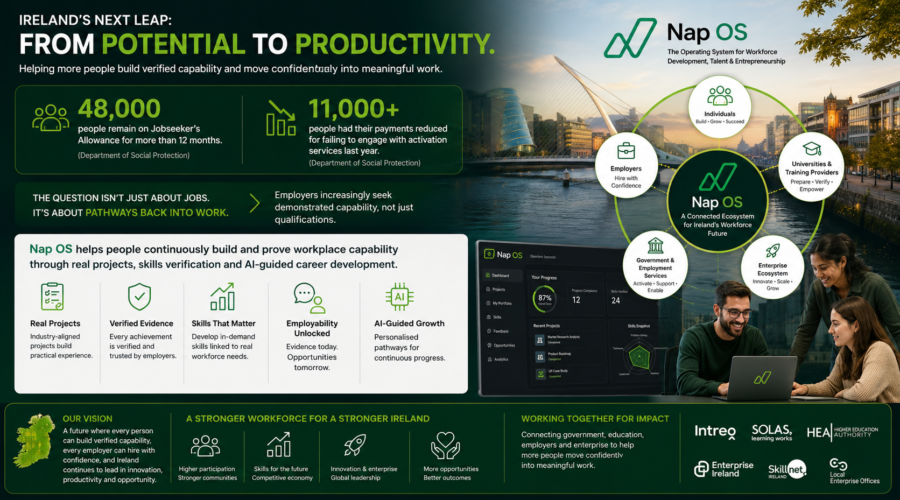
Nearly 48,000 people have remained on Jobseeker’s Allowance for more than 12 months, while over 11,000 people had their payments reduced last year for failing to engage with employment activation services.
These figures suggest that Ireland’s challenge is no longer simply about creating jobs.
It is increasingly about creating pathways back into work.
Employment activation has traditionally focused on job searching, training programmes and career guidance. These remain essential, but today’s labour market increasingly rewards demonstrated capability rather than qualifications alone.
Many employers now ask candidates to show evidence of:
• Practical experience
• Industry projects
• Professional portfolios
• Technical capability
• Collaboration and communication skills
For many long-term jobseekers, graduates, career changers and internationally trained professionals, this creates a difficult cycle.
Without recent work experience, securing employment becomes harder.
Without employment, gaining recent experience becomes almost impossible.
This presents an opportunity to rethink workforce development.
Rather than viewing employability as preparation before entering work, we should view it as a continuous process of building verified capability.
Ireland already has outstanding public infrastructure supporting education, employment services and enterprise development through organisations such as the Department of Social Protection, Intreo, SOLAS, Skillnet Ireland, the Higher Education Authority, Enterprise Ireland, Local Enterprise Offices and our universities.
The next evolution could be connecting these ecosystems through technology that enables people to continuously build evidence of workplace capability while seeking employment.
Imagine if every jobseeker could:
• Complete structured industry projects aligned with labour market needs.
• Build a verified portfolio of work recognised by employers.
• Receive structured feedback from industry professionals.
• Continuously develop skills linked to real workforce demand.
• Present evidence of capability instead of relying solely on a CV.
This would not replace existing employment services.
It would strengthen them.
For policymakers, the objective extends beyond reducing unemployment figures. It is about increasing workforce participation, improving productivity, supporting lifelong learning and helping more people contribute to Ireland’s innovation economy.
These ambitions are already reflected across Ireland’s national strategies for skills, research, innovation and enterprise.
The question is how technology can better connect these strategies into a single workforce ecosystem.
At Nap OS, this is the challenge we are working on every day.
We believe the future of employability will be built on verified work, continuous skills development and trusted evidence of capability, creating better outcomes for individuals, employers, universities and the wider economy.
As Ireland plans for the next decade of workforce development, this is an important conversation worth having.
How can Ireland better connect education, employment and entrepreneurship to help more people move confidently into meaningful work?
Nap OS, Workforce Operating System could solve the problem.
Mail to: Palani@napblog.com to learn more…