5 min read
By Nap OS
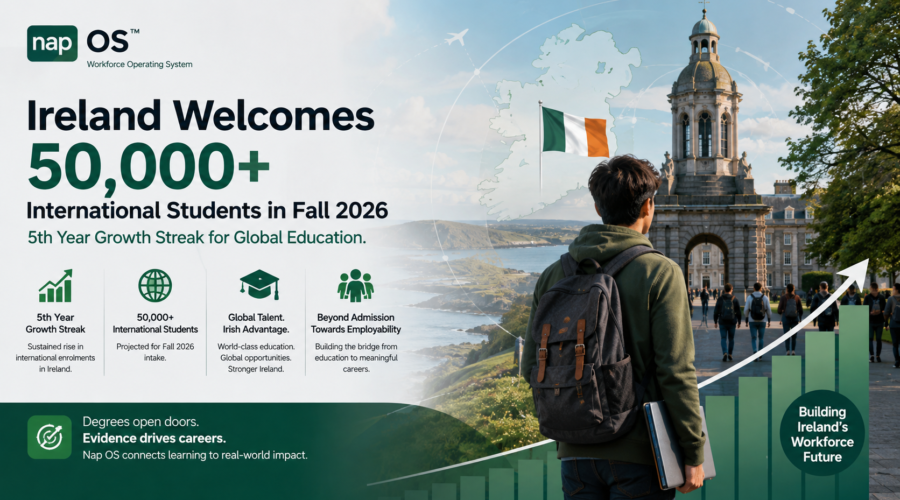
Ireland is on track to welcome more than 50,000 international students for the Fall 2026 intake, marking what appears to be the fifth consecutive year of growth in international education. Recent sector data already showed international enrolments reaching 44,500 in 2024/25, with Indian students becoming the largest international student population and postgraduate demand continuing to accelerate.
Universities are celebrating.
Recruitment agencies are celebrating.
The education sector is celebrating.
But almost nobody is asking the most important question.
What happens after graduation?
For every additional international student Ireland welcomes, another graduate enters one of Europe’s most competitive labour markets.
The challenge isn’t attracting students anymore.
The challenge is creating the workforce infrastructure that helps them successfully transition from education into employment.
From the perspective of Nap OS, this is the next major innovation challenge for Irish higher education.
Ireland Has Built an Outstanding Education Engine
Ireland deserves enormous credit.
Over the last decade it has become one of the world’s strongest international education destinations.
Students choose Ireland because of:
- English-speaking education
- EU employment opportunities
- Technology ecosystem
- High quality universities
- Safety
- Multinational employers
- Strong graduate reputation
This has created an incredible national asset.
International education now contributes billions to the Irish economy.
Universities continue expanding.
Government policies continue supporting growth.
Global demand remains strong.
Everything appears healthy.
But education is only half the journey.
Universities Produce Graduates.
The Labour Market Produces Careers.
Those are completely different systems.
A university can successfully graduate 5,000 students.
That does not automatically produce 5,000 employable graduates.
Because employment depends on something universities have historically struggled to provide consistently:
- verified commercial experience
- employer relationships
- portfolio evidence
- workplace confidence
- project delivery
- commercial communication
- industry references
Degrees prove education.
Employers hire evidence.
The Bigger Ireland Becomes…
…the larger this transition challenge becomes.
Imagine Ireland welcomes:
- 50,000 international students
- 60,000
- 70,000
Fantastic.
But unless workforce transition improves at exactly the same rate, we simply create larger numbers of graduates competing for limited entry-level opportunities.
Growth without transition creates pressure.
Not opportunity.
Students Don’t Want Another Career Workshop
Most international students aren’t asking for:
- another CV workshop
- another LinkedIn webinar
- another networking event
They are asking one question.
How do I become employable?
That’s a completely different problem.
Employability isn’t taught.
It is demonstrated.
Employers Are Also Frustrated
Irish SMEs repeatedly tell the same story.
Graduate applications are increasing.
Finding work-ready graduates is not.
Hundreds of CVs.
Very little evidence.
Everyone lists:
- teamwork
- leadership
- communication
- adaptability
- problem solving
But very few can actually demonstrate those skills through real commercial work.
Employers aren’t rejecting graduates because they lack potential.
They’re rejecting uncertainty.
Universities Cannot Solve This Alone
Career departments work incredibly hard.
They organise:
- employer events
- career fairs
- CV clinics
- interview preparation
- networking sessions
These are valuable.
But career services face an impossible equation.
One advisor may support thousands of students.
They cannot individually create personalised commercial experience for every graduate.
Nor should they be expected to.
That requires an entirely different infrastructure.
Ireland Needs Workforce Infrastructure
Higher education has learning infrastructure.
Research infrastructure.
Innovation infrastructure.
Incubation infrastructure.
Technology transfer infrastructure.
But workforce transition remains fragmented.
Every student independently tries to solve employability.
Every employer independently tries to identify talent.
Every university independently builds partnerships.
The entire system duplicates effort.
The Missing Layer Is Evidence
Imagine two graduates.
Graduate A
- MSc Marketing
- Excellent grades
- Strong motivation
Graduate B
- MSc Marketing
- Excellent grades
- Delivered six verified marketing projects
- Worked with Irish SMEs
- Portfolio reviewed by employers
- Commercial references available
- Campaign performance documented
Which graduate gets interviewed first?
The answer is obvious.
The degree is identical.
The evidence is not.
This Is Where Nap OS Sees The Opportunity
Nap OS wasn’t created to replace universities.
Nor replace careers services.
Nor replace recruitment.
It exists to strengthen the missing transition layer between education and employment.
Instead of asking students:
“What skills do you have?”
We ask:
“What evidence have you created?”
That changes everything.
Project-Based Workforce Development
Rather than simulated assignments…
students contribute to real organisational challenges.
Rather than hypothetical case studies…
they solve real business problems.
Rather than generic internships…
they build structured, verified project portfolios.
Instead of claiming experience—
they create it.
Employers Benefit Too
This isn’t only about students.
Irish SMEs often cannot justify hiring graduates purely on potential.
Project-based collaboration reduces risk.
Companies observe:
- communication
- initiative
- reliability
- creativity
- execution
- learning ability
before making hiring decisions.
Hiring becomes evidence-driven.
Not interview-driven.
Universities Already Understand This Direction
One encouraging trend is that Irish universities increasingly recognise the value of experiential learning.
Across Ireland we are seeing:
- live industry projects
- consultancy modules
- entrepreneurship programmes
- innovation challenges
- multidisciplinary collaboration
These are excellent developments.
Nap OS believes the next step is connecting these experiences into a lifelong workforce portfolio that graduates continue building after university.
Ireland Can Lead Europe
Ireland has something many countries don’t.
Universities.
Government.
Innovation agencies.
SMEs.
Multinationals.
Startup ecosystems.
Incubators.
Research centres.
Enterprise supports.
All within a relatively connected ecosystem.
That makes Ireland uniquely positioned to pioneer workforce innovation.
Not simply education innovation.
The Next Competitive Advantage
For years universities competed on:
- rankings
- research
- facilities
- international recruitment
The next competitive advantage may become much simpler.
Graduate outcomes.
Not employment statistics.
Real workforce readiness.
Students increasingly ask:
“Will this university help me build my career?”
Not merely:
“Will this university award my degree?”
International Students Deserve More Than Admission
International students invest enormous amounts of money.
Many relocate across continents.
Leave families.
Adapt to new cultures.
Build new lives.
For many, education is only one part of the investment.
Employment is the goal.
Ireland owes them more than classroom excellence.
It should also strive for transition excellence.
Workforce Innovation Is National Competitiveness
Every graduate who successfully enters the labour market contributes:
- tax revenue
- innovation
- entrepreneurship
- productivity
- community growth
Every graduate who struggles unnecessarily represents lost potential.
Workforce transition is not simply an education issue.
It is an economic development issue.
The Future Isn’t More Degrees
Ireland probably doesn’t need dramatically more degrees.
It needs stronger bridges between education and employment.
Degrees will remain valuable.
Universities will remain essential.
Career services will continue playing a critical role.
But the missing piece is scalable, evidence-based workforce development.
Final Thoughts
Ireland’s continued international education growth is genuinely worth celebrating. Welcoming more than 50,000 international students in 2026 reflects the country’s global reputation for high-quality education and its appeal as a destination for ambitious learners.
However, recruitment success should not be the final measure of success.
The next chapter is ensuring that these students can successfully transition into meaningful careers after graduation.
That requires stronger collaboration between universities, employers, innovation ecosystems, and workforce technology providers. It also requires a shift from measuring educational inputs to measuring employability outcomes.
At Nap OS, we believe the future of graduate employability is built on verified experience rather than claimed experience. If Ireland can combine world-class education with scalable workforce transition infrastructure, it has the opportunity to become not only one of the world’s leading study destinations, but also one of the world’s leading destinations for launching careers.