Last updated: May 29, 2026
5 min read
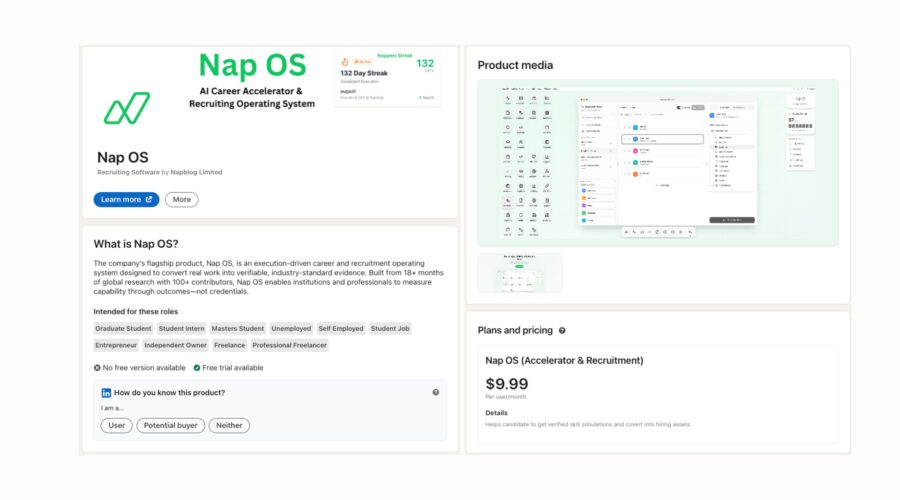
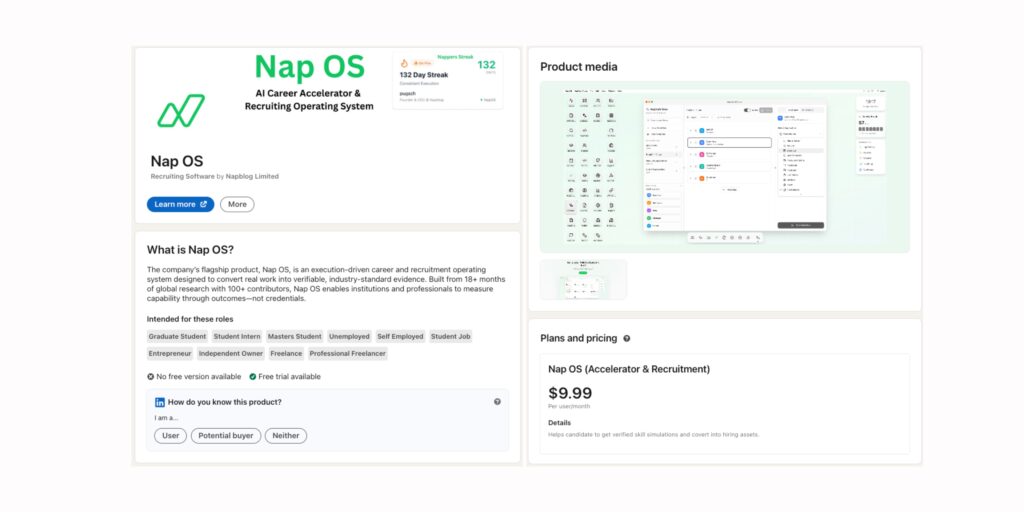
Napblog Limited has always believed that credibility is not claimed—it is built, demonstrated, and verified over time. With the official launch of the Nap OS product page on LinkedIn, we are taking a deliberate step toward making execution-first career infrastructure visible, accessible, and accountable to the global professional community.
This is not just a product listing. It is a strategic move to position Nap OS in the world’s largest professional ecosystem, where hiring decisions, talent discovery, and industry conversations happen every day.
The launch of Nap OS on LinkedIn marks the beginning of a new phase—where career systems are no longer hidden behind private dashboards but are evaluated in the open, against real alternatives, real expectations, and real outcomes.
Why Launch on LinkedIn Matters
LinkedIn is not just a social platform. It is a marketplace of credibility.
Every day:
- Millions of professionals update their profiles
- Recruiters search for talent
- Companies evaluate candidates
- Products compete for attention
- Ideas are tested publicly
By launching Nap OS on LinkedIn, Napblog Limited is placing its flagship product in a high-signal environment where visibility is earned through relevance, not marketing noise.
This aligns with our core philosophy: build in public, validate in public, and improve in public.
What Nap OS Represents on LinkedIn
Nap OS is introduced as:
“An execution-driven career and recruitment operating system designed to convert real work into verifiable, industry-standard evidence.”
This positioning is intentional.
Traditional recruitment tools on LinkedIn often focus on:
- Applicant tracking
- Resume filtering
- Keyword matching
- Job posting distribution
Nap OS operates differently.
It focuses on:
- Execution tracking
- Evidence creation
- Portfolio validation
- Skill-to-output mapping
- Recruiter verification
This creates a new category within the recruiting software ecosystem.
Standing Among Established Products
On LinkedIn, Nap OS appears alongside well-known recruiting tools such as:
- LinkedIn Recruiter
- Zoho Recruit
- HackerRank
Each of these tools solves a part of the hiring problem.
But none of them solve the core issue Nap OS is built for:
The inability to verify real capability through execution.
Nap OS does not compete by adding more features.
It competes by redefining what should be measured.
From Resume-Based Identity to Execution-Based Identity
LinkedIn profiles have long been the digital representation of professional identity.
But they are still largely:
- Self-declared
- Static
- Narrative-driven
- Endorsement-based
Nap OS introduces a complementary layer:
Execution-based identity.
Instead of saying:
“I have experience in marketing.”
Nap OS enables users to show:
- Campaigns executed
- Tools used
- Results achieved
- Workflows built
- Consistency maintained
By integrating with platforms like:
- Google Analytics
- Google Ads
- GitHub Advanced Security
- Notion
- WordPress
Nap OS connects real activity to professional identity.
This transforms LinkedIn visibility into verifiable credibility.
Product Page as a Trust Layer
Launching a product page on LinkedIn is not just about visibility.
It is about trust.
The Nap OS page includes:
- Product description
- Use cases
- Target users
- Pricing model
- Integrations
- Public posts and updates
This creates a transparent layer where:
- Users can evaluate the product
- Potential buyers can assess value
- Recruiters can understand capabilities
- Partners can explore collaboration
In a world where many products hide behind landing pages, LinkedIn forces clarity.
And clarity builds trust.
The Role of Public Content
The Nap OS product page is not static.
It is supported by continuous content such as:
“Most career advice sounds good. But it rarely works. So, we don’t just advise—we build.”
“Every missed follow-up = lost opportunity. Every generic CV = missed match.”
These are not just marketing statements.
They reflect real problems in the hiring ecosystem.
By publishing these insights directly on LinkedIn, Napblog Limited:
- Engages with real professionals
- Tests ideas in real time
- Builds credibility through consistency
- Attracts aligned users
Content becomes a validation layer for the product.
Why This Matters for Users
For students, graduates, and professionals, the LinkedIn product page provides:
- A clear understanding of what Nap OS does
- A way to compare it with other tools
- Access to real-world use cases
- Entry into a system that values execution
Users are no longer dependent on:
- Generic advice
- Static resumes
- Unverified claims
They can explore a system designed for:
- Real work
- Real outputs
- Real growth
Why This Matters for Recruiters
Recruiters operating on LinkedIn face a common challenge:
Too many applications, too little signal.
Nap OS introduces a different approach:
- Candidates with verified portfolios
- Evidence-backed skill claims
- Structured execution history
- Measurable outputs
This reduces:
- Screening time
- Hiring risk
- Guesswork
The LinkedIn product page becomes a gateway for recruiters to discover this new model.
Why This Matters for Institutions
Educational institutions are under pressure to improve employability outcomes.
Nap OS offers:
- A system to track student execution
- A way to measure real capability
- A bridge between learning and hiring
By being present on LinkedIn, Nap OS becomes visible to:
- Universities
- Training providers
- Career services
This opens the door for deeper collaboration.
Pricing and Positioning
Nap OS is listed at a starting price of $9.99 per user per month, with a free trial available.
This pricing strategy reflects:
- Accessibility for individuals
- Scalability for institutions
- Flexibility for different user types
It also reinforces the idea that:
Career infrastructure should not be a luxury.
It should be accessible to those who are building their future.
The Importance of Integrations
Modern professionals do not work in isolation.
They use multiple tools.
Nap OS integrates with platforms across:
- Analytics
- Advertising
- Development
- Content
- Automation
This ensures that:
Execution is not siloed.
It is connected.
And when execution is connected, it becomes measurable.
Competing Through Philosophy, Not Noise
The recruiting software space is crowded.
Many tools compete through:
- Feature lists
- Pricing discounts
- Sales outreach
Nap OS competes differently.
It competes through philosophy:
Execution over theory
Evidence over claims
Systems over shortcuts
The LinkedIn product page becomes a place where this philosophy is communicated clearly.
Building in Public at Scale
Napblog Limited has consistently followed a build-in-public approach.
Launching on LinkedIn extends this approach.
Now:
- Product updates are visible
- User engagement is public
- Feedback is immediate
- Credibility is continuously tested
This creates a feedback loop that improves the product faster.
Challenges Ahead
Launching on LinkedIn is not without challenges.
- Users may compare Nap OS with traditional tools
- Some may not immediately understand the model
- Adoption requires mindset change
- Execution-based systems demand effort
But these challenges are necessary.
Because meaningful systems are not built for passive users.
They are built for those willing to engage.
The Long-Term Vision
The LinkedIn product page is not the end goal.
It is a step toward a larger vision:
A world where:
- Careers are built through execution
- Hiring is based on evidence
- Skills are continuously validated
- Systems replace guesswork
Nap OS aims to become a standard layer in this future.
Conclusion
Launching Nap OS on LinkedIn is more than a product update.
It is a statement.
A statement that:
Career systems must evolve
Execution must be visible
Credibility must be earned
And hiring must become more intelligent
By entering the LinkedIn ecosystem, Napblog Limited is placing Nap OS in the center of global professional conversations.
Not as another tool.
But as a new way of thinking about careers, hiring, and value creation.
The journey is just beginning.
And now, it is visible to the world.