7 min read
An international degree represents more than an academic achievement. For many students, it involves savings, education loans, relocation, and the hope of building a meaningful career.
Yet completing a qualification does not automatically lead to employment that uses it.
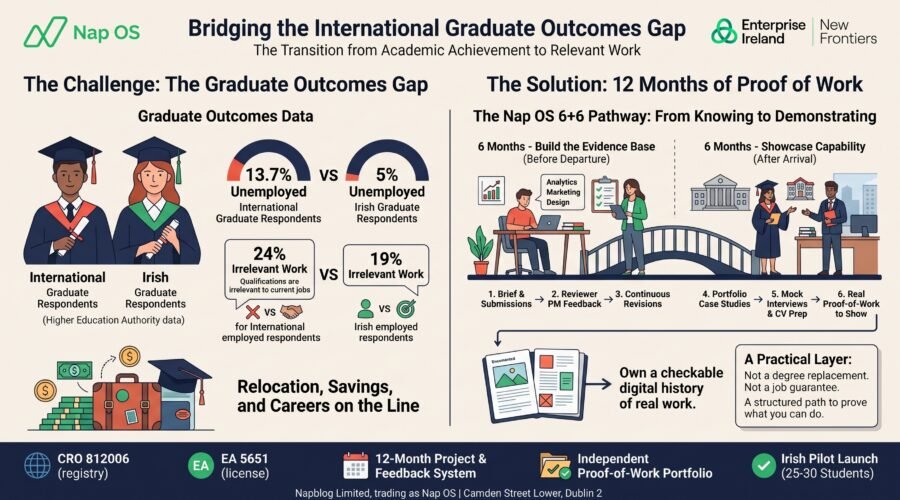
Reporting published by The Journal in October 2026, drawing on Higher Education Authority graduate outcomes data, found that 13.7% of international graduate respondents were unemployed, compared with 5% of Irish graduate respondents. Among those employed, 24% of international respondents said their qualifications were irrelevant to their jobs, compared with just over 19% of Irish respondents.
These figures raise a difficult question: how can international students prepare more effectively for the transition from academic achievement to relevant work?
Nap OS’s answer focuses on a practical contribution: twelve months of work projects, assessed by Project Managers, helping participants develop evidence of what they can do.
Not a replacement for a degree. Not a promise of employment. A structured way to turn learning into work that can be inspected, discussed, and improved.
What the Figures Actually Tell Us
The statistics deserve attention—but also careful interpretation.
The October 2026 reporting refers to earlier HEA graduate outcomes data, not a live count of all international students struggling in 2026. The reported survey response rate was 50.9%. Its findings concern graduate respondents, rather than every international student enrolled in Ireland
The unemployment and qualification-mismatch figures also describe different groups:
- Unemployment concerns graduates reporting that they were unemployed.
- Qualification mismatch concerns employed respondents who considered their qualifications irrelevant to their jobs.
These percentages cannot simply be added together. Nor can they be applied to total international enrolment to calculate a reliable national headcount.
The evidence identifies an important gap. It does not establish that every international graduate faces the same difficulty or that one intervention can resolve it.
A Job Is Not the Only Measure of Progress
Employment matters, but the relationship between someone’s education and their work matters too.
A graduate may accept an unrelated role to meet immediate financial needs while continuing to pursue their preferred career. Another may discover a rewarding direction outside their original discipline.
Working outside one’s qualification is therefore not automatically evidence of failure. The concern is whether graduates have meaningful choices—and whether they can demonstrate their capabilities when pursuing relevant opportunities.
Nap OS’s product proposition addresses that question.
Rather than asking someone to rely entirely on a qualification or a list of skills, it encourages them to develop a more concrete professional story:
Here is the problem I worked on. Here is my contribution. Here is the feedback I received. Here is how I improved the result.
The Gap Between Knowing and Demonstrating
Consider an illustrative business analytics graduate.
They may understand statistical methods, visualisation tools, and business reporting. Yet an application stating “strong analytical skills” tells an employer little about how that person approaches an unclear problem.
A documented project can provide a different conversation.
What question did the participant investigate? Why did they choose a particular dataset? How did they handle missing information? What assumptions did they make? What would they change before using the analysis commercially?
Nap OS is designed around making that process visible.
The objective is not simply to generate attractive outputs. It is to help participants understand their work well enough to explain its strengths, limitations, and relevance.
What Nap OS Means by Proof of Work
In the Nap OS context, proof of work means documented evidence of an individual’s contribution.
A useful record should connect:
- The original brief.
- The participant’s responsibilities.
- The submitted deliverable.
- Assessment against stated criteria.
- Feedback and revisions.
- A final reflection on the work.
This creates a stronger basis for discussion than an unsupported claim of proficiency.
However, the evidence must be described accurately. A simulated business brief is not paid employment. An independently completed project is not automatically client work. A reviewer’s assessment is not an employer’s hiring endorsement.
Those distinctions protect the participant’s credibility as well as the platform’s.
Why Project Manager Assessment Matters
Nap OS’s stated model combines work projects with Project Manager assessment.
The potential value lies in the feedback cycle: participants submit work, receive specific observations, and make improvements.
For example, a market-research submission might identify an interesting opportunity but rely on weak assumptions. Useful feedback would explain which assumptions need testing, what evidence is missing, and how the recommendation could become more defensible.
The revised submission then demonstrates something beyond knowledge: the ability to respond constructively to review.
Assessment should be tied to clear criteria, not vague encouragement. Participants should know what is being evaluated and understand the basis of the feedback.
A finished document matters. So does the reasoning that produced it.
A Twelve-Month Structure for Consistent Development
Nap OS’s twelve-month positioning should communicate continuity rather than an instant transformation.
The intended value is repeated practice: completing briefs, receiving feedback, revising work, and gradually building a more coherent portfolio.
Programme duration must nevertheless be understood correctly. Twelve months of participation does not mean twelve months of paid employment, a full-time placement, or continuous commercial assignments.
Students should understand the actual workload, available support, review arrangements, and fees before enrolling.
For someone already managing academic commitments or a demanding job search, an additional programme must have a clear purpose. Nap OS should help participants identify that purpose—not encourage them to accumulate activity without direction.
Start With a Target Role, Not Random Projects
A portfolio becomes more useful when its contents support a defined professional direction.
An aspiring business analyst might build a process review and requirements document. A marketing applicant might develop a campaign proposal with audience assumptions and measurement criteria. A data applicant might create a dashboard accompanied by an explanation of data quality and analytical choices.
These are illustrative pathways, not claims that every project or reviewer is currently available.
The principle is relevance.
Before beginning a brief, a participant should be able to answer:
What capability will this project help me practise, and how might I explain its relevance to my target role?
That question keeps portfolio-building connected to career goals.
Turn Completed Work Into an Interview Conversation
A project does not become useful merely because it appears in a portfolio.
Participants also need to communicate it clearly.
Nap OS’s approach should encourage a concise explanation of:
- The problem and its context.
- The participant’s individual contribution.
- The decisions and trade-offs involved.
- The feedback received.
- The changes made.
- The limitations that remain.
This is particularly important for collaborative work. Applicants should distinguish their contribution from the team’s overall output.
The aim is not to memorise an impressive story. It is to become comfortable answering detailed questions about work they genuinely understand.
Preparation Cannot Remove Every Employment Barrier
The reporting that prompted this article describes concerns beyond skills and portfolios. Student representatives highlighted prolonged job searches, financial pressure, expectations shaped by marketing, and immigration-related obstacles.
Those concerns should not be reframed as evidence that students simply need another paid product.
Nap OS cannot create vacancies across the economy, compel employers to sponsor applicants, or guarantee that relevant work will be available.
It also cannot grant immigration permissions. Participants should obtain current information from official sources or qualified advisers before undertaking employment, commercial projects, or freelance work.
The product’s contribution is preparation and evidence—not control over the wider employment system.
Replace Dream-Selling With Clear Commitments
International students deserve clarity before making another financial commitment.
The Journal’s reporting includes student representatives’ concerns that some prospective students develop unrealistic expectations about salaries and employment after studying abroad. Those are reported experiences and opinions, not proof that every institution makes misleading promises.
Nap OS should respond by being explicit about its own offer:
- What participants receive.
- What costs extra.
- Who reviews the work.
- What feedback is included.
- How long reviews take.
- What completion represents.
- What outcomes are not guaranteed.
A programme should be judged by commitments it can deliver, not the emotional power of its advertising.
Measure the Product Beyond Testimonials
A credible career-readiness product needs evidence of its own.
Nap OS should distinguish activity from improvement and improvement from employment.
Relevant measures include completed submissions, feedback delivered, revisions, portfolio completion, participant satisfaction, and assessed progress.
With consent, longer-term follow-up could examine interviews, paid assignments, employment, and whether work relates to the participant’s goals.
Published outcomes should include cohort size, timeframe, and response rate. A graduate obtaining a job after participating does not automatically establish that Nap OS caused the outcome.
Honest measurement strengthens the product by showing both where it helps and where it needs improvement.
Build Evidence Before Asking for Opportunity
Ireland’s graduate outcomes gap deserves more than alarmist headlines. It calls for realistic information, responsible recruitment, employer engagement, and practical support.
Nap OS can contribute by helping participants move from statements of potential to documented examples of contribution.
Its strongest promise is not that a qualification plus a portfolio guarantees employment. It is that people should have a structured opportunity to apply knowledge, receive assessment, and show how their work improves.
Nap OS: Twelve months of work projects, assessed by Project Managers. Build work you can explain. Develop evidence you can show.
For international graduates navigating an uncertain transition, that is a practical place to start.