7 min read
Why education needs a stronger bridge between what people learn, what they can demonstrate, and the opportunities they pursue.
The UK faces two challenges that deserve to be discussed together: the financial commitment involved in higher education and the difficulty some young people face when entering employment.
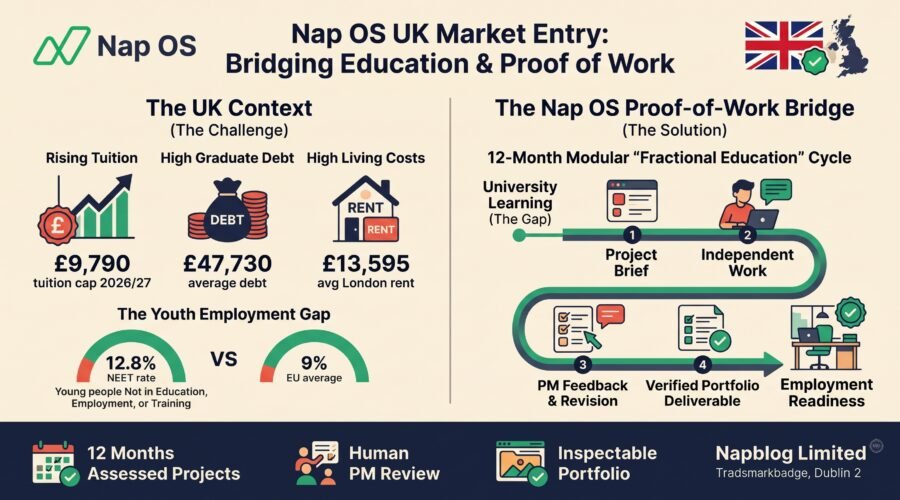
In England, the maximum standard undergraduate tuition fee rose from £9,000 in 2015 to £9,535 in the 2025/26 academic year. It increased again to £9,790 in 2026/27. These figures exclude accommodation, food, transport, and other living expenses.
Meanwhile, the Office for National Statistics estimated that 12.8% of UK young people aged 16–24 were not in education, employment or training between October and December 2025.
These statistics do not prove that university causes unemployment, or that degrees lack value. They raise a more practical question:
When people invest substantial time and money in education, how can they leave with stronger evidence of what they can actually do?
That is the question Nap OS proposes to address through its UK market entry.
The Cost of Education Deserves a More Precise Conversation
University costs are often discussed as though one number applies across the UK. It does not.
Tuition policies differ across England, Scotland, Wales, and Northern Ireland. Fees also depend on residency, course, institution, and eligibility for support. International fees are a separate category.
For a consistent historical comparison, consider England’s standard maximum undergraduate tuition fee:
| Academic period | Annual tuition fee cap |
|---|---|
| 2015/16 | £9,000 |
| 2017/18 | £9,250 |
| 2025/26 | £9,535 |
| 2026/27 | £9,790 |
These are fee caps, not average total student costs or universities’ expenditure per student. The increase from £9,000 to £9,535 was approximately 5.9% in nominal terms. Fees remained frozen for much of that period, while inflation reduced the purchasing power of universities’ income.commonslibrary.parliament+1
The strongest argument is therefore not that tuition fees exploded between 2015 and 2025. It is that students face a substantial overall financial commitment while institutions themselves face funding pressure.
Living Costs Make the Investment Larger
Tuition is only one part of attending university.
BBC reporting, drawing on Higher Education Policy Institute research, states that average annual student rent across ten university towns and cities outside London and Edinburgh increased from £6,520 in 2021/22 to £7,475 in 2023/24. Average purpose-built student accommodation rent in London reached £13,595 in 2024/25. These figures refer to different samples and periods, so they should not be combined into a single national average.
The same reporting puts average student debt at £47,730 for graduates in England who became liable to repay in April 2026. That is a loan-balance measure—not the amount every graduate will ultimately repay.
Against this backdrop, asking education providers to help students develop practical capability is reasonable. Asking students to purchase another programme, however, requires an equally clear explanation of its additional value.
Nap OS must meet that standard too.
Youth Disconnection Is Bigger Than a Skills Gap
The chart accompanying this discussion highlights the UK’s position relative to European countries. Its comparison uses UK figures for ages 16–24 and European figures for ages 15–24.
The government’s Young People and Work interim report acknowledges this age-band difference when comparing the UK’s end-2025 rate of 12.8% with a 2025 EU average of 9%. The comparison is informative, but not perfectly like-for-like.
Nor does NEET status identify one common cause. The report discusses barriers involving health, disadvantage, and the transition into work—not simply a shortage of qualifications.
Nap OS should not claim that projects alone can resolve these issues. Its potential contribution is more specific: helping suitable participants develop practical work, receive feedback, and communicate their capabilities.
Qualifications and Evidence Serve Different Purposes
A degree can provide disciplinary knowledge, intellectual development, professional foundations, and access to opportunities. Nap OS does not need to dismiss those benefits to establish its relevance.
Instead, it can focus on a complementary question:
Beyond your qualification, what can you show?
A business graduate might explain a market-entry recommendation. A data analyst might demonstrate a dashboard and defend its assumptions. A developer might walk through an application, its tests, and the decisions behind its design.
These examples are not substitutes for every qualification or employment requirement. They are opportunities to make learning inspectable.
Nap OS’s UK proposition should centre on proof of work: a documented relationship between a brief, an individual’s contribution, feedback, revisions, and a final deliverable.
What Nap OS Proposes to Bring to the UK
The proposed offer is straightforward:
Twelve months of work projects, assessed by Project Managers, helping participants build evidence of capability.
The programme should make its practical commitments explicit:
- What projects participants undertake.
- How much time they should expect to invest.
- Who assesses their work.
- What feedback they receive.
- How revisions are supported.
- What records and portfolio materials they retain.
“Twelve months” describes programme duration. It should not imply twelve months of paid employment, continuous client work, or a guaranteed placement.
Simulated briefs, independent projects, and commercial assignments should also be labelled separately. Honest descriptions make the evidence more credible.
Fractional Education: A Practical Definition
Nap OS can use “fractional education” to describe a modular approach to applied learning.
Rather than asking someone to undertake another broad qualification, the proposed model would organise development around focused briefs, targeted guidance, assessment, and improvement.
A participant might complete a customer-research project, identify weaknesses through review, revise the work, and then move to a more demanding brief.
The value would lie in the progression—not merely in collecting completed tasks.
To make this positioning meaningful, Nap OS should publish the programme’s structure and standards. “Fractional” must explain how learning is organised, not become an unexplained marketing term.
Make the Project Manager Role Credible
Human assessment is central to the Nap OS proposition. It must therefore be more than a name attached to a submission.
The UK model should define reviewer selection, relevant experience, feedback expectations, turnaround times, and quality assurance.
Assessment should examine:
- Understanding of the problem.
- Quality of reasoning.
- Accuracy and completeness.
- Communication.
- Response to feedback.
- Understanding of limitations.
- Disclosure of assistance, including AI tools.
Participants should be able to explain their work, not simply upload a polished output.
A moderation and appeals process would help establish confidence that assessments are consistent and open to challenge.
Enter Through Focused Partnerships
A credible UK launch should begin with a limited pilot, not a claim to transform the entire education system immediately.
Potential partners include university careers teams, further-education colleges, adult-learning providers, employability organisations, and employers willing to review project standards.
The invitation could be:
Help us test a structured pathway from learning to assessed work, with clear responsibilities and transparent reporting.
The UK already has work-experience provision, including Jobcentre Plus opportunities intended to help unemployed people develop practical workplace skills. Nap OS must demonstrate how its feedback, documentation, and portfolio process add value alongside existing routes.
Design With Employers, Without Implying Guaranteed Hiring
Nap OS should ask prospective employers what evidence would genuinely help them assess an early-career applicant.
Their input could shape briefs, rubrics, presentation formats, and project showcases.
However, reviewing a brief does not mean an employer has agreed to recruit. Attending a showcase does not establish a placement partnership.
The proposed benefit is a clearer basis for conversation: participants can show their work, and employers can inspect the reasoning behind it.
Any subsequent hiring decision remains with the employer.
Affordability Must Be Part of the Product
Nap OS cannot criticise education costs while remaining vague about its own.
Before UK enrolment, participants should receive clear pricing, workload expectations, support entitlements, cancellation terms, and refund information.
Institution-funded places and employer sponsorship could be explored, but should not be presented as available before agreement.
Nap OS should also avoid claiming it is cheaper than university without a defined price and a fair comparison of scope. A project programme and a degree provide different services.
The appropriate test is whether Nap OS delivers sufficient additional value for its cost.
Measure Outcomes, Not Just Enrolment
The pilot should distinguish participation from improvement and improvement from employment.
Useful measures include project activation, feedback delivered, revisions completed, assessed progress, portfolio completion, satisfaction, and complaints.
With consent, Nap OS could also follow interviews, paid projects, and employment outcomes over a defined period.
Every published outcome should include its denominator and timeframe. Employment after participation should not automatically be attributed to Nap OS.
Participant protections matter equally: commercial projects need appropriate arrangements around pay, working status, intellectual property, confidentiality, and data. These should be reviewed before launch.
A Stronger Bridge From Education to Opportunity
Rising costs and youth employment challenges create a serious context for Nap OS’s UK ambitions. They do not establish that university has no value—or that Nap OS has already proved an alternative.
They establish a demanding opportunity.
Nap OS can propose a focused contribution: structured projects, Project Manager assessment, documented improvement, and work participants can explain with confidence.
The invitation to UK institutions and employers is to help test that contribution honestly.
Nap OS UK: Build work. Receive feedback. Demonstrate your contribution.
Not another promise that education automatically produces employment, but a practical effort to make the journey from learning to opportunity more visible—and more accountable.