7 min read
A one-year master’s abroad can cost an Indian family €30,000 to €40,000 once living costs are added, most of it borrowed. It is often the largest financial decision the family has ever made, and it is usually made in a few weeks, on the strength of a brochure, a ranking and a cousin’s advice.
This article is not an argument against degrees. A good degree opens doors, and for many careers it is required. It is an argument for thinking three times before you pay, and for considering a cheaper first step that builds the one thing a degree alone cannot: proof that you can do the work.
We call that step fractional education.
Contents
- Think once: what job will this lead to, and what is the evidence?
- Think twice: what will employers ask for that the degree won’t give?
- Think three times: how can I test it before committing the full cost?
- What fractional education is, and what it costs
- Where Nap OS fits, and what it doesn’t claim
- A checklist before you pay
1. Think once: what job will this lead to, and what is the evidence?
Before asking “which university?”, ask “which job?”. Then ask for evidence that this course leads there.
Most families compare courses on rankings, fees and location. Very few ask the question that decides whether the loan can be repaid: what happened to last year’s graduates? Not the top student in the brochure, but the typical one. How many found graduate-level work in the country within six months, and at what salary?
In Ireland, that salary matters more than most families realise. To stay and work after graduating, an international graduate generally needs a job that meets the employment-permit salary floor, which starts at €34,009 a year. A degree without a job at that level can mean returning home with the debt but without the career.
If a course cannot tell you where its international graduates went, treat that as information. It does not mean the course is bad. It means you are being asked to pay before seeing the evidence, and you should look for ways to reduce that risk.
2. Think twice: what will employers ask for that the degree won’t give?
Employers rarely reject international graduates for their degree. They reject them for having no local work experience.
This is the catch-22 every international student meets. Employers want experience in their market. Students cannot get it without a job. And a degree, however good, is evidence of learning, not evidence of doing.
The gap shows up in the data. Mercer-Mettl’s India Graduate Skill Index 2025 rated 42.6% of Indian graduates as employable. Employers abroad know that a strong transcript does not guarantee someone can handle a real brief, a real deadline and real feedback, so they look for proof elsewhere: internships, projects, references from people they trust.
AI has made this sharper. Anyone can now produce a polished CV, cover letter or portfolio in minutes. What an employer still trusts is a named professional who has examined someone’s actual work and is willing to say it was good.
So the second question is: when I graduate, what will I be able to show an employer that I did, and who will vouch for it? If the honest answer is “my degree certificate”, the degree is not the whole investment. You need a plan for the rest.
3. Think three times: how can I test it before committing the full cost?
The smartest way to make a large decision is to make a small one first.
Businesses do this all the time. Before building a factory, they run a pilot. Before hiring for a year, they offer a trial. Families can do the same with education: before committing €30,000 or more, spend a fraction of that testing whether the student can do the work the degree is meant to lead to.
A small test answers questions a brochure never will:
- Does the student actually enjoy this kind of work? Many discover, after a semester, that the field is not for them. Better to find out for a few hundred euro than a few thousand.
- Can they meet the standard employers expect? Feedback from a practitioner in the target market is far more useful than a grade.
- Which country and role fit best? Working on briefs set by different markets shows where a student’s skills travel.
The test does not replace the degree. It makes the degree decision better informed, and if the student goes ahead, they start with work already on record.
4. What fractional education is, and what it costs
Fractional education means buying the specific piece of learning you need, when you need it, instead of paying for the whole bundle upfront.
A traditional degree bundles many things into one price: teaching, a qualification, a campus, a visa route, a network. Some of those are worth every cent. But the piece international students most often lack, assessed experience that employers in a specific country trust, is usually not in the bundle at all.
Fractional education unbundles it. Instead of a semester, it is a project. Instead of an exam, it is a brief reviewed by a practitioner. Instead of a certificate, it is a record of work an employer can open and read.
| One-year master’s abroad | Fractional work experience with Nap OS | |
|---|---|---|
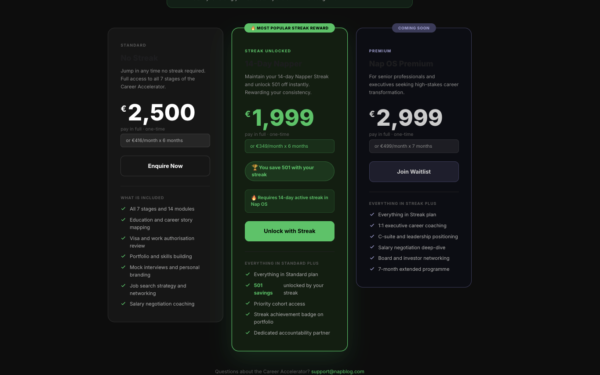
| Typical cost | €30,000–40,000 with living costs | €999 for 12 months, or €49.99 a month |
| Share of the master’s cost | 100% | Roughly 3% |
| What you get | Teaching, a qualification, a visa route | Assessed projects and a proof-of-work record |
| Who judges your work | Lecturers | Project Managers working in your target market |
| When it starts | On arrival | At home, up to five months before you fly |
The two are not either-or. For most students the right answer is both: the degree for the qualification and the visa, fractional work experience for the proof. But the order matters. Starting the small, cheap part first tells you whether the large, expensive part is the right bet.
5. Where Nap OS fits, and what it doesn’t claim
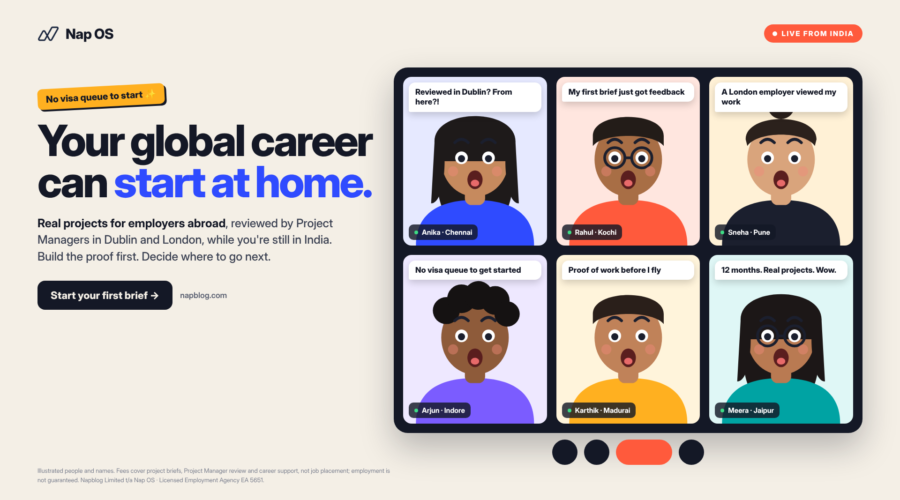
Nap OS is fractional education built around one outcome: proof that you can do the work, judged by the market you want to work in.
Students choose one of five domains: Startup and Entrepreneurship, Strategy and Operations, Marketing and Sales, Product and Research, or Data and AI. Each project brief is scoped like a real workplace task. A named Project Manager working in the destination country reviews every submission in writing within seven days, against criteria published in advance.
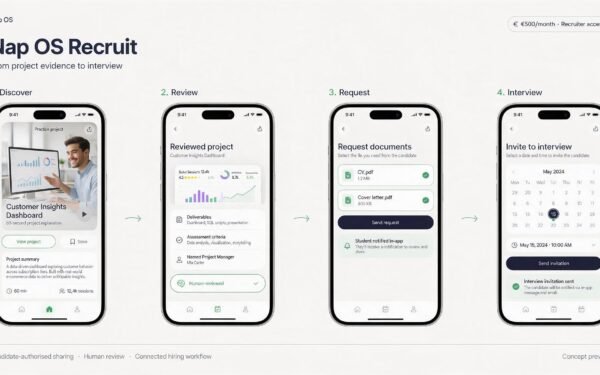
On the 12-month programme, the first five months happen at home, before departure. By the time a student lands in Ireland or the UK, they already have assessed work on record. Every project stays in Nap OS afterwards as proof of work, so employers can see what a candidate has done before the first interview.
Nap OS has been live since January 2026 and has generated more than 600 project briefs. We have delivered a 30-credit capstone for University College Dublin’s MSc in Communication and Media and hosted a credit-bearing MSc placement for Grenoble École de Management.
What we don’t claim:
- No guaranteed job. Fees cover project briefs, Project Manager review and career support, not recruitment or job placement. Employment is not guaranteed.
- Not a degree. Nap OS is not an accredited award and does not replace one where a qualification is required.
- No immigration advice. If a visa is refused, students can continue remotely, switch destination, pause, or take a refund for the part not delivered.
Napblog Limited, which runs Nap OS, holds Irish employment agency licence EA 5651.
6. A checklist before you pay
Think once, twice and three times. Then decide.
- I know which job this course is meant to lead to
- I have asked what happened to last year’s international graduates, and got an answer with numbers
- I know the salary I will need to stay and work, and whether graduates of this course reach it
- I know what I will be able to show an employer, beyond my degree, when I graduate
- I have tested my interest and ability with real work before committing the full cost
- I have a plan to start building proof of work before I fly, not after I land
I came to Ireland from India on an education loan, and I know how much a family puts on the table when a child leaves to study. Nap OS exists so that money buys a future, not just a qualification.
Pugazheanthi Palani, Founder & CEO, Nap OS palani@napblog.com · napblog.com
This article is general information, not financial advice. Napblog Limited t/a Nap OS · CRO 812006 · Licensed Employment Agency EA 5651 · Dublin
Sources
- Mercer-Mettl, India Graduate Skill Index 2025: 42.6% of Indian graduates rated employable
- Irish employment-permit graduate salary thresholds from 1 March 2026 (Department of Enterprise, Tourism and Employment): from €34,009
- Cost of a one-year master’s abroad, including living costs: Nap OS estimate
- Nap OS figures: Napblog Limited platform data, November 2026