7 min read
1. The number nobody publishes
Irish universities publish their rankings, their research income and their graduates’ starting salaries. None of them is required to publish this: how many careers advisers there are for every student.
Ireland sets no required or recommended ratio of careers staff to students in higher education. Each institution funds its careers service out of its own student-support budget and decides for itself how far that money stretches. We could find no published national figure for how many careers advisers serve how many students.
The one staffing ratio Ireland does publish is for teaching. In 2024 there were 19 tertiary students for every member of teaching staff, against an OECD average of 15. Careers advisers are not in that figure, and nobody publishes theirs.
So a student choosing a university, or a parent signing a loan to pay for it, cannot see the one number that tells them how much individual attention the job search will get.
2. The arithmetic of one adviser
Since nobody publishes the ratio, work it out from the other end.
A full-time job in Ireland is roughly 1,700 working hours a year once leave and public holidays are taken out. Now give every student one thirty-minute conversation a year. Not coaching. Not a mentoring relationship. One meeting.
- One adviser for every 1,000 students: 500 hours, under a third of the working year.
- One for every 3,000: 1,500 hours, almost all of it.
- One for every 5,000: 2,500 hours, nearly a year and a half of work.
That is before a single workshop, a single employer phone call, a single email, a careers fair, a report to management or a graduate survey.
Somewhere past three thousand students per adviser, it becomes arithmetically impossible to meet every student even once. Which side of that line your university sits on is a question worth asking. Most students never ask it.
3. This is not the careers team’s fault
We want to be clear about this, because it would be easy and unfair to read this as an attack on careers services.
Careers teams in Irish universities and colleges are some of the most committed people on any campus. They run fairs, chase employers, review CVs at eleven at night before a deadline, and build programmes on budgets that would embarrass a small company. Their staffing is not their decision. It is a funding decision, taken across the whole system.
And the system is stretched everywhere. Irish institutions spent USD 8,547 on staff per full-time student in 2023, against an OECD average of USD 11,181. The 2022 Funding the Future report identified a €307 million annual gap in core funding, and the Irish Universities Association’s pre-budget submission for 2027 asks for €190.2 million more a year.
When budgets are that tight, support services are where the strain shows.
4. What students are actually paying for
In 2024/25 there were 278,880 students in Irish universities and technological universities. 44,535 of them were not Irish, about 16%, and India was the largest single country of origin.
International students pay the most. Non-EU tuition typically runs from about €10,000 to €35,000 a year. On one Dublin university’s published fees for 2027/28, a non-EU student on a one-year master’s pays €24,600; an EU classmate on the same course pays €16,575. Same classroom, same lecturers, same award. Add a year of Dublin rent and living costs and a one-year master’s passes €40,000.
Many families borrow that money. Some borrow against the family home.
Nobody spends €40,000 on a timetable of lectures. They spend it on the job they believe comes after. That is the outcome the student is buying, whatever the prospectus says it is selling.
And the part of the university most directly concerned with that outcome is a service with no required staffing level and no published ratio.
Universities do measure what happens next. Graduate outcomes are surveyed and published every year. But measuring an outcome is not the same as resourcing it.
5. Why “come back in final year” is too late
When a small team serves a large student body, it has to ration its time, and the rational way to ration is by urgency. Careers provision in Irish higher education is aimed mainly at final-year students and recent graduates. That is not a failure of imagination. It is triage.
But employability does not run on a final-year timetable.
Graduate programmes at large employers open in the autumn of final year, which means the evidence has to exist before then. The internships that lead to those programmes are usually secured the year before. And for an international student, the post-study permission clock starts at graduation: 12 months after a bachelor’s, up to 24 after a master’s. After that comes an employment permit with a minimum salary of roughly €34,000 to €37,000.
By the time a student becomes urgent enough to be seen, the time to build the evidence has mostly gone. The system serves people at exactly the moment it is hardest to help them.
6. What one adviser cannot do, however good they are
A good careers adviser can teach you to write a CV, rehearse an interview with you, tell you which employers recruit from your course and introduce you to some of them. All of that matters.
What one person responsible for thousands of students cannot do is watch you work.
They cannot set you a real piece of work, read what you produce, tell you specifically what is weak about it, and see whether the next piece is better. They cannot do it every fortnight. They cannot do it for you and for everyone else.
That missing thing is exactly what employers now trust most. A competent CV, a polished portfolio, even a strong report can now be produced in an afternoon with tools everyone has. What cannot be generated is this: a named professional, working in the market you want to enter, who has examined your work and will stand behind an opinion about it.
That needs many practitioners giving a few hours each, not one adviser giving everything.
7. Where Nap OS fits, and where it does not
Nap OS is built by Napblog Limited in Dublin to add exactly that layer.
A student takes a structured project brief every fortnight, up to ten across five domains: Startup and Entrepreneurship, Strategy and Operations, Marketing and Sales, Product and Research, and Data and AI. The marking criteria are published before they begin. A Project Manager, a practitioner with five or more years in their field and real hiring responsibility, reviews the work and returns written feedback within seven days, under their own name.
At the end the student holds a record: the brief, what they produced, the criteria it was measured against, and who measured it. Because Napblog Limited is a Licensed Employment Agency (EA 5651), an employer can review that record, where the student has authorised it, and hire from it.
It works alongside a university careers service, not in place of one. An adviser responsible for thousands of students can do far more with a student who arrives holding assessed work and written feedback than with one who arrives holding a blank page and a deadline.
The programme costs €999 for twelve months, paid by the institution where it has bought places for its students, and otherwise by the student. Fees cover project briefs, Project Manager review and career support, not recruitment or job placement. Employment is not guaranteed.
8. What we do not claim
We do not replace careers services, and we cannot fix higher-education funding. We are not an accredited award.
We have never measured our reviewer agreement rate: whether two assessors marking the same work against the same criteria reach the same judgement. We measure it for the first time by 31 January 2027, and we will publish the figure whatever it shows.
We think students who build assessed work early get hired sooner. We have not proven it, and until we do, we will keep calling it a belief.
9. If you are a student right now
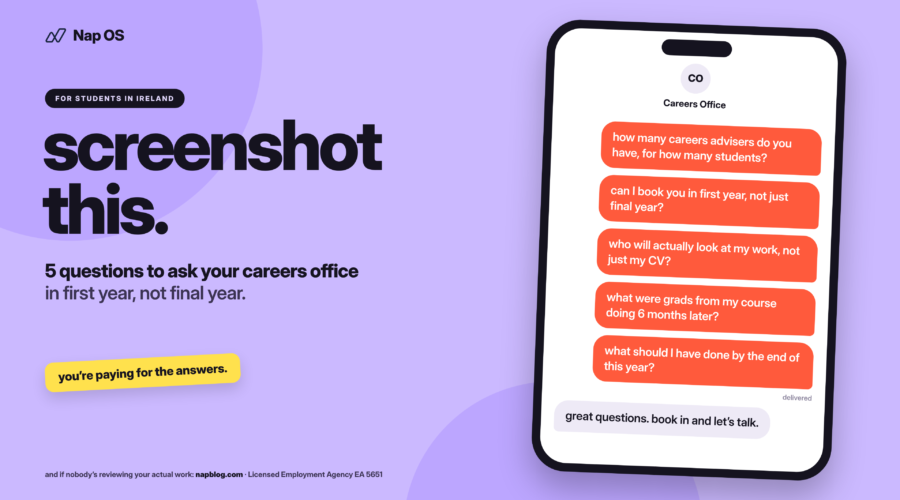
Book your careers appointment in first year, not final year. The service will see you more readily when you are not yet urgent, and you will get far more from it.
Go with something specific. “Can you look at this project and tell me what an employer would think” is a better use of thirty minutes than “what should I do with my life”.
Build evidence someone else has examined. Your own description of your skills is the weakest thing on your CV.
And ask your university the question nobody has to answer. How many careers advisers are there, for how many students? You are paying for the answer either way.
Pugazheanthi Palani, Founder & CEO palani@napblog.com · +353 89 453 0418 Napblog Limited t/a Nap OS · CRO 812006 · Licensed Employment Agency EA 5651 77 Camden Street Lower, Saint Kevin’s, Dublin 2, D02 XE80 · napblog.com
Sources: absence of a national careers-staff ratio and the final-year focus of provision, Cedefop and Euroguidance country reports on guidance in Ireland; student-to-teaching-staff ratio and staff spending, IFUT citing OECD Education at a Glance; funding gap, Funding the Future (2022) and IUA Pre-Budget Submission 2027; enrolment, HEA data for 2024/25; fee example, a Dublin university’s published 2027/28 fee schedule; employment permit thresholds, Department of Enterprise, Tourism and Employment, from 1 March 2026. The adviser arithmetic is illustrative.