9 min read
For international business students preparing to graduate in 2027, the strongest opportunities in Europe are not limited to one “hot” job title. They sit at the intersection of business analysis, financial decision-making, data literacy, supply-chain operations, market research, and cross-border commercial strategy. Nap OS helps students prepare for these roles by turning classroom knowledge into reviewed, portfolio-ready project evidence that employers can understand and assess.
Nap OS is a career and recruitment operating system built by Dublin-based Napblog Limited. It provides structured project briefs, project-manager feedback, career support, and verifiable records of completed work; it does not guarantee employment, provide immigration advice, or replace a degree.
The 2027 European Job Market
Across Europe, employers are looking for graduates who can combine commercial awareness with analytical capability. In Ireland, Robert Half’s 2027 Ireland Salary Guide identifies finance business partners, financial controllers, financial modellers, and financial planning and analysis (FP&A) analysts among the roles expected to be in high demand, alongside AI engineers and data scientists.
This matters for international business students because many of these roles require more than accounting knowledge or a business degree. Employers need people who can interpret data, communicate recommendations, understand commercial trade-offs, and support decisions across markets.
| High-demand area | Typical graduate entry roles | Core capabilities to build |
|---|---|---|
| Finance and FP&A | Finance analyst, FP&A analyst, financial modeller | Excel, financial modelling, forecasting, variance analysis, business communication businessplus+1 |
| Data and analytics | Business analyst, data analyst, market analyst | SQL, Excel, Power BI or Tableau, research, dashboarding, storytelling businessplus+1 |
| Operations and supply chain | Operations analyst, supply-chain coordinator, procurement assistant | Process mapping, forecasting, supplier analysis, logistics, risk awareness |
| Marketing and market research | Market researcher, digital marketing assistant, growth analyst | Consumer research, segmentation, campaign planning, CRM, performance analysis |
| International business development | Market executive, business development associate, export-support roles | Market entry, stakeholder engagement, cross-cultural communication, lead research enterprise-ireland+1 |
There is no single “hottest job” that suits every student. The practical goal is to choose a realistic target role, build evidence aligned with it, and demonstrate that you can solve business problems—not simply that you have completed a degree.
Why International Students Need More Than a Degree
International business students often face a difficult paradox. They may have strong academic results, multilingual ability, and international perspectives, but employers still ask for local experience, professional references, and evidence of practical execution. Nap OS describes this as the gap between what candidates know and what they can prove they can do.
A degree can demonstrate theoretical knowledge. A project portfolio can demonstrate how that knowledge is applied: how a student researched a market, analysed a dataset, built a financial model, designed a campaign, evaluated a supplier, or recommended a business decision.
This is especially important in competitive European markets such as Ireland, where employers are expected to compete for specialised finance, technology, and business-support talent in 2027. Graduates who can show a clear record of practical work are better positioned to stand out from applicants with similar academic backgrounds.
What Nap OS Provides
Nap OS is designed around a simple principle: execution meets evidence. Students select a project brief, complete defined tasks, submit deliverables, receive feedback, revise their work, and retain a record of what they produced and how it was assessed.
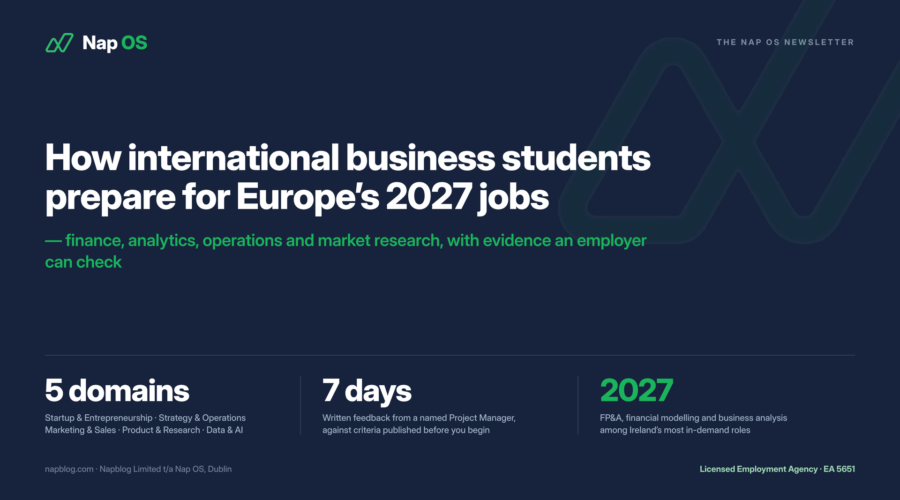
The platform offers briefs across five domains:
- Startup and entrepreneurship
- Strategy and operations
- Marketing and sales
- Product and research
- Data and AI
Each brief is structured as ten tasks over two weeks. The deliverables and assessment criteria are published before the participant begins, which makes expectations clear and reduces uncertainty about what “good work” looks like.
A named project manager with at least five years of relevant field experience reviews submissions against those published criteria and returns written feedback within seven days. On completion, the participant receives a verified record identifying the brief, the work produced, and the criteria used for assessment; the record includes a code that an employer can check.
Building Skills for Business Analysis
Business analysis is one of the most accessible and versatile career paths for international business graduates. It connects strategy, operations, data, customer insight, and decision-making—skills that transfer across industries.
A student preparing for a business analyst or data analyst role could use Nap OS to complete a project such as:
- Analysing customer churn for a subscription business.
- Building a sales-performance dashboard.
- Researching a new market-entry opportunity.
- Evaluating pricing strategy for a product launch.
- Mapping an operational process and identifying bottlenecks.
- Creating a competitor and customer-insight report.
The final portfolio should not simply say, “I completed a data project.” It should explain the business question, data sources, method, findings, recommendation, and limitations. Nap OS supports this by requiring defined deliverables and providing structured feedback rather than leaving students to guess what employers expect.
For example, a student might produce a report that identifies why customer retention is falling, segments customers by behaviour, recommends three retention actions, and estimates the potential commercial impact. That is far more persuasive than a CV bullet that says “strong analytical skills.”
Preparing for Finance and FP&A
Finance remains one of the strongest professional pathways for business graduates in Europe. In Ireland, Robert Half expects demand for finance business partners, financial controllers, financial modellers, and FP&A analysts in 2027.
International business students should not assume these roles are only for accounting graduates. Entry-level finance, FP&A, and commercial-analysis roles often value graduates who can combine financial reasoning with business context.
Nap OS can help students develop a practical finance portfolio through projects such as:
- Building a monthly budget and variance analysis.
- Creating a three-year revenue forecast for a small business.
- Comparing pricing scenarios and margin impact.
- Assessing the financial feasibility of a product launch.
- Preparing a management report with key performance indicators.
- Analysing cash-flow risks for a startup.
A useful portfolio project could examine whether a company should enter a new market. The student would estimate market size, customer acquisition cost, expected revenue, fixed and variable costs, break-even point, and risks. The output would demonstrate financial literacy, commercial judgement, and the ability to communicate a recommendation.
Preparing for Supply Chain and Operations
Supply chain and operations roles are increasingly important as European companies manage cross-border trade, logistics costs, compliance, supplier risk, and changing customer expectations. These roles suit students who enjoy structured problem-solving, process improvement, and practical decision-making.
Nap OS’s strategy and operations briefs can help students practise:
- Mapping a fulfilment or procurement process.
- Identifying delays, cost drivers, and quality risks.
- Building a supplier-evaluation framework.
- Creating an inventory or demand-forecasting plan.
- Recommending process improvements using data.
- Preparing a risk register for an international supply chain.
A strong operations project should show more than research. It should identify a problem, measure it where possible, propose an intervention, and explain how success would be measured. This mirrors the way employers assess operational analysts, supply-chain coordinators, and continuous-improvement roles.
Preparing for Marketing and Market Research
Marketing is often misunderstood as a creative field alone. In reality, modern marketing roles require research, segmentation, positioning, campaign planning, digital analytics, customer insight, and commercial accountability.
Nap OS’s marketing and sales briefs can help students build evidence in areas such as:
- Customer persona and market segmentation.
- Competitor analysis.
- Go-to-market strategy.
- Social-media or content campaign planning.
- CRM and lead-nurturing workflows.
- Pricing and promotion analysis.
- Market-entry research for a new country.
This is particularly relevant for students targeting international business development or market-entry roles. Enterprise Ireland’s International Graduate Programme, for example, recruits Market Executives to support Irish enterprises across Europe, the Americas, the Middle East, and Asia Pacific. The role involves business development campaigns, international awareness, business connections, content creation, event management, digital marketing, and stakeholder engagement.
A Nap OS project could simulate this type of work: research a target market, identify potential customer segments, analyse competitors, develop a market-entry recommendation, and create a campaign plan. The reviewed output becomes evidence of international commercial thinking.
Turning Projects Into Employer Evidence
The value of a project is not the certificate. It is the ability to explain the work clearly and defend the decisions behind it.
Nap OS encourages students to build evidence through a repeatable project cycle: define the problem and intended outcome, take ownership, develop work in visible stages, review outputs against the brief, and organise the final deliverable, feedback, and improvements into evidence.
A strong portfolio entry should include:
- Business problem: What question or challenge were you solving?
- Approach: What research, data, framework, or method did you use?
- Deliverable: What did you produce—a model, dashboard, report, plan, or recommendation?
- Skills demonstrated: Which tools and capabilities did the work prove?
- Outcome or recommendation: What decision or action would follow?
- Review feedback: What did you improve after receiving feedback?
This structure helps students answer interview questions with specific examples. Instead of saying, “I am good at problem-solving,” they can say, “In my market-entry project, I identified three barriers to entry, prioritised them using a risk-impact matrix, and recommended a phased launch strategy.”
A 12-Month Preparation Plan for 2027
International business students targeting 2027 roles should begin preparation well before graduation. A structured plan can prevent the common problem of applying widely without a clear professional identity.
Months 1–3: Choose a Direction
Select two target career paths, such as business analysis and FP&A, or market research and international business development. Research 20–30 job descriptions and identify recurring skills, tools, and responsibilities.
Create a skills gap list. If your target roles require Excel, SQL, Power BI, financial modelling, CRM, or market research, begin building those skills through structured practice.
Months 4–6: Complete Relevant Projects
Complete two or three Nap OS project briefs aligned with your target roles. For example, a student targeting business analysis might complete a data-and-AI brief, a strategy-and-operations brief, and a product-research brief.
Do not aim for quantity alone. Aim for work that can be discussed in depth during an interview.
Months 7–9: Build a Portfolio and Network
Turn completed projects into clear case studies. Update your LinkedIn headline, About section, experience section, and featured portfolio links. Share short posts explaining what you learned from each project, but avoid overstating results.
Begin informational interviews with alumni, professionals in target roles, and recruiters. Ask about the skills that matter most in their teams and the types of projects that impress them.
Months 10–12: Apply Strategically
Apply to graduate programmes, internships, placements, and entry-level roles that match your evidence. Enterprise Ireland’s International Graduate Programme, for example, is a two-year programme for Market Executives, with eligibility for graduates who completed a degree between January 2025 and August 2027 and who can work under an Irish contract for the full programme duration.
Use a tracker to monitor applications, deadlines, referrals, interview stages, and follow-ups. Tailor each application to the specific role rather than sending the same CV everywhere.
What Nap OS Does Not Do
Nap OS can help students build relevant evidence, but it cannot remove structural barriers. It does not guarantee a job, act as a recruitment agency, provide immigration status, or replace accredited academic qualifications. Its fees cover project briefs, project-manager review, and career support—not recruitment or job placement.
Students should therefore use Nap OS alongside:
- University career services and employer events.
- Internships, placements, and part-time work where permitted.
- Professional networking and alumni engagement.
- Country-specific work-permission research.
- Interview preparation and language practice.
- Applications to employers whose hiring criteria they genuinely meet.
The Best Role to Prepare For
If forced to identify one high-potential direction for international business students in Europe, business analysis with a finance or operations specialisation is a strong starting point. It offers broad transferability, connects directly to high-demand finance and analytics roles, and gives students a practical way to demonstrate commercial value.
However, the best role is the one that matches a student’s strengths and interests. A student who enjoys storytelling and customer insight may thrive in market research or growth marketing. A student who enjoys numbers and decision-making may thrive in FP&A or financial modelling. A student who enjoys systems and efficiency may thrive in operations or supply chain.
Nap OS helps students test these directions through real project work before committing to a career path. Instead of guessing which job will suit them, they can complete a brief, receive feedback, and learn whether they enjoy the work and can perform it well.
Final Thought
The international business graduates who succeed in 2027 will not necessarily be those with the most impressive degree titles. They will be those who can show employers how they think, what they have built, and how they turn ambiguity into a useful business recommendation.
Nap OS gives students a structured way to develop that proof. Through project briefs, reviewed deliverables, portfolio records, and career support, it helps international business students move from “I studied business” to “Here is evidence of how I solve business problems.”