8 min read
Dear educators, students, employers, and policy partners,
Ireland’s reputation as a destination for world-class education depends on one simple promise: that a qualification represents real learning, and that a graduate can do what their degree says they can do. When students outsource university assignments to commercial writers or AI-powered “assignment services” abroad, that promise breaks.
This is not a minor shortcut. It is contract cheating: the use of an undeclared third party to produce work for academic credit, whether that third party is a person, an essay mill, or an automated service. In Ireland, facilitating or advertising such services is a criminal offence under Section 43A of the Qualifications and Quality Assurance (Education and Training) (Amendment) Act 2019, with penalties of up to €100,000 and/or up to five years’ imprisonment.
The consequences reach far beyond one student and one module. They weaken employer trust, damage the value of Irish qualifications, and—most damaging of all—leave students without the confidence, skills, or verifiable evidence they need to enter the workforce.
At Nap OS, we believe the answer is not merely to catch cheating after the fact. It is to build an education and employability system where authentic work is visible, assessable, and valuable.
The problem we must name clearly
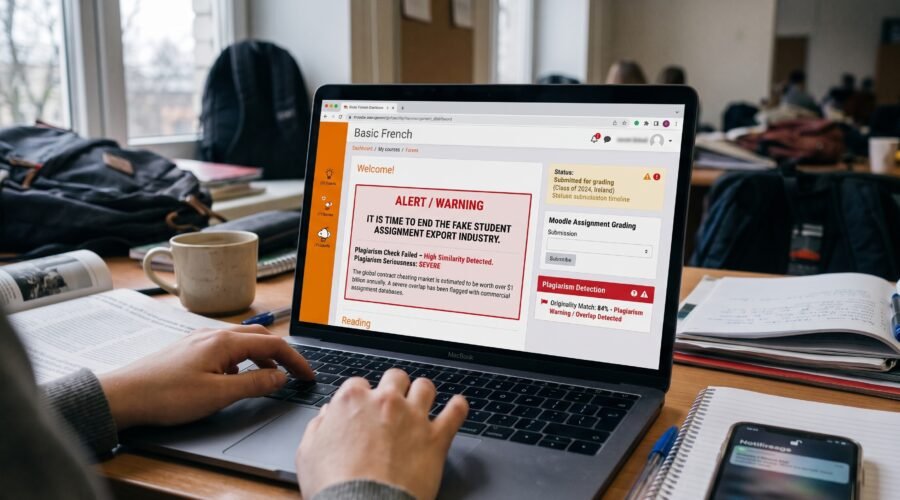
The phrase “fake assignment export industry” describes a global market in which students pay external providers to complete essays, reports, coding tasks, research proposals, data analysis, presentations, and other assessed work. These providers may be based in another country, may use freelance writers, or may increasingly use generative AI to mass-produce submissions. The “export” is not a physical product; it is the fraudulent completion of academic work.qqi+1
This industry is harmful because it sells students a dangerous illusion: that a grade can replace capability. A student may submit a polished assignment and receive marks, but they may be unable to explain the argument, defend the method, reproduce the analysis, or apply the learning in an interview or workplace.
That gap becomes obvious at the worst possible moment: during a job interview, probation period, team project, or client engagement.
Why this matters for Ireland
Ireland competes globally for students, investment, talent, and employers. Our universities and technological universities are part of that national offer. If employers begin to doubt whether a graduate portfolio, final-year project, or master’s dissertation reflects the student’s own ability, the cost is borne by every honest graduate.
Contract cheating also undermines the students who follow the rules. A student who spends nights learning a dataset, debugging code, revising a literature review, or preparing a business case is competing against someone who purchased the appearance of the same work. That is unfair, demoralising, and corrosive to academic culture.
Quality and Qualifications Ireland (QQI) has been clear that contract cheating threatens the integrity, standards, and reputation of Irish education and training. Its guidance defines academic integrity as a commitment to honesty, trust, fairness, respect, responsibility, and courage.qqi+1
The confidence crisis behind cheating
We must be honest about why some students turn to these services. International students, in particular, can face intense pressure: high tuition costs, visa-related anxiety, family expectations, language barriers, unfamiliar assessment norms, limited local work experience, and fear of failure.
Some students do not outsource work because they are lazy. They do it because they have lost confidence that they can pass on their own.
That does not excuse misconduct. But it tells us where intervention must begin.
If a student believes that failure will lead to financial ruin, visa complications, family disappointment, or permanent exclusion from opportunity, they may see a cheating service as a survival mechanism. This is exactly the moment when institutions need visible support: writing centres, academic skills coaching, extension processes, mental-health services, peer mentoring, and clear explanations of what is permitted.
Punishment without prevention creates fear. Prevention without accountability creates impunity. Ireland needs both.
Professors must act—but fairly
Faculty members are often the first people to notice that something is wrong. A student who cannot explain their own methodology, whose writing style changes dramatically, whose references do not support the claims, or whose project files show no development history may need closer attention.
Educators should be empowered to:
- Ask students to explain their work orally, in a viva, tutorial, or short defence.
- Require drafts, research notes, version history, data files, and process evidence.
- Use authentic assessment: live presentations, supervised tasks, workplace simulations, and applied projects.
- Compare submissions with prior work and check whether the student can discuss key decisions.
- Report suspected contract-cheating providers to institutional integrity teams and QQI.
- Refer struggling students to support services before a small problem becomes a crisis.
But we should be careful with the language of “exposing students immediately” or “punishing hard.” Ireland’s own academic-integrity framework emphasises both robust detection and fair, proportionate procedures.qqi+1
A serious allegation can change a student’s life. It must be investigated through due process, with evidence, a right to respond, and consistent institutional procedures. The goal is not public humiliation. The goal is protection of standards, education of the student, and deterrence of repeat misconduct.
Where misconduct is proven, sanctions should be meaningful: module failure, resubmission under supervised conditions, formal academic-integrity records, restrictions on progression where appropriate, and, in serious or repeated cases, stronger institutional penalties. At the same time, institutions should distinguish between deliberate commercial cheating, careless misuse of AI, poor referencing, and a genuine lack of academic-skills support.
Fairness is not weakness. It is what makes enforcement credible.
The fake assignment industry must be abolished
The suppliers of contract cheating should face the full force of the law. Ireland has already taken an important step: QQI can prosecute those who facilitate learner cheating, advertise cheating services, or publish advertisements for those services.qqi
But legislation alone is not enough. The industry adapts quickly, hides behind ordinary-looking websites, uses social-media advertising, and increasingly blends human ghostwriting with AI generation. QQI has reported that providers are seeing more approaches from essay mills seeking links on institutional pages, and it supports monitoring and reporting processes to remove promotional content from platforms.tudublinsu
A serious national response should include:
- Rapid reporting pathways from universities to QQI and platform providers.
- Stronger takedown action against websites and social-media accounts selling academic work.
- Clear warnings to students that using such services can invalidate their academic claim, even if the provider is abroad.
- Data-sharing between institutions where repeat offenders move between programmes.
- Employer awareness campaigns explaining why verified project evidence matters.
- Investment in legitimate alternatives: tutoring, skills labs, supervised projects, and structured work experience.
We should not treat the students and the suppliers identically. Students need education, support, and accountability. Suppliers need enforcement.
Proof of work: the missing infrastructure
The deeper issue is that many students graduate with grades but without convincing evidence of what they can actually do.
A transcript says a student passed a module. It does not show whether they can build a dashboard, run a user-interview programme, clean a dataset, write a technical specification, manage a campaign, or present a recommendation to a manager.
This is why Nap OS exists.
Nap OS is designed around project-based work and verifiable evidence. Instead of asking students and graduates to wait for someone to give them a first opportunity, it helps them develop capability through structured projects, mentor support, assessed outputs, and a portfolio that shows what they actually did.napblog+1
Its virtual internship programme, for example, gives students and graduates remote experience on real projects across areas such as marketing, technology, content creation, and data analytics. Work is tracked through the platform and added to a verified career portfolio.napblog
That matters because employability is not built by claims alone. It is built by evidence:
- A repository showing iterative code and documentation.
- A campaign plan with research, execution, and measured outcomes.
- A data project showing the raw data, cleaning steps, analysis, and interpretation.
- A product brief showing user research, trade-offs, prototypes, and decisions.
- A mentor assessment explaining the student’s contribution and professional behaviours.
Proof of work gives students confidence because it turns learning into something they can show. It gives employers confidence because it reduces uncertainty. And it gives educators a constructive alternative to a system where the only visible outcome is a final submission.
What students should hear
To every student reading this: asking for help is not cheating. Using a grammar tool, a citation manager, a coding assistant within your institution’s rules, a study group, or a mentor is not the same as buying an assignment.
The line is consent, disclosure, and authorship. If another person or service produces work that you submit as your own for credit, that is contract cheating. If you are unsure, ask your lecturer, academic-integrity office, or student support service before submitting.
Your degree should be a record of what you can do—not a document you have to defend with fear.
What institutions should do next
Irish higher education institutions should treat this as a workforce-development issue, not only a disciplinary issue.
- Publish clear AI and third-party-support rules for every module, with examples of permitted and prohibited use.
- Redesign high-risk assessments around process, oral defence, supervision, and applied work.
- Train staff to identify concerns and manage cases consistently.
- Invest in student support before deadlines, especially for international students.
- Create verified work-experience pathways with structured projects, mentor review, and portfolio evidence.
- Report cheating providers, not only penalise students.
- Measure outcomes: academic-integrity cases, student confidence, placement rates, employer feedback, and portfolio quality.
A better future for Irish graduates
Ireland does not need more students who can submit perfect assignments. Ireland needs graduates who can think, build, communicate, collaborate, and deliver.
The fake assignment export industry offers students a shortcut that leads to a dead end: a grade without growth, a qualification without confidence, and a CV without proof.
Nap OS exists to offer the opposite path: real work, visible progress, mentor feedback, and a portfolio that employers can trust. If we combine firm enforcement against cheating suppliers with fair accountability for students, better support, and authentic proof-of-work infrastructure, we can strengthen both Irish education and Irish workforce development.
The choice is clear. We can continue allowing a hidden market to sell students the appearance of competence. Or we can build a system where every student can say, with evidence: “This is my work, and I can do it again.”
Let’s choose the second path.
— The Nap OS Team