7 min read
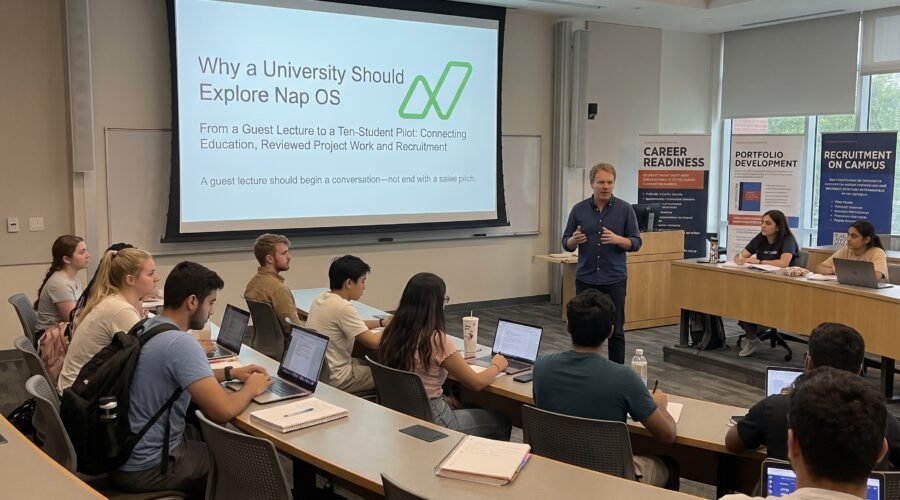
A guest lecture should begin a conversation—not end with a sales pitch.
When the Napblog Limited team speaks with students about careers, project portfolios and an AI-changing workplace, our first responsibility is to make the session useful. Students should leave with practical ideas they can apply, whether or not their institution ever purchases Nap OS.
But these conversations can also reveal something important.
Do students understand how to demonstrate their capabilities? Can they explain work they have completed? Would structured feedback from an experienced practitioner help them improve?
Those questions form the starting point for Nap OS’s institutional proposition.
We are inviting universities and colleges to explore a defined programme that complements their existing provision: practitioner-guided projects, human assessment, portfolio development and an optional recruitment pathway.
The next step is not a whole-university rollout. It is a carefully scoped, paid pilot for ten students.
1. Start with the Catch-22 students recognise
The experience barrier can feel circular:
An employer wants evidence of capability. A student wants an opportunity to develop it. Neither knows where the first step should happen.
Nap OS addresses a practical part of that problem.
Students do not need employment before they can practise analysing information, researching a market or presenting a recommendation. They need a meaningful brief, clear expectations, suitable guidance and an opportunity to improve.
That does not make practice equivalent to employment.
It creates an additional source of evidence that students can discuss alongside their qualifications, previous work and other experiences.
The question becomes less abstract: “What can you do?”
The answer can become more specific: “Here is what I produced, how it was reviewed and what I changed.”
2. Use guest speaking to listen
Nap OS founder Pugazheanthi Palani delivered an educational guest session at Independent College on 14 October 2026, discussing careers in an AI-changing workplace and building evidence beyond the CV.
A completed session creates an opportunity for further discussion. It does not establish purchasing demand or prove that every student wants the programme.
The responsible next step is to listen.
Which questions did students ask? What confused them? Which examples felt relevant? Did they want help choosing projects, receiving feedback or presenting their contribution?
Where feedback has not been formally collected, we should not invent a positive response.
A useful lecture opens discovery. It is not a substitute for it.
3. Turn reactions into structured discovery
After a session, the institution and Nap OS can collect a short, voluntary response.
Useful questions include:
- Do you have work you could confidently discuss in an interview?
- Have you received substantive feedback on that work?
- Which practical capabilities would you like to develop?
- What would make participation difficult?
- How much time could you realistically commit?
These questions should help understand needs—not pressure students into expressing interest.
A preference for practical support does not automatically establish willingness to pay or institutional budget.
The findings should inform a conversation with the appropriate college team. Where possible, report both interest and hesitation. Reservations about workload, timing or relevance are valuable design information.
4. Position Nap OS alongside existing provision
Universities do not need another provider telling them that their education is obsolete.
Nap OS should begin by understanding what the institution already does well.
A college may have strong careers support, academic projects, employer relationships and placement preparation. Our proposal must identify a genuine additional contribution.
That might be extra practitioner feedback for a specific cohort, a structured portfolio-development journey or a way to coordinate assessed practice work outside existing modules.
The institution retains its academic responsibilities.
Nap OS is not proposing to replace lecturers, award academic credit or become a compulsory gateway to employment.
The commercial discussion should answer: “What useful service is missing, stretched or difficult to deliver internally?”
5. Bring the right people into the conversation
A supportive contact can help navigate the institution, but enthusiasm is not purchasing authority.
An initial discussion should establish the roles involved.
A programme director may assess relevance to the cohort. Student-experience or careers staff may identify support needs. Quality, data-protection and finance colleagues may evaluate the proposed arrangement.
Nap OS should not expect one person to resolve every question.
Our responsibility is to make evaluation straightforward.
That means bringing a concise proposal, sample brief, reviewed output and clear service schedule—not asking the contact to build our business case for us.
The objective is a decision-making conversation with the right people, supported by understandable materials.
6. Propose ten students, not institutional transformation
The proposed starting point is one paid cohort of ten students.
At €999 per participant for twelve months, the programme contract would total €9,990, plus applicable VAT.
The college is the buyer. Students are the beneficiaries. No referral commission applies to this institutional purchase.
A small cohort limits the initial operational scope while allowing the institution to inspect a complete delivery experience.
It does not eliminate the college’s purchasing requirements or guarantee easy approval.
Before offering the pilot, Nap OS must confirm that ten students can be served sustainably, including shared activities, individual support and assessments.
A manageable pilot is valuable only if the full promised service can be delivered.
7. Explain the programme precisely
The proposed programme combines project-based learning with professional guidance and career-readiness support.
Its service schedule includes individual career and progress sessions, mock interviews, group workshops, small-group project clinics, CV and LinkedIn review cycles, two assessed practice projects and defined support.
The approved schedule must be confirmed before contracting.
Universities should understand the difference between access to project briefs and formal assessment allowances. A library containing many briefs does not mean unlimited professional review.
The twelve-month structure also requires appropriate sequencing.
For incoming international students, it can connect pre-departure preparation with post-arrival development. For students already enrolled, the institution and Nap OS would need to agree a relevant pathway without pretending that a pre-departure phase still applies.
8. Make professional review visible
Industry involvement should mean more than a logo or a guest appearance.
The institution should be able to inspect who will review student work, what experience they bring and how assessment decisions are made.
A named Project Manager might examine whether an analysis supports its conclusion, whether a research method is appropriate or whether a recommendation acknowledges uncertainty.
Feedback should explain the reasoning.
Students then revise their work and discuss what changed.
Where destination-market experience is relevant, reviewer matching should reflect actual expertise and availability. Ireland-based professionals form the initial proposed reviewer focus; global coverage should not be assumed.
Applicants are not an approved delivery bench until screening, agreements and onboarding are complete.
9. Agree success before the pilot begins
A pilot needs a clear evaluation plan.
Participation matters, but attendance alone does not demonstrate useful learning.
The institution and Nap OS could agree to examine:
- Activation and sustained participation.
- Completion of selected project milestones.
- Improvement against defined criteria.
- Feedback quality and turnaround.
- Students’ ability to explain their contribution.
- Staff administration required.
- Complaints, withdrawals and delivery costs.
An early checkpoint after approximately eight to twelve weeks can identify problems.
That checkpoint does not automatically shorten the twelve-month commitment or create a cancellation right. Those arrangements belong in the contract.
The purpose is to make delivery visible early enough to improve it.
10. Connect portfolios to recruitment carefully
Nap OS Recruit is being developed as a separate employer-facing workflow.
Its proposed €500 monthly organisation subscription enables authorised employers to inspect shared project evidence, request application documents and arrange interviews.
An employer letter of interest is an encouraging signal, but not proof of paid adoption or future hires.
For a university, the recruitment pathway answers a useful question: what might happen after a portfolio is developed?
With the student’s permission, relevant employers could inspect outputs and approved review summaries.
That adds a possible route to conversation.
It does not guarantee an interview, a job or a placement. The learning programme must remain worthwhile independently of recruitment outcomes.
11. Protect the space needed for learning
Students need room to ask basic questions, make mistakes and seek support.
Those activities should not become hidden negative hiring signals.
Private mentoring notes, support disclosures and session recordings should not automatically be available to employers.
Students should choose which eligible records, deliverables and assessment summaries they share.
An employer-facing project record should accurately explain the work and its context. Practice must remain labelled as practice.
The institution also needs proportionate reporting rather than unrestricted access to every conversation.
Trust depends on clear boundaries: learning support, academic oversight, recruitment and marketing are connected activities, but they are not interchangeable permissions.
12. Decide the next cohort through evidence
At the review stage, the question should not be simply: “Did everyone enjoy the app?”
The institution needs to know whether the service added value.
Did students engage? Did work improve? Was feedback useful? Was administration manageable? Could Nap OS repeat delivery at the agreed price?
Recruitment activity can provide additional information, but it should be reported precisely.
A portfolio view is not an interview. An interview is not a hire. A later job does not automatically establish that Nap OS caused the outcome.
Expansion should follow a deliberate purchasing decision—not automatic renewal or pressure to justify the first pilot.
An invitation to begin with one useful conversation
Nap OS does not ask a university to accept a sweeping promise.
We propose a sequence: deliver something educational, listen to students, understand the institutional need, demonstrate the service and evaluate a ten-student programme.
That is how a guest session can become a credible starting point rather than an aggressive sales funnel.
For decision-makers, the first question is practical:
Could one defined cohort benefit from additional practitioner-guided projects and reviewed portfolio development?
If the answer may be yes, Napblog Limited welcomes a discovery discussion.
Contact Pugazheanthi Palani at palani@napblog.com to explore the proposed pilot.
Start with the need. Inspect the work. Agree the responsibilities. Then decide what deserves to grow.